
Editors’ Vox is a blog from AGU’s Publications Department.
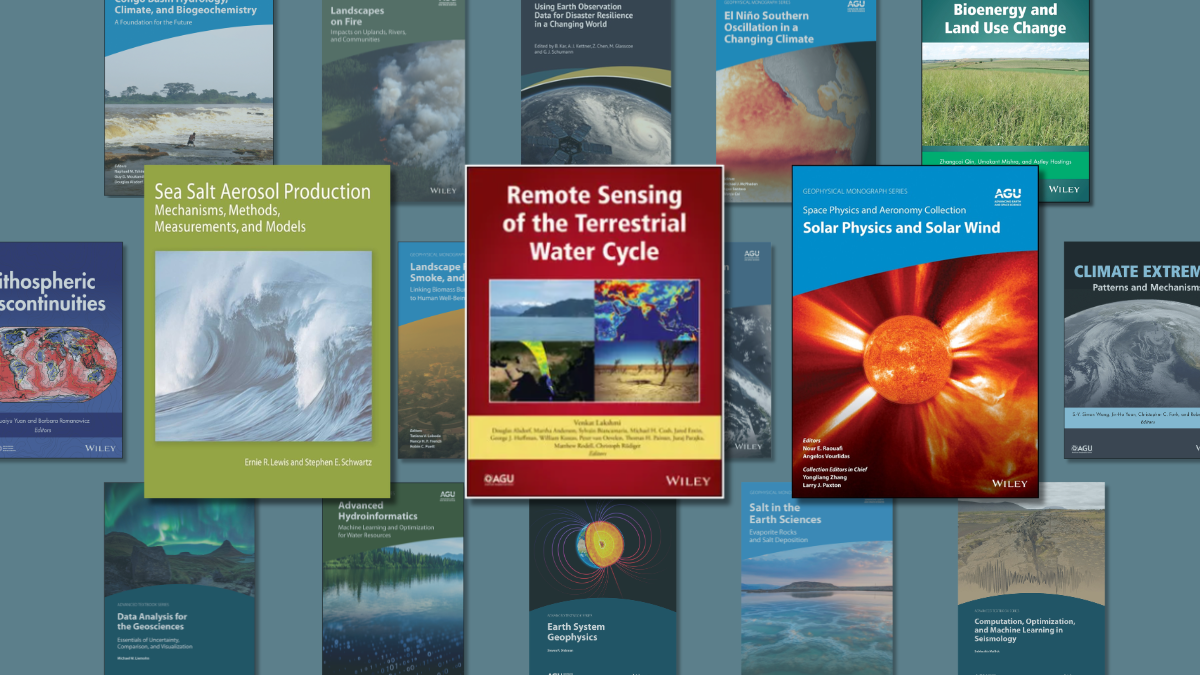
As the AGU Books Program celebrates its 70th anniversary in 2026, we reflect on the longevity of scientific work published in book format and the enduring nature of readership—sometimes for decades after publication. We spoke with Volume Editors and Authors of AGU books published in each of the past 3 decades about why they decided to pursue book projects and why readers are still discovering their work years later.
2000s: Filling Gaps in the Existing Research
Ernie R. Lewis and Stephen E. Schwartz decided to write a book after finding a gap in the literature when conducting their own research. Sea Salt Aerosol Production: Mechanisms, Methods, Measurements, and Models, published in 2004, explores the major influences that sea salt aerosol exerts over diverse areas of geophysics.
Why did you decide to write an AGU monograph?

We were looking for a quality venue for publication that would lend respect to the book and could accommodate many large, complicated color figures, which were essential to the book. AGU’s Geophysical Monograph Series met these requirements.
We had been examining the literature pertinent to the production of sea salt aerosol, the dominant background aerosol in the atmosphere, to develop means of representing it in chemical transport models for aerosol influences on clouds and climate. We found major discrepancies in reported production flux (orders of magnitude) and in its dependence on controlling variables. Ultimately, we decided we needed to write a book dealing with the physical processes and comparing the numerous prior studies.
How has the study of sea salt aerosols evolved since the publication of your book?
This field has grown enormously since publication of the book in 2004, especially with new studies identifying the role of organics affecting production of aerosol particles, particle composition, hygroscopic properties, and rate of exchange of water between gas and condensed phase.
Why do you think your book continues to be of value to readers?
Perhaps the greatest strength of the book is its emphasis on processes and material properties. The chapter on fundamentals is nearly 100 pages; the chapter on measurements and models required to determine production fluxes is nearly 200 pages. The material in these chapters is essential to understanding the governing processes.
We are gratified by the continuing influence of the book, a measure of which is that the book has been cited over a thousand times, with an average annual citation rate of more than 70 over the past several years—some 20 years after publication.
2010s: Finding the Cutting Edge from AGU Events
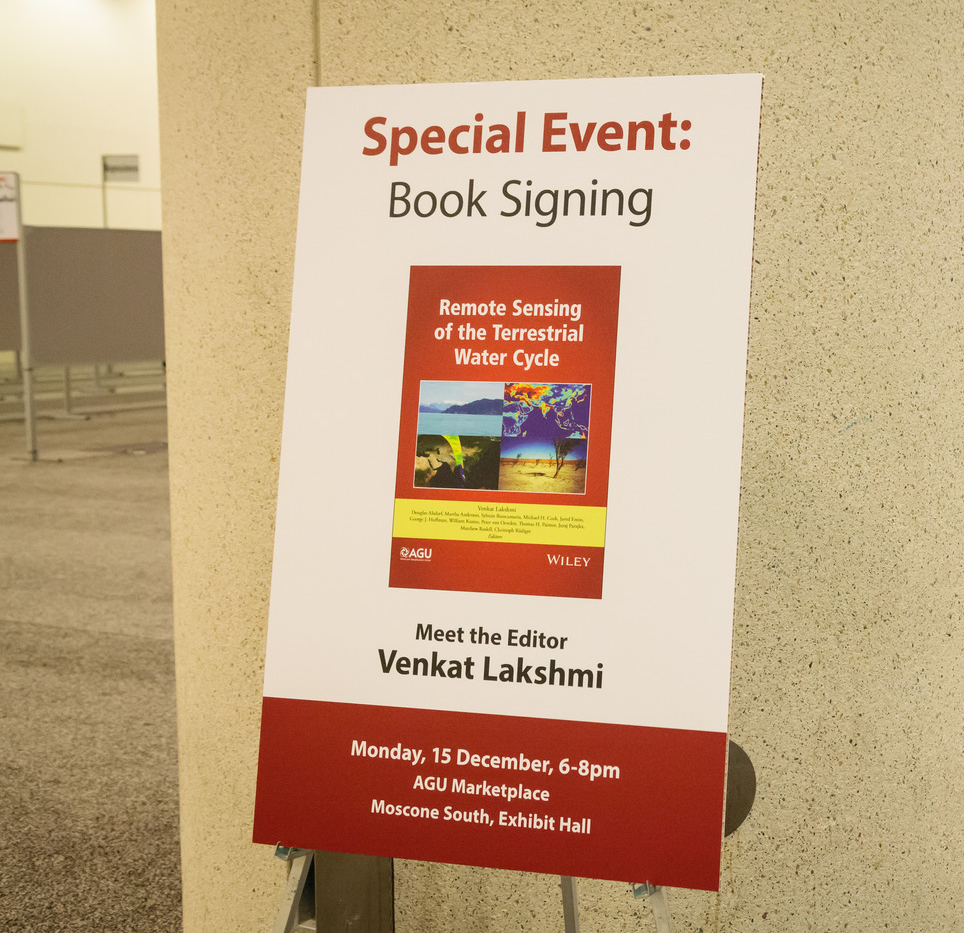
A successful 2012 AGU Chapman Conference convinced Venkataraman Lakshmi that a book was needed to document key outcomes from the conference. He went on to co-edit Remote Sensing of the Terrestrial Water Cycle, published in 2014, which examines the use of satellite data for quantifying the spatial and temporal variations in the hydrological cycle.
Why did you decide to edit a book?
The reason to edit any book is a lack of content on the subject and that the topic is cutting-edge in the research sphere. All the books I have edited with AGU, including Remote Sensing of the Terrestrial Water Cycle, have been outcomes of either sessions organized at the AGU Annual Meeting or a Chapman Conference. The book then serves as a state-of-science for the community and is still widely read.
How has the field of remote sensing as it relates to the terrestrial water cycle evolved since the publication of your book?
The field of remote sensing of the terrestrial water cycle doubles in knowledge every few years. New Earth observing missions have been launched or will be launched soon, and these missions hold promise for unraveling the mysteries of the hydrological cycle.
Why do you think your book continues to be of value to readers?
The book captures what we can expect from Earth observing missions and sets the stage for how the science questions regarding the water cycle have evolved over the past few decades.
2020s: Building on the Success of Earlier Work
Yongliang Zhang and Larry J. Paxton, from the Johns Hopkins Applied Physics Laboratory, edited not one but five books, published in 2021. This five-volume collection, Space Physics and Aeronomy, presents the latest scientific observations, models, and theories about the Sun and the solar wind, magnetospheres in the solar system, Earth’s ionosphere, Earth’s upper atmosphere, and space weather.
Why did you decide to edit a set of books?
Following a successful AGU 2014 session on auroral dynamics to which about 60 abstracts were submitted, we were invited by editors of three publishers in the United States and Europe to edit a book on auroras. We accepted the invitation from AGU–Wiley as there was a lot of interest in auroral study in the AGU community. We submitted a proposal for a book titled Auroral Dynamics and Space Weather. The book,published in 2015, was successful and a few years later, we were invited to edit multiple books as a major reference work in the field of heliophysics. We took the opportunity and finished the five-book set in 2021.
How have space physics and aeronomy evolved since the publication of your books?
First, new satellite missions and more ground observations are available that fill some of the measurement gaps that existed when we published the books. Second, recent advances in AI capability together with increasing data volume in space physics enable a better specification of the space physics phenomena as well as space weather forecasting.
Why do you think your books continue to be of value to readers?
These five volumes (six, counting Auroral Dynamics and Space Weather) provide, in one set, a detailed overview of the science of the space environment from the Sun to the Earth and its variability, or “space weather.” A series of books like this is invaluable as a survey of real knowledge that provides readers the opportunity to discover new insights in heliophysics.
As of early 2026, two major imperatives that drive NASA research are facilitating the space economy and supporting the Moon to Mars initiative with an emphasis now on supporting the return to the Moon. Heliophysics, the focus of our books, enables the outward journey to near-Earth space, the Moon, and beyond. Scientists at all stages in their careers are sure to find in these six volumes useful insights that they can use to address new NASA funding opportunities.
These three experiences are just a snapshot of the more than 750 volumes published by AGU Books since the 1950s. While the methods and technologies used in scientific research have evolved dramatically, as has the process and formats for publishing books, the need for volumes covering the breadth of Earth and space sciences remains strong. The AGU Books Program has proven that books—whether the outcome of a gap discovered in the literature, a popular conference session, or the success of previous works—have a lasting place in the ecosystem of scientific publishing.
—Dara Liling ([email protected],  0009-0005-6828-2811), American Geophysical Union, USA; Venkataraman Lakshmi (0000-0001-7431-9004), University of Virginia, USA; Ernie R. Lewis (0000-0002-2023-7406), Brookhaven National Laboratory, USA; Larry J. Paxton (0000-0002-2597-347X), Johns Hopkins University Applied Physics Laboratory, USA; Stephen E. Schwartz (0000-0001-6288-310X), Stony Brook University, USA; and Yongliang Zhang (0000-0003-4851-1662), Johns Hopkins University Applied Physics Laboratory, USA