
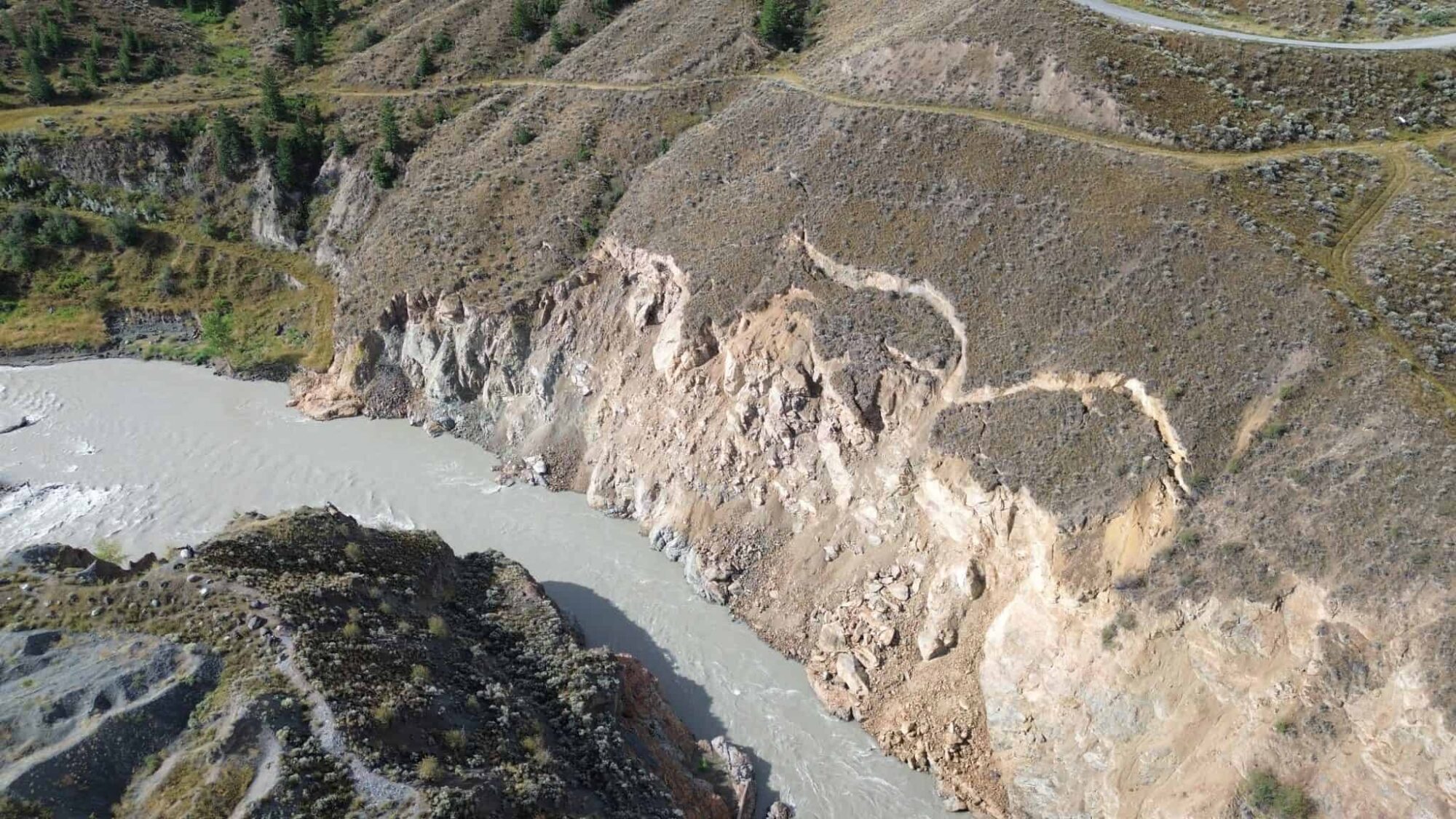
There are concerns about the potential impact of an incipient landslide at Farwell Canyon on the Chilcotin River in British Columbia, Canada.
On 30 July 2024, a large landslide occurred on the Chilcotin River in British Columbia, Canada, blocking the flow. The scale of the landslide was massive – on the BC website about the event, it is estimated that the landslide was about 1,000 metres in length, 600 metres in width, and roughly 30 metres deep. There is a good Youtube video with footage of the landslide:-
And this image, from the BC Government, captures the landslide itself:-
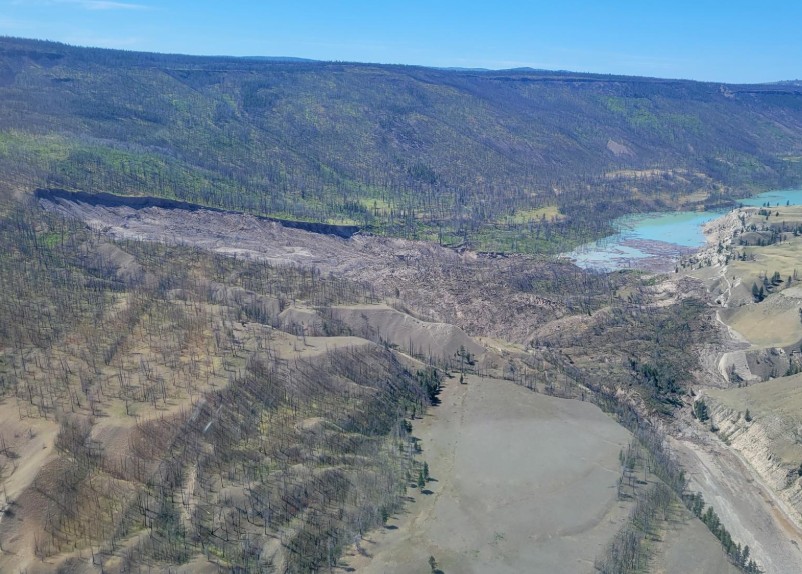
The landslide breached and the lake drained on 5 August 2024.
In the aftermath of that landslide, geotechnical monitoring was established for the riverbanks, which has identified another site on the Chilcotin River that appears to be vulnerable to a landslide. A tension crack has developed at a site known as Snhaxalaus, located just downstream of the the Farwell Canyon Bridge (the bridge is at [51.82790, -122.56296].
The Tŝilhqot’in National Government has published this image of the site:-
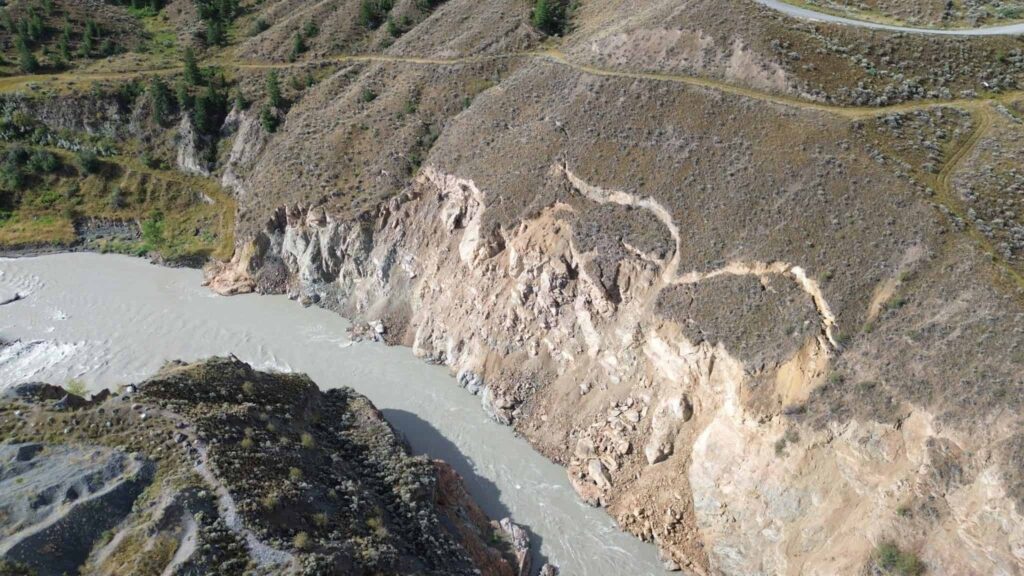
The tension crack, and the large displacements, are clearly evident.
The major concern at this site is the potential impact on Chilko salmon. Following 2024 landslide, an Emergency Salmon Task Force was established, led by the Tŝilhqot’in National Government but also working with the Williams Lake First Nation. To manage the threat posed by the incipient landslide on the Farwell Canyon, the Task Force is planning to undertake “a proactive slope stabilization plan that includes manual scaling and targeted trim blasting”, which seems like a reasonable approach.
However, national and/or provincial funding is not in place to undertake this work ahead of the salmon migration later this year, so the Tŝilhqot’in National Government is planning to fund the work itself. The costs are estimated to be in the range of CAN$2.5M – $3M. Tŝilhqot’in National Government is concerned that a failure at this site ahead of the salmon migration could cause devastating damage to the salmon populations on the Fraser River.