
A new analysis (Reiss et al. 2026) explores a global database of fatal coastal cliff failures, showing that these tragic events most frequently occur in the summer months when beaches are heavily populated.

One significant type of fatal landslide is coastal cliff failures. Whilst I have recorded a number of these events through the years, they are poorly researched and even understood. The risk associated with this hazard is particularly significant on tourist beaches backed by coastal cliffs – and indeed in June this year, two people were killed on a beach in Biarritz, France in just such an event.
It is particularly welcome to see a new paper (Reiss et al. 2026) in the journal NHESS that details the compilation of a global database of fatal coastal cliff failures, and provides an analysis of the result. The paper is both open access and published under a creative commons license.
In total, the authors have documented 114 fatal coastal cliff failures, claiming 292 lives between 1927 and 2024. The authors are transparent about the reality that the dataset is incomplete, but they provide an interesting analysis in time and space. For example, they recorded large numbers of events in both Réunion Island in France, and in San Diego County in California, USA. This graph, from the paper, shows both the number of fatal coastal cliff failures and the number of fatalities in the dataset:-
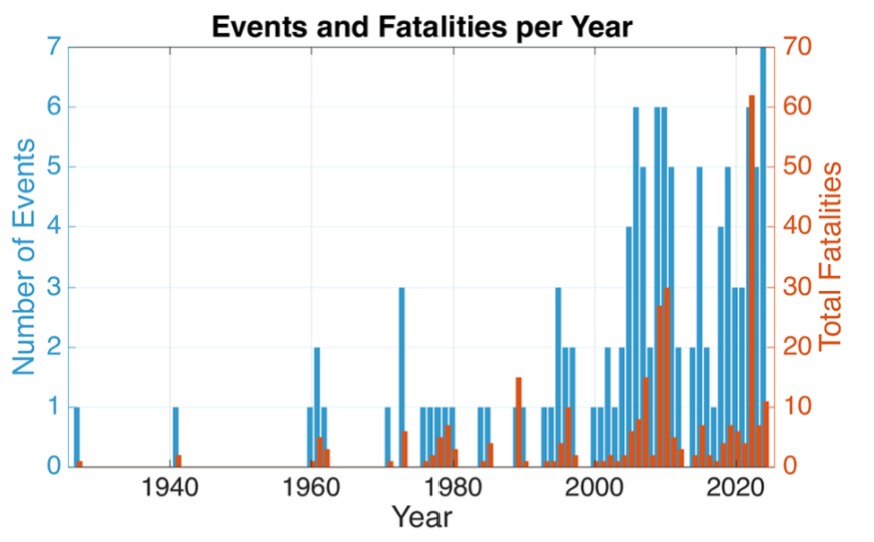
Of course there are a host of things happening in the graph. The dataset is undoubtedly more complete in recent years than in, for example, the mid twentieth century. But it is also likely that more people are in the path of danger now when cliffs collapse – essentially there are more people on the beach – and of course climate change may be driving a change in the occurrence of events too.
But look at this graph, also from Reiss et al. (2026):-
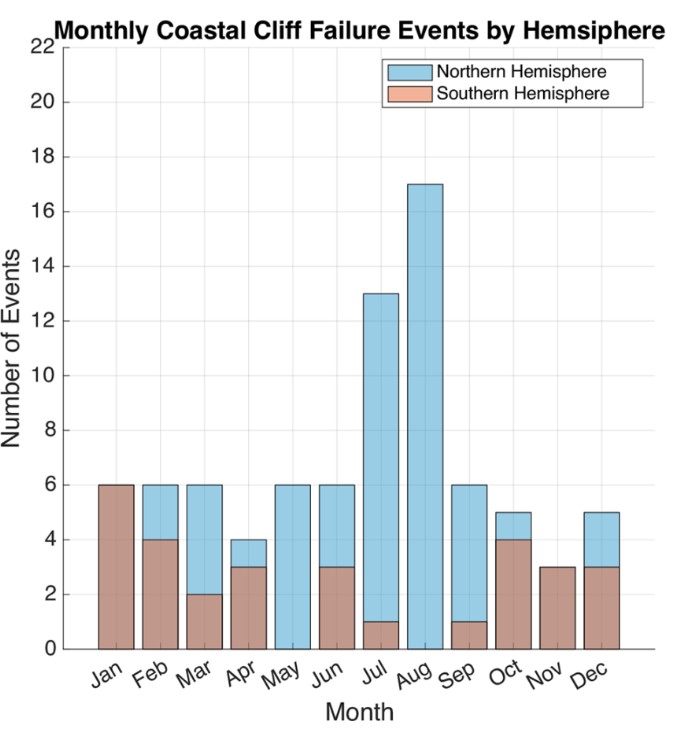
There is a seasonal pattern in both hemispheres, with more events occurring in the local summer months. This is particularly notable for the northern hemisphere. This is a tale of two main factors. The most important by far is the exposed population on the beach. In the summer months, people flock to beaches, putting themselves in the way of danger.
But Reiss et al. (2026) have also found that these events are influenced by rainfall, although to a lower degree than is the case for most other landslides. Thus, fatal events can also spike in the wetter months, even though the beach has a lower population density.
I have long felt that it is only a matter of time before we have a mass fatality event on a beach in the UK associated with a coastal cliff failure. There have been several near misses in recent years, and the behaviour of some people is reckless. Reiss et al. (2026) is a very timely analysis that highlights the perils of coastal cliff failures.
Reference
Reiss, M. N., Young, A. P., and Carilli, J. 2026. A database of fatal coastal cliff failures. Natural Hazards and Earth System Sciences, 26, 3707–3722, https://doi.org/10.5194/nhess-26-3707-2026.