
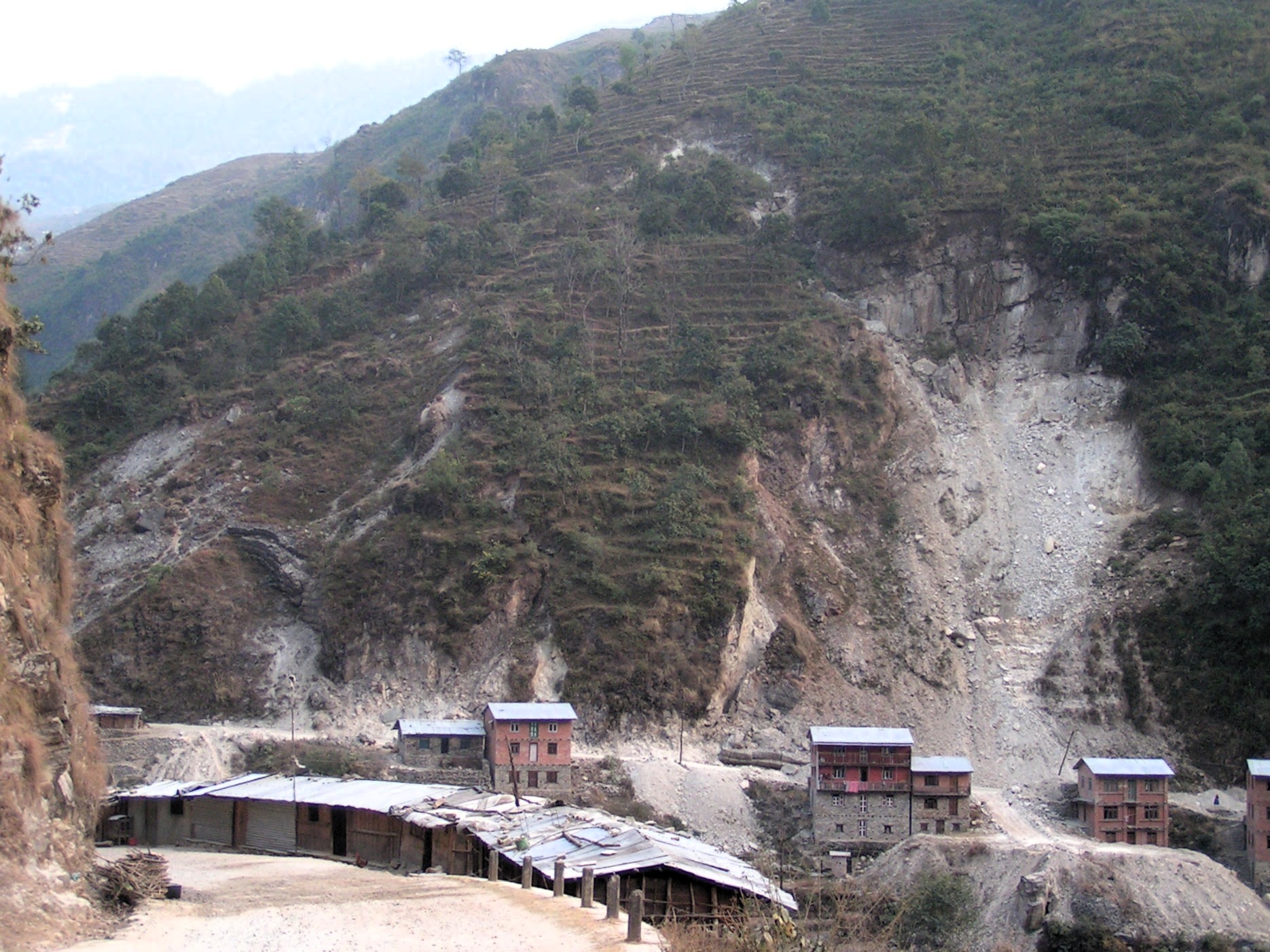
A new paper (Adhikari et al. 2026) in the journal Asian Development Review shows that earthen roads in the hilly areas of Nepal generate limited economic benefits but carry a high landslide cost.
Loyal readers of this blog will have seen many posts that cover the problematic landslide history of low technology rural roads in Nepal. I have demonstrated repeatedly that these so-called “bulldozer” roads, built with low levels engineering input, lead to large numbers of landslides. However, the arguments in favour of these roads focus on the benefits of rural access – essentially these corridors provide access to education, markets, health facilities, jobs and, during construction if a participatory approach is used, direct employment. Thus, the construction of rural roads has carried on at a high pace in Nepal for over 20 years.
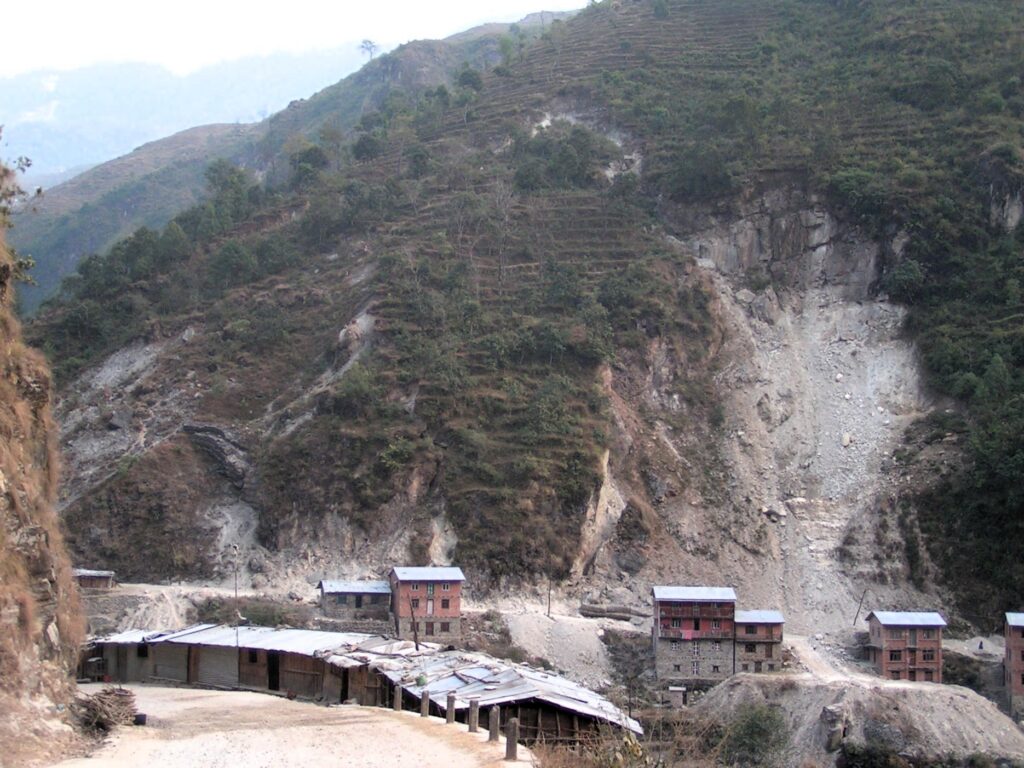
There is a very interesting article (Adhikari et al. 2026) in the journal Asian Development Review (the article is Open Access) that examines the economic benefits of rural roads in Nepal. Now, this is not the first article to examine this issue in Nepal (and there is a massive literature from other parts of the world), but the authors make two key points of context. First, the relevance of literature from other parts of the world to the specific context of Nepal (with its extreme topography) is limited and second, most of the Nepal-specific studies date from the 1990s to early 2000s, when the country had a very different (primarily agricultural) economy. So they set out to examine this issue anew.
There are two key strands to the work of Adhikari et al. (2026). In one component they examine the economic benefits of the two main types of rural road in Nepal across 200 wards in the hilly areas – blacktop (paved) roads and motorable (earthen) roads. They find, as they put it “little systematic evidence that better road access enhances economic outcomes”. Across a wide range of economic indicators, they find no real quantitative data that rural roads in Nepal are improving the livelihoods of people living in remote locations now.
In the other component, they examine the incidence of landslides in the vicinity of these roads. They find “ward-level estimates reveal that the expansion of earthen (motorable) roads between 2016 and 2018 is associated with a significant increase in landslide-affected areas, whereas blacktop roads exhibit no detectable effect”. This is a fascinating result in line with my long-standing arguments about the problems of low technology roads in Nepal.
Adhikari et al. (2026) have a more nuanced argument about blacktop roads than I have tended to favour. They note that blacktop roads are often upgrades on existing roads, and as such they inflict a much lower environmental cost than new construction. Earthen roads tend to be new-build. Thus, blacktop roads tend not to carry the landslide burden of low technology infrastructure.
Overall, Adhikari et al. (2026) argue that the economic benefits of rural roads are at best limited in Nepal (a finding that will be disputed) whilst the environmental costs of earthen roads are high. This asks serious questions about a key development paradigm in Nepal (with implications for other high mountain areas too).
Finally, Adhikari et al. (2026) make some recommendations for ways forward:-
“Future research should exploit advances in remote sensing and GIS technologies to construct high-resolution time series on road placement, earthwork intensity, hydrological disruption, and slope-failure events.”
This is sage advice. The frustration is that this is not news. Back in 2003, at the end of the Landslide Risk Assessment in the Rural Access Sector, we wrote a report (Scott Wilson Kirkpatrick 2003) on the project activities, which is still available as a pdf. In Section 9, the report makes essentially the same recommendations.
I have noted in a recent post that fatal landslide occurrence in Nepal is on an upward trajectory. A part of this is being driven by more intense rainfall events, but these low cost rural roads are also a factor. Sadly, there is little sign that the lessons are being learnt. And we will soon move into the 2026 monsoon season, which will once again lead to many lives lost from landslides in Nepal.
References
Adhikari et al. 2026. Paved to Nowhere: Dubious Payoffs of Rural Road Expansion in Nepal’s Rugged Terrain. Asian Development Review, 0, 1-28. doi: https://doi.org/10.1142/S0116110526400019.
Scott Wilson Kirkpatrick 2003. Landslide Risk Assessment in the Rural Access Sector. DfID, 38 pages.