
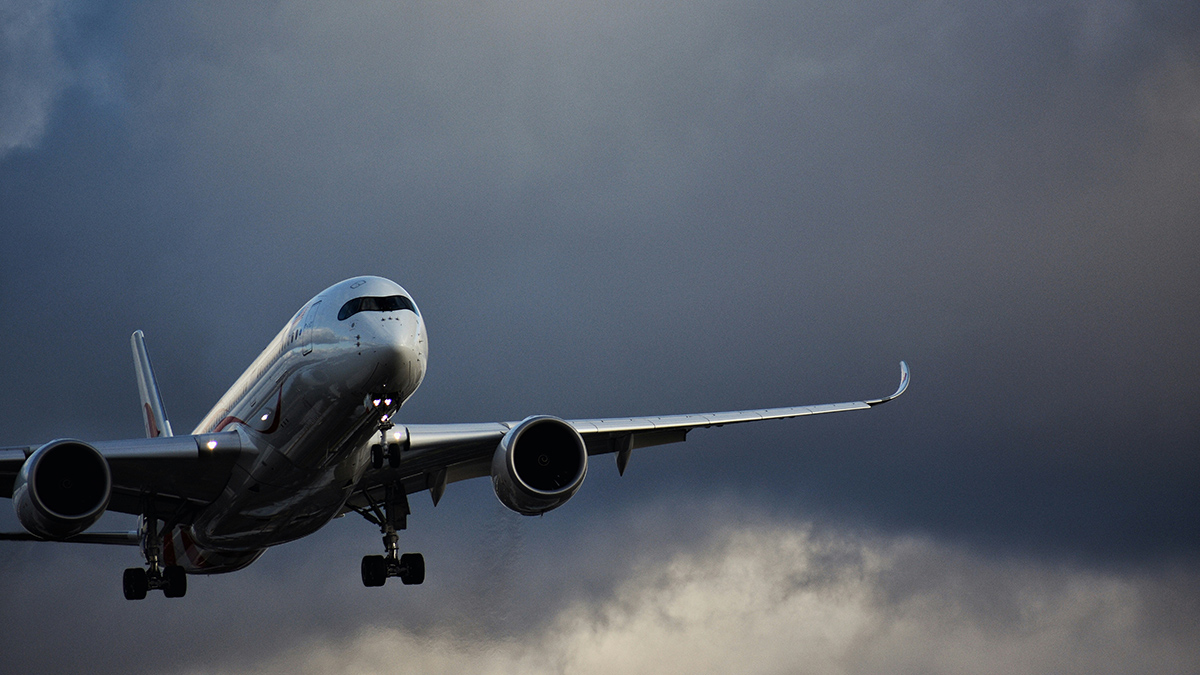

Stomach-churning dips and swerves can be the most unpleasant—and dangerous—part of flying. To travelers’ chagrin, climate change has already begun to make such aircraft turbulence more common, as it alters the movement of air masses at the heights where planes fly.
Researchers wondered whether stratospheric aerosol injection (SAI), a controversial climate intervention strategy to cool the planet by injecting sunlight-blocking aerosols into the stratosphere, could help. In a study published last month in Environmental Research Letters, a team modeled aircraft turbulence under future climates with and without SAI. The researchers found that climate intervention could, indeed, reduce aircraft turbulence, even below modern-day levels.
“SAI is very important, but on the other hand, it’s very dangerous,” said study author Hye-Yeong Chun, an atmospheric scientist at Yonsei University in Seoul, South Korea. “These results show that aviation turbulence is quite significantly reduced [with SAI]—so this is one merit, at least, on the SAI side.”
A Bumpy Future
Climate change isn’t warming the planet evenly; the poles are heating up faster than the equator. This imbalance shrinks the temperature difference between the rising masses of cool and warm air that meet to form the jet stream, a fast-moving current of air that swirls like a river around the globe near 9,100 meters (30,000 feet) in elevation. The lower temperature difference weakens the jet stream, making it wavier and prone to wind shear, or changes in wind speed or direction over short distances. Because wind shear is one of the primary causes of aircraft turbulence, plane rides are getting bumpier, explained Chun.
“[Turbulence is] a very intermittent and localized phenomenon. Even current weather forecasting models and high-resolution numerical models cannot directly predict turbulence.”
But turbulence is also one of the trickiest weather elements to predict, she said. Unlike turbulence from storms or clouds, which is visible and easier to forecast, so-called clear-air turbulence can’t be seen by pilots. “It’s a very intermittent and localized phenomenon,” said Chun. “Even current weather forecasting models and high-resolution numerical models cannot directly predict turbulence.”
Understanding turbulence and how the jet stream is changing is important “not only for comforting people, but also for reduction of greenhouse emissions,” said Tommaso Alberti, a physicist at Italy’s Istituto Nazionale di Geofisica e Vulcanologia who was not involved with the study. Turbulence can increase a plane’s fuel requirements as it readjusts, while taking advantage of a strong jet stream can shrink flight times and associated carbon emissions.
Since the phenomenon can’t be directly predicted, scientists like Chun use proxies—other measurements that indicate potential regions where turbulence might occur. In the new study, she and her colleagues used a measure called the Ellrod index, which combines data on vertical wind shear and the stretchiness of masses of air.
The researchers modeled how the Ellrod index would change across seven climate futures with varying amounts of greenhouse gas emissions, three of which had no human intervention and four of which had SAI. They found that although climate change should increase aircraft turbulence across nearly all latitudes, SAI could reduce such increases by up to 60%. And to Chun’s surprise, SAI was powerful enough not only to counteract future turbulence but also to reverse modern-day levels of climate-driven turbulence. One possible explanation is that depending on where the aerosols get injected, SAI cools the tropics more strongly than the poles, counteracting the shrinking temperature difference that forces the jet stream out of balance.
Global Tactics, Global Implications
“We have to find the optimal way to reduce temperature but, on the other hand, reduce any potential side effects.”
Though the study results are promising, they are far from a green light to conduct climate intervention, said Chun. Still, the goal set forth in the Paris Agreement of limiting global warming to 2°C above preindustrial levels will not be easy to achieve, she said. “We have to find the optimal way to reduce temperature but, on the other hand, reduce any potential side effects.”
With global climate interventions such as SAI, a top concern is that any side effects will occur throughout the world, ranging from changes in rainfall to disruptions to the ozone layer. The most commonly proposed aerosol, sulfur dioxide, can also cause acid rain as it falls out of the atmosphere.
Ramalingam Saravanan, an atmospheric scientist at Texas A&M University who was not involved with the study, said that researching SAI in “controlled and safe conditions” had its merits. But as a longtime modeler, he said, “There are all kinds of errors in models that we are still working with…saying ‘This is what will happen’ in a model may not exactly be what will happen in the real world.”
In turn, Saravanan worried that private individuals or companies pushing to enact climate intervention might overstate the benefits to airplane turbulence. “Focusing on potential modest benefits of a radical and uncertain mitigation approach, as this study does, risks deflecting attention away from the inherently large dangers of climate intervention,” he clarified in an email.
Alberti noted that artificial intelligence models may eventually be able to forecast clear-air turbulence, providing a less risky solution for dealing with the hazard. However, he noted that would only be a way to adapt to climate-driven turbulence, not mitigate it.
Chun said that she was not yet advocating for the actual implementation of SAI but that researching it is critical if global leaders are to consider such a strategy. AGU’s Ethical Framework Principles for Climate Intervention Research acknowledges that such geoengineering approaches shouldn’t move forward without an internationally agreed-upon ethical governance structure but states that “more knowledge about climate intervention approaches and their consequences will help society make informed, just decisions about the deployment of climate intervention.”
“The risk is quite significant,” Chun said. “Scientists have to work very hard to save lives, to save our planet.”
—Hannah Richter (@hannah-richter.bsky.social), Science Writer
This news article is included in our ENGAGE resource for educators seeking science news for their classroom lessons. Browse all ENGAGE articles, and share with your fellow educators how you integrated the article into an activity in the comments section below.