

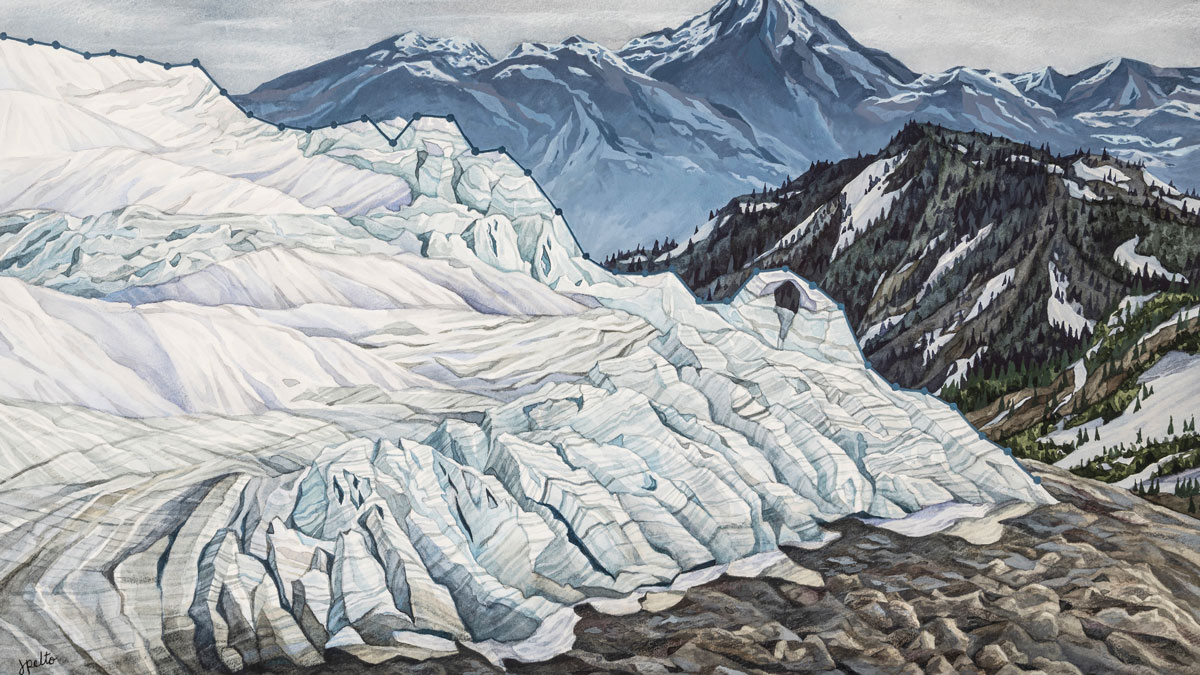

Jill Pelto describes herself as a climate artist. Her evocative paintings of glacial landscapes, forests, oceans, and savannas reflect the shapes of real environmental and Earth science monitoring data, portraying both the beauty and the vulnerability of our planet.
“I’ll weave in the data and try to make it a part of the landscape or a part of the form in my painting,” Pelto said.
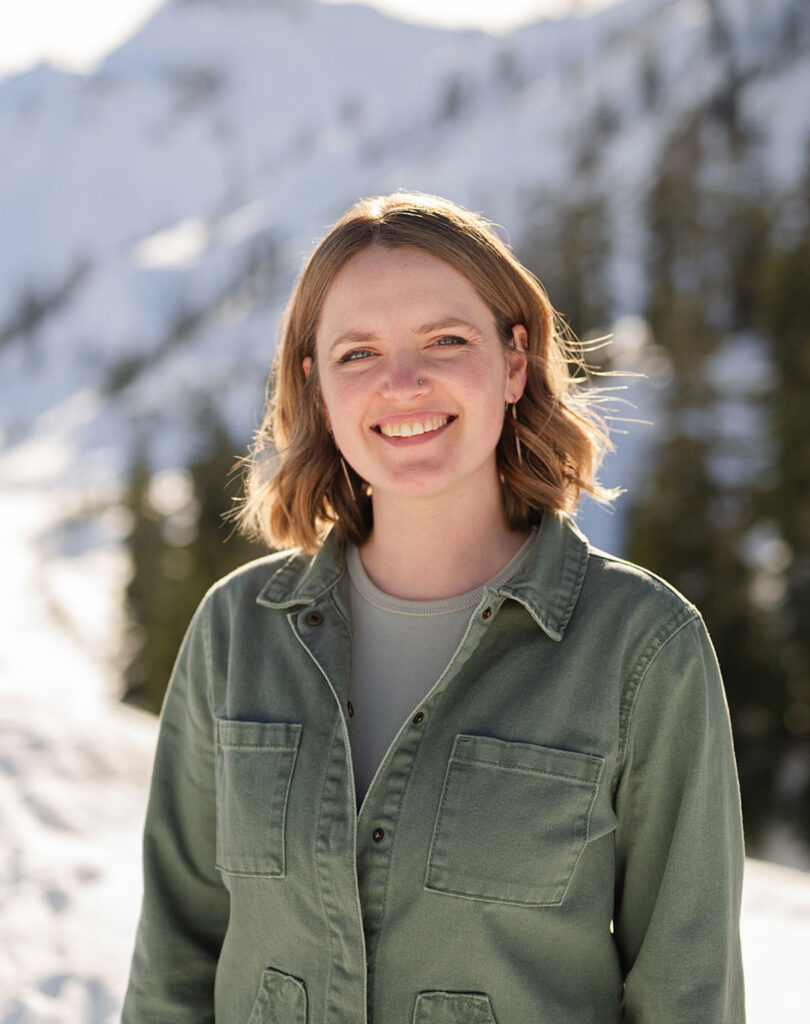
Much of her artwork is focused on glaciers—the result of a lifelong connection to Earth’s cryosphere. Growing up in Massachusetts, she’d always loved the magic of snowy winters. And at just 16, Pelto was joining her dad, glaciologist Mauri Pelto, on field surveys of glaciers in Washington’s North Cascade Mountains.
Her love for art, though, was innate. In high school, Pelto was already creating art related to climate change and shifting winter weather. She followed her dual passions for glaciers and painting to a double major in studio art and Earth and climate science at the University of Maine. There, she began to think about how to incorporate environmental data into her paintings.
As she continued through a master’s degree in Earth and climate science, also at the University of Maine, she realized a full-time science career wasn’t for her and committed to building a business around her art by selling it online and at local shows. People responded positively. “Even though I didn’t know what it would look like financially, I felt confident in the art itself,” Pelto said. “It really helped me see that this could be something I could pursue.”
What is one book, movie, or piece of media about your field that you would recommend to young scientists?
My recommendation is Tiny Worlds of the Appalachian Mountains: An Artist’s Journey by Rosalie Haizlett. It shares her exploration and communication of ecosystems, how she connects with scientists, and how she explores and learns on her own. This book is a passion project of a region she lives in and shows how we can combine art and science in a career.
Pelto also continues her work with glacier monitoring as the art director for the North Cascade Glacier Climate Project, a 43-year-old project established by her father that maps and measures 47 retreating glaciers in Washington. As art director, Pelto coordinates with other artists, journalists, and writers who join monitoring efforts in the field and communicate what they see. Pelto curated an exhibition, Shaped by Ice, in 2025 to showcase some of the resulting art.
She extends her outreach work to K–12 classes, leading students as they create their own data-art. “It’s ended up really inspiring me, just to see all of their ideas come to life,” she said.
Pelto encourages artists who are interested in data-art or science communication not to be intimidated by science fields: “You don’t necessarily need a science background—you can do so much learning on your own” by connecting with scientists and learning from their work. She’s always excited to find other scientists and artists to partner with to share the science of our changing world, she said.
—Grace van Deelen (@gvd.bsky.social), Staff Writer
This profile is part of a special series in our August 2026 issue on science careers.