
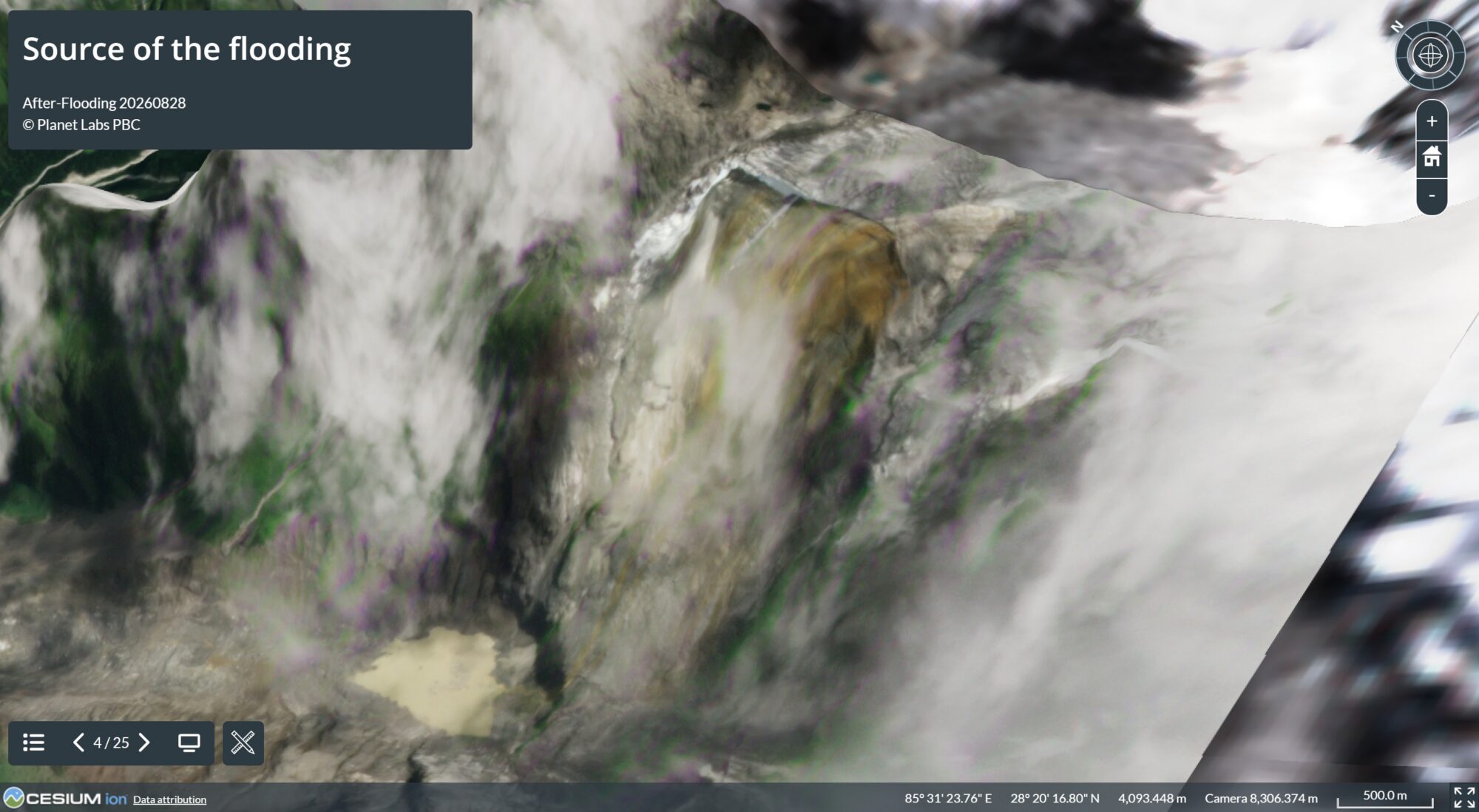
A new paper (Wang et al. 2026) suggests that the bedrock failure that initiated the Nepal landslide disaster may have displayed measurable precursory deformation.

Inevitably, one of the key discussion points in the aftermath of the 26 August 2026 Nepal landslide disaster is whether the failure could have been anticipated. Opinions differ, but a key starting point is the identification of precursory signals in the days, weeks or months leading up to the failure.
The focus is inevitably on INSAR, but the terrain in the source area of the landslide (on the north face of Langtang Lirung) is unforgiving to this technique. An alternative lies in pixel offset tracking from optical imagery, which can extract movement in more challenging terrain.
In the journal Landslides, a paper published with impressive rapidity (Wang et al. 2026 – the article is paywalled but this link should provide access) uses the pixel offset tracking technique on Sentinel-2 satellite data to examine deformation of the glaciers in the area of the initial failure. They have compared movement of the main glacier, which was not involved in the landslide, and of the hanging glacier under which the landslide occurred. In the Google Earth image below, this is the portion of the glacier under the location marker (the hanging glacier) and main glacial area upslope:-
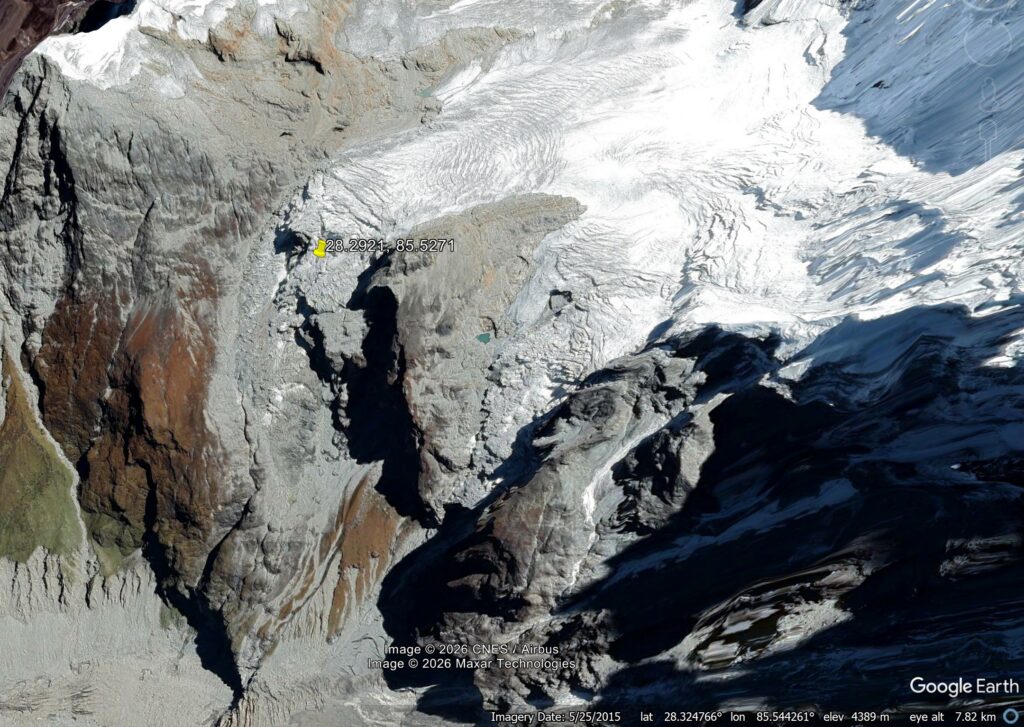
Wang et al. (2026) have measured movement of these two parts of the glacier from 2018 to now. Until the early part of 2026, the two glaciers moved at a linear rate, although the main glacier moved at a much higher rate than the hanging glacier. But, from late 2025 or early 2026, the hanging glacier started to move faster, and from that point onwards showed a dramatically accelerating trend to failure.
Presumably, this is the development of failure in the underlying bedrock being transmitted through to the ice. By the end, the movement rate had increased from about 7.4 m per year to about 55 m per year.
Wang et al. (2026) have a slightly strange interpretation of the mechanical processes that led to this behaviour that I must admit I don’t really understand. To me, this is likely to have been a progressive failure of the bedrock, which is known to show this style of deformation. I would be very interested in seeing a plot of 1/velocity against time for the period of acceleration, which will give an indication as to whether there was a brittle failure mechanism in play.
But nonetheless, this is a fascinating result that might suggest that the initiating bedrock failure that started the disastrous cascade in Nepal demonstrated precursory signals. Please note though that this does not mean that the event itself could have been reliably predicted nor that a warning system can be easily developed.
Reference
Wang, T., Sassa, S., Yang, W. et al. 2026. Precursor of a powerful large glacier landslide causing tsunami floods in the 26 August 2026 Nepal disaster. Landslides. https://doi.org/10.1007/s10346-026-02842-6.