
Editors’ Vox is a blog from AGU’s Publications Department.
As wildfire activity and severity continue to amplify across the globe, it is increasingly important to understand and have the ability to forecast wildfire emissions, which can affect air quality, climate, and public health.
A new article in Reviews of Geophysics explores our current understanding of the chemical reactions within wildfire smoke plumes. Here, we asked the lead author to give an overview of fire plumes, how scientists study them, and future directions for research.
In simple terms, what are fire plumes?
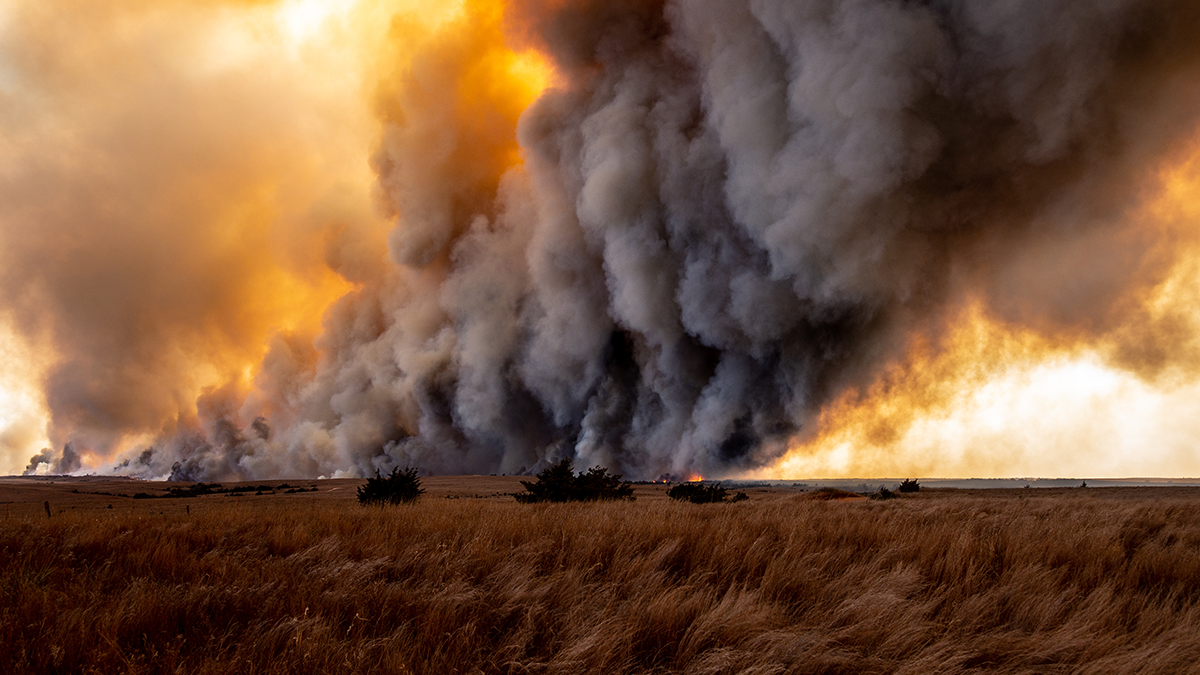
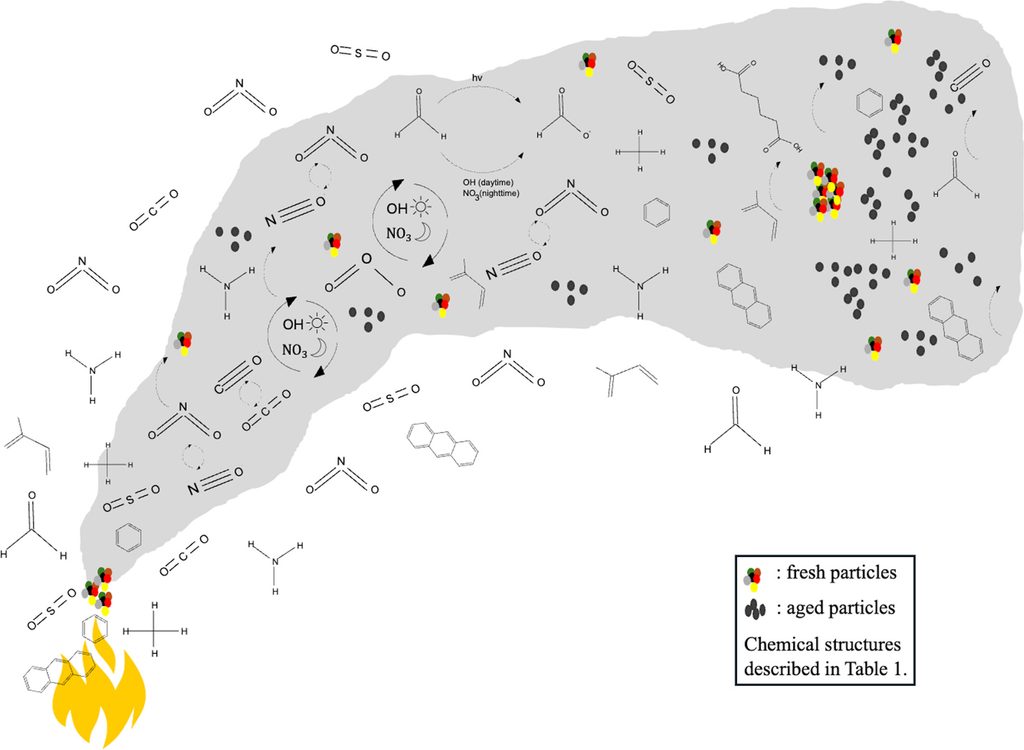
Fire plumes are rising masses of hot air, gaseous chemical species and particles produced as vegetation and other material burn. We commonly see them as smoke columns above the fire source, but their chemical constituents are not visible. Depending on the fire intensity and meteorological conditions, a plume may disperse near the source or rise high into the atmosphere and travel further away from the source. Its composition also depends on the fuel type. For example, a forest, a grassland, and a building can release different pollutants and chemicals. A plume is not chemically uniform or static. Close to the flames, newly emitted compounds can react rapidly, while downwind in-plume species mix with surrounding gases and form new secondary species. This is commonly called plume aging, meaning that smoke can alter significantly between the fire source and the areas it reaches.
Why is it important to understand the chemistry inside fire plumes?
Understanding the chemistry inside fire plumes helps us answer the question that smoke concentration alone cannot: “What are people and ecosystems actually exposed to as smoke travels?”
Fires release pollutants directly, but reactions inside the plume can result in the formation of new pollutants.
Fires release pollutants directly, but reactions inside the plume can result in the formation of new pollutants. Specific compounds get consumed, while others become more abundant or change their properties as the plume moves downwind. Our review brings together these chemical pathways to explain why smoke from different fuels, locations, and meteorological conditions present different behaviors. Combining this knowledge, in-plume chemistry helps improve air-quality forecast and estimates of downwind exposure. In addition, it provides necessary evidence and information to investigate health and climate impacts, inform health guidelines, and fire management decisions. It is important to understand that smoke that reaches a community may be chemically different from the smoke emitted near the fire source.
How do scientists observe and measure chemical reactions in fire plumes?
Scientists usually investigate plume chemistry by utilizing a combination of complementary approaches. Ground stations continuously measure gases and particles as smoke passes, while research aircrafts can collect samples within and around a plume at different distances from the fire source. These approaches are characterized as online methods. Comparing these measurements helps see which compounds are emitted, reduced, and formed as the smoke ages.
Air filters collected during fire events can later be analyzed to identify additional particle components and constitute an offline method. Additionally, controlled in-lab combustion experiments allow scientists to burn selected fuels and examine reactions under known conditions. Moreover, satellites provide a wider view of plume dispersion and select, typically long-lived, species. However, they cannot detect reactions. Finally, atmospheric models combine these observations to test possible chemical pathways and investigate changes that cannot be measured directly. Each method reveals different pieces of the same evolving chemical system.
What are the main chemical components of fire plumes explored in your review?
Fire plumes contain a complex mixture of gases and particles, rather than a single compound we simply call smoke. Major gases emitted during a fire include carbon dioxide and monoxide, methane, nitrogen oxides and volatile organic compounds, usually referenced as VOCs. Depending on the fuel, plumes can also contain ammonia and sulfur species. The particle fraction includes soot, organic material, ash, and trace metals.
In our review, we pay particular attention to black and brown carbon, which are light-absorbing species, and organic particles that can change as the smoke ages. It is important to note that not all the species existing inside a plume were emitted directly by the fire. Chemical reactions can generate ozone and secondary organic aerosols, resulting in the formation of new pollutants in the original mixture. Understanding both the initial emissions and the secondary formed products is essential for assessing air quality, climate effects, and potential exposure.
What factors influence the chemistry inside fire plumes?
The chemistry of a fire plume begins with what is burning and how it burns. Different vegetation types and anthropogenic materials release different compounds, while intense flaming and slower, smoldering combustion produce release emissions. Temperature and oxygen availability also affect the in-plume chemistry. In addition, plume size and injection height play a key role. Specifically, a dense plume rising high above the surface encounters different conditions from a smoke remaining close to the ground. As the plume dilutes and ages, gases can react or dilute into particles, altering both pollutant concentrations and particulate properties. All these factors interact; thus, two fires of similar size will produce chemically different smoke plumes.
How do fire plumes impact cloud formation?
Fire smoke can influence clouds, as small smoke particles can act as cloud condensation nuclei, meaning surfaces on which water vapor condenses to from droplets. When smoke adds large numbers of these particles, a cloud may contain more droplets that are individually smaller, potentially changing its lifetime and precipitation. Some fire-related mineral particles can also assist ice crystals to form colder clouds. In-plume chemistry is important because the particles continue to change as plume ages, altering their size, composition, and ability to take up water. There is also a competing effect. Black and brown carbon absorb sunlight and warm the surrounding air, occasionally reducing humidity and making cloud formation less favorable. The overall outcome depends on the plume and cloud types as well as the atmospheric conditions.
What are some of the remaining knowledge gaps where additional research efforts are needed?
Ultimately, the goal is to predict not only where the plume travels, but how its composition and impacts evolve along the way.
One major challenge is capturing the fastest reactions in fresh smoke and following the same plume as it ages, especially under dark conditions or after it passes through clouds. We also need to understand why models sometimes struggle to reproduce ozone, and the formation or loss of organic particles when simulating fire events. Other uncertainties include the mechanism of smoke rise, its mixture with surrounding air, and the way that biological particles change during plume transport. Our review highlights the value of combining controlled laboratory experiments with aircraft, ground-based and satellite observations, supported by higher-detailed chemical models. Improved sensors and drones could also help fill important gaps. Ultimately, the goal is to predict not only where the plume travels, but how its composition and impacts evolve along the way.
—Eleni Dovrou ([email protected];  0000-0003-0564-9573), Assistant Professor at the University of Crete, Department of Chemistry, Greece, Visiting Fellow Honorary Appointment at the HEAL Research Institute, University of Canberra, Australia, Alumni Affiliate at the Leverhulme Research Center, Imperial College, UK, Alumni Affiliate at the Technical University of Crete, School of Chemical and Environmental Engineering, Greece
