

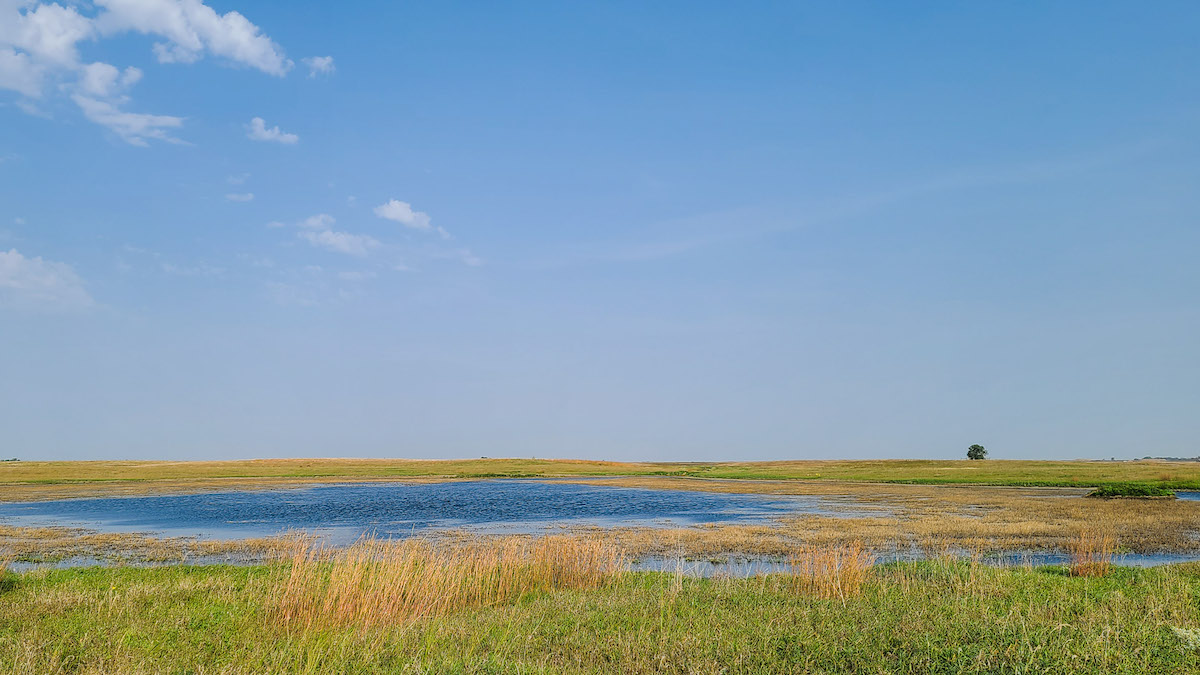
Three hundred years ago, the central United States was a land of wetlands—more than 150 million hectares of them. All that water made the region highly attractive to farmers, who, over time, converted most of it into agricultural land.
For the wetlands that remain, protections secured by the Clean Water Act are often the only thing preventing wetland conversion or development, especially when state protections are weak, said Kylie Wadkowski, a landscape ecohydrologist and doctoral candidate at Stanford University.
With wetlands, “you actually can’t do whatever you want,” said Elliott White Jr., a coastal socioecosystem scientist at Stanford University. “That’s how this Sackett case came about.”
The Supreme Court’s 2023 Sackett v. EPA decision ruled in favor of two landowners backfilling a lot containing wetlands. The decision changed the definition of the term “waters of the United States”—which is used in the Clean Water Act—to exclude wetlands without continuous surface connections to larger, navigable bodies of water. In November 2025, the Trump administration’s EPA proposed to set new rules for water regulations that may be even looser than the updated Sackett definition.
According to research by Wadkowski and White presented on 15 December 2025 at AGU’s Annual Meeting in New Orleans, the changing definition will leave millions of hectares of wetlands unprotected and more vulnerable to development.
Wadkowski and White are the first to analyze wetland protections in detail on a nationwide scale, said Adam Ward, a hydrologist at Oregon State University who was not involved in the research. “This represents a huge advance in understanding what is being protected and what is losing protections,” he said.
What Will Happen to Wetlands?
Wadkowski and White found that under Sackett, 16.4 million hectares of wetlands, an area about the size of Wisconsin, are either unprotected or have undetermined status. Under the EPA’s newest proposed rule, that number could increase; the proposed rule contains many subjective and ill-defined terms that could be interpreted by regulators to mean even more wetlands lose protections, Ward said.
The approach the researchers took—using the available wetland, stream, and land conversion data with spatial modeling—was “incredibly logical,” Ward said. “They’re using machine learning tools, using the information we have to try and gap-fill and create the most comprehensive analysis that they can, and that’s a huge step in the right direction.”
Rates of vulnerability were not consistent across the United States. A breakdown of protections based on land management categories showed that 43.5% of wetlands on lands managed by tribes was protected under Sackett, compared to the national average of 66%.
Wetlands in the Great Plains states North Dakota, South Dakota, Nebraska, Montana, and Minnesota were the least protected. This area of the country is often called the “prairie pothole” region because many of its wetlands are depressions in the landscape fed by groundwater and disconnected from larger surface water bodies. Under Sackett, these geographically isolated wetlands rely entirely on state-level protections, which are also often weaker in agricultural regions, Wadkowski said.
“The economic pressure and agricultural [conversion] happens a lot more in the Plains states,” she said. “And those are also the states that have less state level protections.”
With a rule that “emphasizes overland [surface] flow and connection to streams and rivers, it shouldn’t surprise us at all that it excludes wetlands that aren’t wet because of overland [surface] flow,” Ward said.
Wadkowski plans to continue to evaluate how various legal frameworks might affect wetland conversion rates in the future by comparing their estimates of protected wetlands under Sackett and the new EPA proposal with past data on wetland conversion rates under previous definitions of “waters of the United States.”
Informing Policy
To best protect wetlands, policymakers should ensure their policies line up with the available science, White said.
Part of that strategy includes acknowledging that wetlands that are not connected to larger bodies of water year-round via surface water and therefore may not be protected under the Sackett decision may still be connected to broader water systems through groundwater, Wadkowski said. “Think about water bodies as not just on the surface.”
“Policymakers need to more thoughtfully engage with the scientific community for a more clear understanding of what a wetland is and what wetlands actually need.”
The Sackett decision and the new EPA proposal do not reflect the scientific consensus, White said. “Policymakers need to more thoughtfully engage with the scientific community for a more clear understanding of what a wetland is and what wetlands actually need.” Scientists, too, need to better engage with policymakers, he added.
For example, said Ward, part of the reason that wetland rule frameworks are so contentious is that none have yet been informed by enough clear, comprehensive science to make enforcement efficient or practical. “We have heaps of scientific understanding, but the scientific community writ large has not been invited to formally weigh-in on how to design a rule that reflects our understanding,” he wrote in an email.
In a presentation on 15 December at AGU’s Annual Meeting, Ward made the case for a new, large-scale U.S. headwater stream monitoring network, which would help reduce some of the uncertainty inherent in wetland regulations. “If you don’t understand the stream network, you can’t possibly understand the wetland protections,” he said.
Scientific engagement, however, has been made more difficult by the courts, according to Ward: Within the past 5 years, the Supreme Court has begun to invoke the major questions doctrine, which preserves major rulemaking on matters of environmental regulations for Congress, giving agencies like the EPA less incentive to seek input from scientists.
“In parallel with our advances in understanding [wetland science] is a court system that is essentially cutting scientists out of the loop,” Ward said.
The public comment period for the EPA’s newest proposed rule closes on 5 January.
—Grace van Deelen (@gvd.bsky.social), Staff Writer