
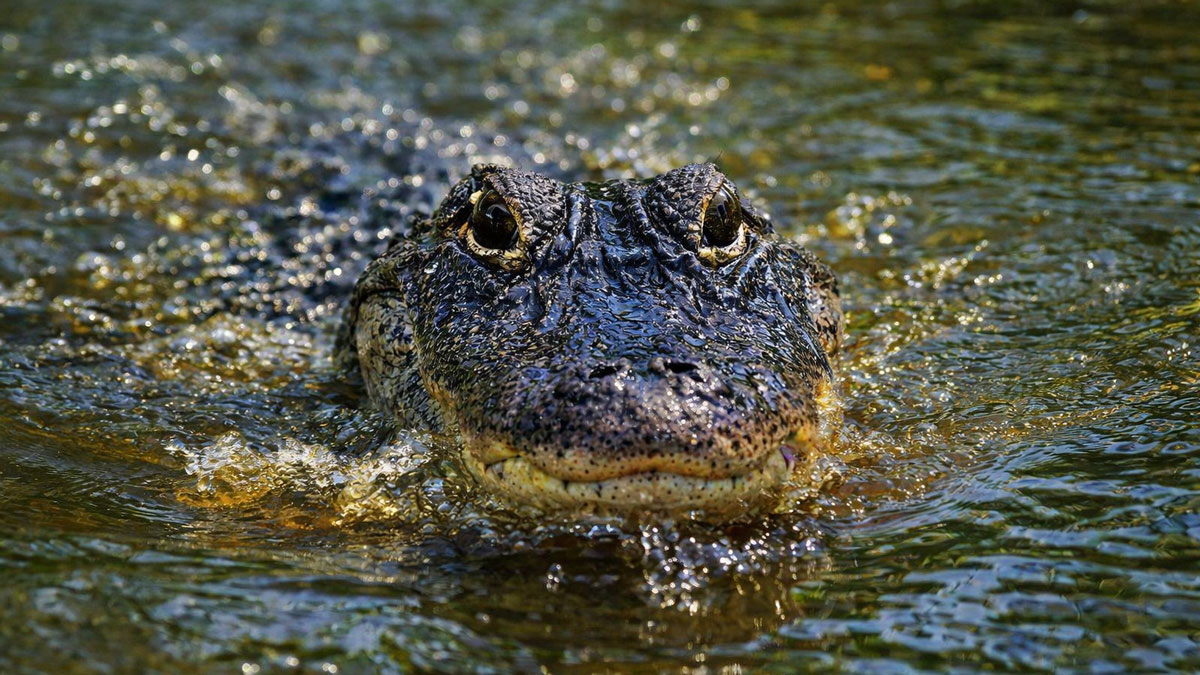
The vital role apex predators play in maintaining healthy ecosystems is well-documented, but research published in Scientific Reports suggests predators might also influence the global carbon cycle. The study found that across coastal wetlands in the southeastern United States, soils store more carbon where American alligators are present, linking predator recovery to enhanced carbon retention in some of the planet’s most efficient natural carbon sinks.
Wetland carbon storage (so-called “blue carbon”) is facilitated by wetlands’ waterlogged, oxygen-poor soils, which slow decomposition and allow organic material to accumulate over time. Scientists know that when wetlands are drained or degraded, stored carbon can be released into the atmosphere as carbon dioxide. Less well understood is how biological interactions within these habitats shape carbon dynamics. The new study adds to a growing body of evidence showing that animals—particularly apex predators—can influence vegetation, soils, sediment flows, and nutrient cycles at scales large enough to affect the planet’s carbon budget.
“What we found was a positive correlation between alligator abundance and carbon sequestration in specific habitats,” said Christopher Murray, an ecologist at Southeastern Louisiana University and lead author of the study. “Where we have more alligators, from small populations to much larger populations, we actually see higher carbon sequestration.”
Across the alligator’s native range, wetlands stored an average of 0.16 gram more carbon per square centimeter in the top 10 centimeters of soil when alligators were present.
Murray and his colleagues at Southeastern and the Louisiana Universities Marine Consortium analyzed soil carbon data from the Smithsonian’s Coastal Carbon Network. From that database, the team selected 649 continuous soil cores from tidally influenced wetlands in 13 states. They compared those carbon measurements with data on alligator presence, density, and nesting patterns assembled from state wildlife agencies and long-running monitoring programs.
Across the alligator’s native range, wetlands stored an average of 0.16 gram more carbon per square centimeter in the top 10 centimeters of soil when alligators were present. That surface layer reflects relatively recent carbon accumulation over roughly the past 6 decades. This period overlaps with the recovery of alligator populations following the Endangered Species Protection Act of 1966.
The researchers attribute the observed patterns to a combination of physical ecosystem engineering and trophic cascades, or actions by predators that reverberate through multiple layers of a food web. As apex predators, alligators may suppress herbivore populations that otherwise damage vegetation and disturb soils, potentially allowing denser plant growth and greater carbon burial. Alligators also modify wetland landscapes directly. By digging dens, carving channels, and creating small ponds, they reshape hydrology, redistribute sediments and nutrients, and create localized microhabitats where organic carbon can accumulate and persist.
Trophic Effects
At a continental scale—spanning a wide range of coastal wetland types across multiple states—the study found no statistically significant difference in carbon storage between sites with and without alligators. The authors suggest that this reflects substantial ecological variability across regions, including differences in vegetation, geomorphology, hydrology, and food web structure, which can mask the influence of any single predator species when ecosystems are analyzed collectively.
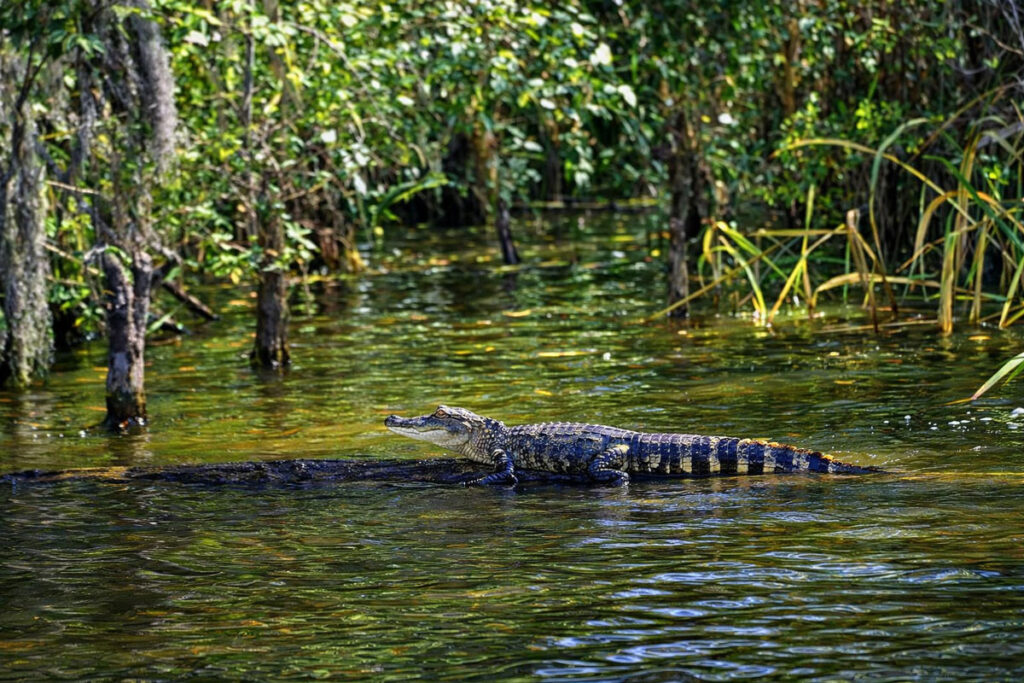
“Originally, I was surprised by that finding,” said Murray. The team’s original hypothesis predicted higher carbon sequestration wherever alligators were present, consistent with trophic cascade theory. The absence of a clear continental-scale signal, Murray said, made it obvious to him, “later on, that there’s a different apex predator that is working in those habitats.”
When the analysis was narrowed to the alligator’s native range, thereby reducing ecological variability, the pattern became clearer. At these regional scales, wetlands with alligators consistently stored more carbon, suggesting that in ecosystems where they occupy the top trophic position, alligators may exert a detectable influence on wetland carbon dynamics.
“Apex predators like crocodilians have a critical role in the function of our world.”
“This study is important because it links an apex predator directly to wetland soil carbon stocks, moving beyond theory to show that food web structure can shape carbon outcomes at ecosystem scales,” marine ecologist and Blue Carbon Lab director Peter Macreadie, who was not involved in the study, wrote in an email. “It also challenges prevailing blue carbon approaches by showing that long-term carbon storage depends not only on vegetation and sediments, but on maintaining intact trophic interactions.”
Such trophic effects help explain how sea otters maintain kelp forests by controlling sea urchins and why wolves have been linked to forest regeneration through changes in large herbivore behavior. The alligator study suggests that similar processes may operate in coastal wetlands, where predator presence supports vegetation growth, soil stability, and carbon retention.
The study does not establish causation, and Murray emphasized that long-term exclusion experiments would be needed to directly test how changes in alligator populations affect carbon accumulation over time. Even so, the findings suggest that predator recovery may have consequences for the climate that are rarely considered in conservation planning. Murray said that the implications of this work extend beyond carbon accounting, however. “Apex predators like crocodilians have a critical role in the function of our world,” he said. “And they should be respected rather than feared.”
—Emil Siekkinen, Science Writer