

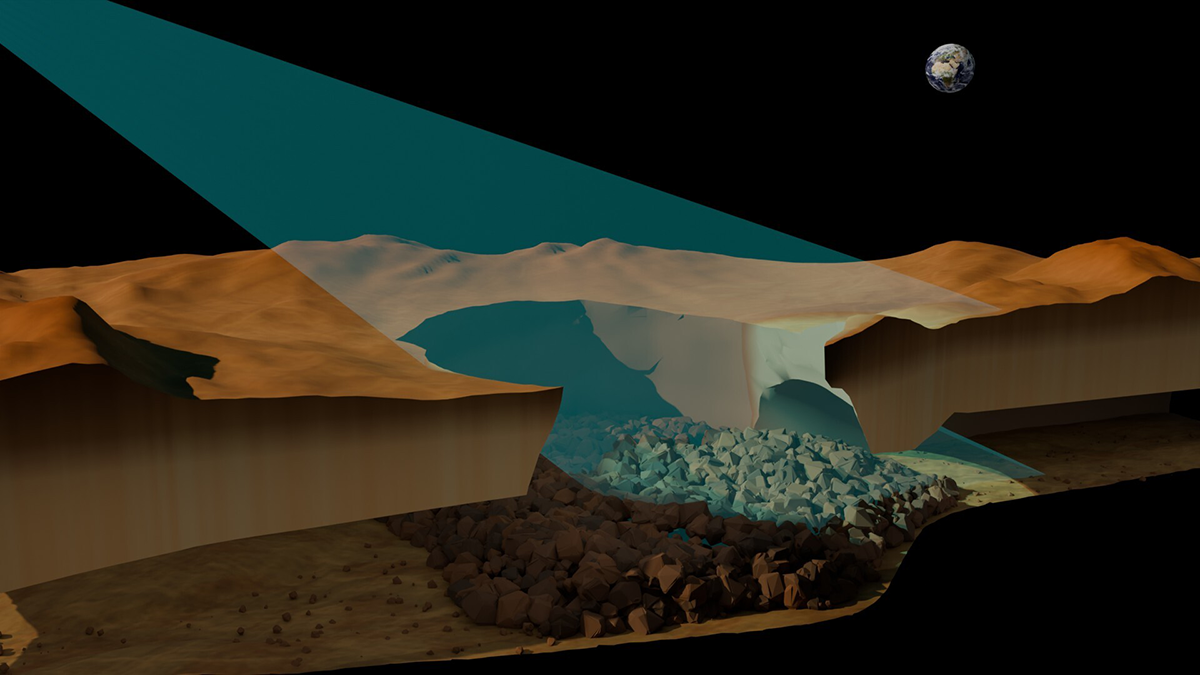
For decades, scientists have suspected the presence of lava tubes on Venus. After all, at least 85% of the planet is covered in volcanic flows. And with more than 1,600 major volcanoes or volcanic features, Venus has more volcanoes than any planet in our solar system.
New research published in Nature Communications has provided the strongest evidence yet for the existence of Venusian lava tubes, or underground passages formed by lava flows. And at nearly 1 kilometer in diameter, they’re much bigger than both lava tubes here on Earth and those predicted to exist on Mars.
“We expected to have in the subsurface of Venus caves, lava tubes. And this is the first direct evidence,” said coauthor Lorenzo Bruzzone, a remote sensing and radar researcher at the University of Trento in Italy. “Starting to identify these kinds of features that are connected with the volcanic activity gives us new information about the evolution of the planet.”
Skylights and SAR
For a project that involved trying to peer beneath the surface of a planet more than 100 million kilometers away, Bruzzone said the method he and his colleagues used was, “conceptually, not very complex.” The key was a new technique for analyzing synthetic aperture radar (SAR) data. With SAR, an instrument sends out a pulse of energy that bounces off a surface, such as the surface of a planet, and is recorded by radar instruments.
SAR can detect pits on a planetary surface as well, if the angle of the radio waves is lined up accordingly. This team used a new technique that closely analyzed the backscattering characteristics, radar shadows, and geometric characteristics of Venusian pits detected with SAR in the 1989 Magellan mission. The researchers suggest that one such pit is actually a skylight, or a collapsed portion of the ceiling of a lava tube.
“And then we looked at each other and said, ‘Well, there is Magellan data on Venus. Why not look at that also?’ And then the rest is history.”
On Earth, skylights exist in volcanic landscapes in Australia, Hawaii, and Spain. Spain’s Corona Volcano has created one of the most extensive lava tube networks on Earth. The team used their new SAR method to see whether it could accurately determine the size of the Corona lava tubes, and what it found matched existing measurements.
“And then we looked at each other and said, ‘Well, there is Magellan data on Venus. Why not look at that also?’” said Leonardo Carrer, the lead author and also a remote sensing and radar researcher at the University of Trento in Italy. “And then the rest is history.”
The team also used their work identifying terrestrial skylights to rule out the possibilities that what they saw on Venus wasn’t something like a regular pit, volcanic vent, or impact crater.
“We had a really good idea of how the radar reflections from that feature should look if it was a lava tube,” Carrer said. “So, if you compare…the radar response of a terrestrial lava tube to the one we have seen on Venus, they are strikingly similar.”
New Life for Old Data
NASA’s Magellan mission imaged the entire surface of Venus using SAR more than 30 years ago, but Bruzzone said improved processing capabilities allowed his team to “give a new life to old data.”
“With a new technique, we can squeeze the data and get what was not visible before,” he said.
“Look, this is what we found. It’s gigantic.”
What became visible was surprisingly big: The team calculated that the lava tube they discovered on Venus, near the shield volcano Nyx Mons, was about 1 kilometer in diameter and 300 meters tall, with a roof at least 150 meters thick. Carrer said he actually had trouble grasping the “incredible size” of the lava tube at first. So he took a 3D model of a lava tube skylight in Spain and scaled it up to match the size of the tube on Venus. Then, he placed a 3D model of the entire Eiffel Tower inside the scaled skylight.
“I sent this to Lorenzo and said, “Look, this is what we found. It’s gigantic,’” Carrer said.
Onward and Tubeward
Marcin Chwała, a geotechnical engineer at Wrocław University of Science and Technology in Poland who was not involved with the new research, wrote in an email to Eos that the study represents “yet another line of evidence pointing to the potential existence of lava caves beyond Earth.”
Chwała is the corresponding author of a recent paper that used numerical analysis to estimate the size of potential lava tubes on Venus. He noted that the numerical analyses were based on simplified geometries and that accounting for irregularities in the tube shape and changing assumptions about the strength of the tube ceiling could affect size estimates.
“Nevertheless,” he said, “the agreement between these two independent studies is striking and certainly very interesting.”
Ultimately, Bruzzone said, the research marks a starting point for furthering understanding of Venus, perhaps in the form of future robotic missions. Chwała agreed.
“In my opinion, we will only be certain that these are skylights into lava tubes once we have the opportunity to explore their interiors using robotic missions and observe these structures from the inside, thereby excluding other possibilities,” Chwała said.
—Emily Gardner (@emfurd.bsky.social), Associate Editor