

After loitering near Earth for the past year, twin spacecraft that will study the interactions between the Sun and Mars’s magnetic field and atmosphere are scheduled to head for the Red Planet in early November. They will arrive at Mars next September.
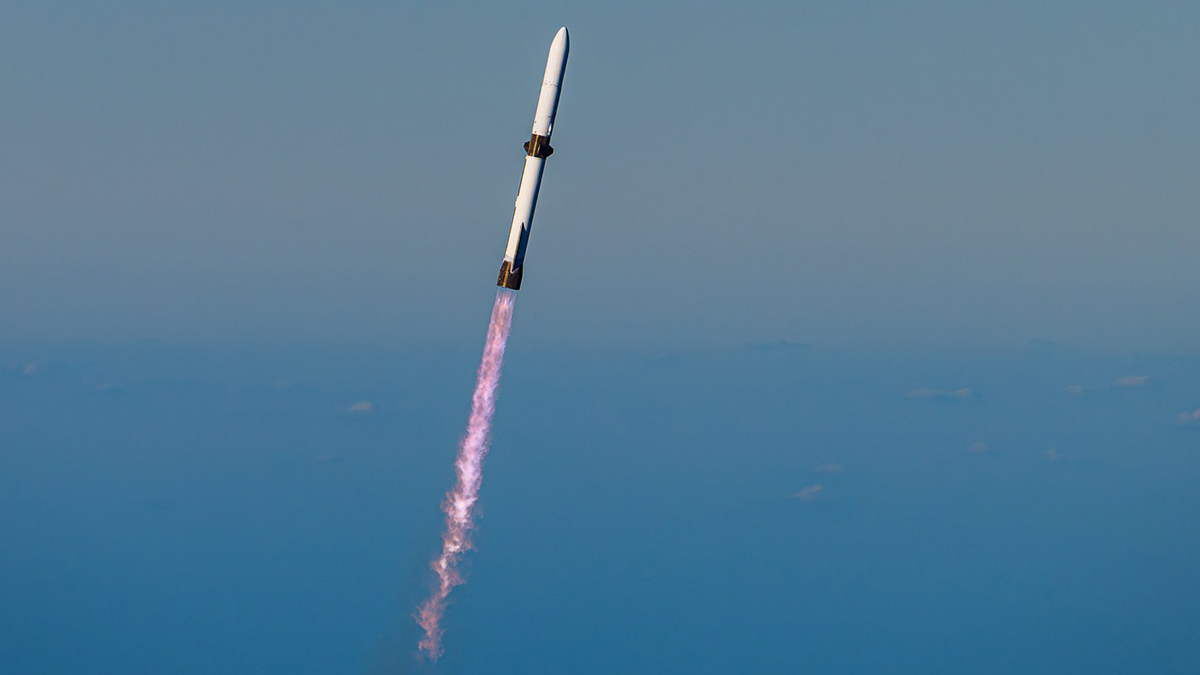
ESCAPADE (Escape and Plasma Acceleration and Dynamics Explorers) is a low-cost NASA mission designed to help scientists understand how Mars lost its atmosphere and water early in its history. It consists of two small, identical spacecraft, Blue and Gold. They were launched on 13 November 2025 and have been in a specially designed “loiter” orbit near Earth since then, waiting until Earth and Mars were aligned.
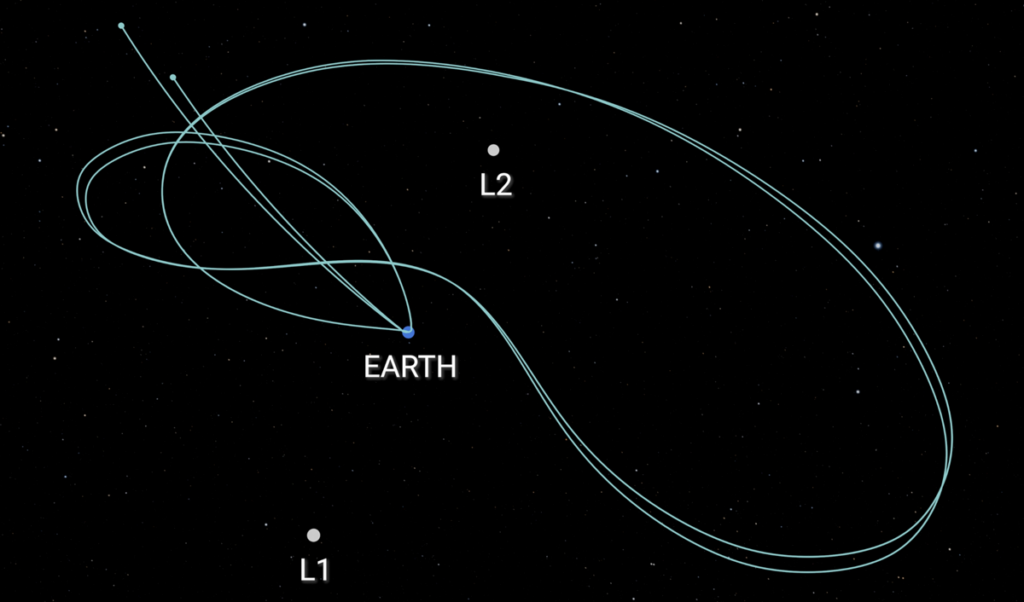
On 7 November, when it is closest to Earth, Blue will fire its engine for 9.5 minutes, then receive an additional boost from Earth’s gravity to propel it toward Mars. Gold will conduct the same maneuver 2 days later.
Their path to Mars was circuitous even before they blasted into space. ESCAPADE was supposed to share a ride into space with NASA’s Psyche asteroid mission in 2022, which would have sent the twins directly to Mars. When Psyche was switched to a different launch vehicle, ESCAPADE was moved to the first flight of Blue Origin’s New Glenn booster, but technical issues scuttled that plan as well.
“Fortunately, we have an incredible team,” said Shannon Curry, the mission’s project scientist and an associate professor of astrophysics and planetary science at the University of Colorado Boulder. “They sat down, sharpened their pencils, and worked out a way to make it happen.”
After launch on the second New Glenn booster, their plan put the probes into a wide, looping kidney-shaped orbit around L2, the second Earth-Sun Lagrange point, where the gravitational pulls of Earth and the Sun are balanced. L2 is roughly 1.5 million kilometers from Earth, in the opposite direction from the Sun.
Getting a Bonus
“The most exciting thing is they transited through Earth’s distant magnetotail—a never-before-explored region. They got a unique set of observations that will be discovery-level science.”
The revised mission plan has provided some bonus science, said Robert Lillis, ESCAPADE’s principal investigator and associate director of the Space Sciences Laboratory at the University of California, Berkeley. “The most exciting thing is they transited through Earth’s distant magnetotail—a never-before-explored region,” he said. “They got a unique set of observations that will be discovery-level science.”
Earth’s magnetosphere—the region where our planet’s magnetic field dominates the space environment—is sculpted into a teardrop shape by the solar wind. The tip of the teardrop, the magnetotail, extends millions of kilometers beyond Earth.
ESCAPADE traveled roughly 2 million kilometers into the tail, which is several hundred thousand kilometers farther than any previous mission, according to Lillis.
“With two spacecraft, we’ve been able to analyze and investigate ways in which the solar wind and the interplanetary magnetic field modify and compress and twist Earth’s magnetotail at that distance,” Lillis said. “It’s a very dynamic environment. We’ve been able to constrain its size, its twist, how it tends to shrink when the solar wind pressure is higher. There’s a lot of ongoing analysis.”
The probes’ instruments, which measure magnetic fields, charged particles, and the Sun’s extreme-ultraviolet radiation, will operate for most of the cruise to Mars.
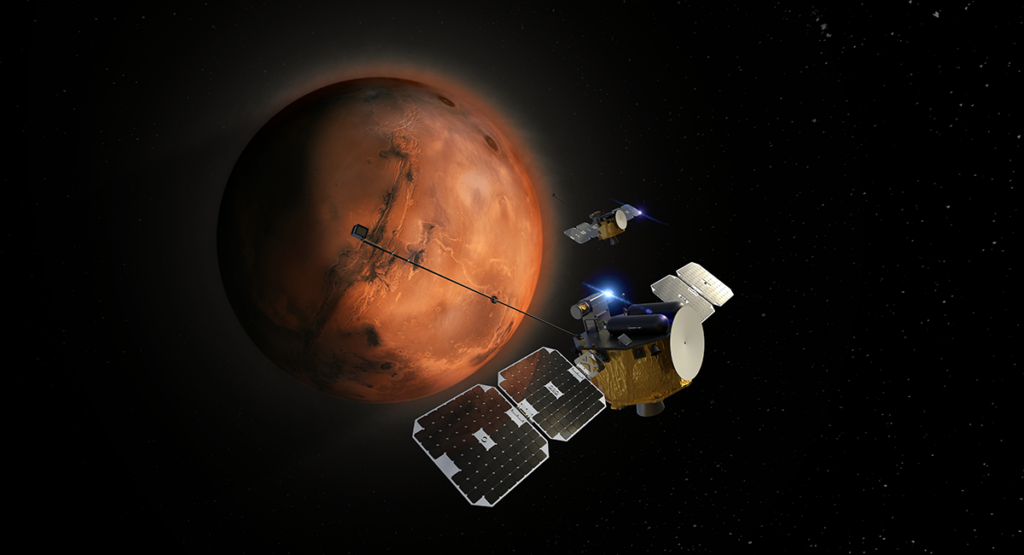
After arrival, the two craft will spend several months refining their orbits. For the initial science campaign, they will use a “string of pearls” alignment, with Blue and Gold following identical elliptical paths. As their distance from Mars varies, the separation between the probes will range from about 2 to 30 minutes.
Martian Time Machine
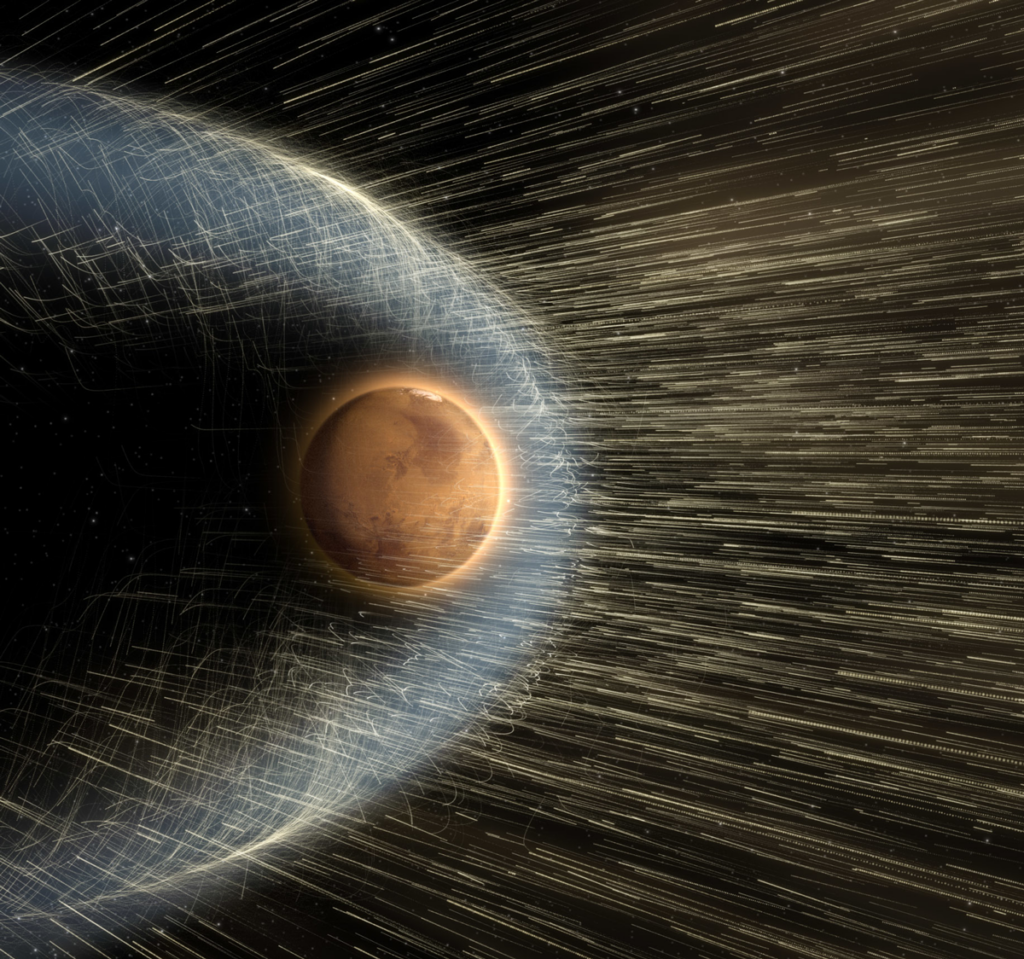
Mars was much warmer and wetter in the distant past, suggesting it might once have been a comfortable abode for life. But it lost most of its atmosphere and surface water billions of years ago. Scientists say much of the loss came as the interior dynamo that created the planet’s global magnetic field shut down. Without a strong field to deflect them, solar particles steadily stripped material from the top of the atmosphere.
ESCAPADE’s dual spacecraft will allow scientists to monitor that process in real time, which they haven’t been able to do with previous missions. “With a single spacecraft, we could only see changes in the magnetic field over timescales of a few hours [the craft’s orbital period],” Lillis said. “Now we’ll have a unique opportunity to understand how this system varies on a range of timescales that we’ve never investigated before.”
After about 6 months, Blue and Gold will shift altitudes, so the gap between them will widen. “I think of it as having one spacecraft ahead of the planet, where it can see the Sun and solar inputs, and the other behind, measuring the response of Mars’s atmosphere and its magnetosphere at the same time,” Curry said. “It’s the first time we can see this response in real time.”
The combination should reveal new insights into how space weather is depleting the Martian atmosphere today, which can be used to better constrain atmospheric loss in the distant past, Curry said.
“This is a huge piece of the puzzle when we think about Mars habitability.”
ESCAPADE’s dual measurements will be especially helpful during solar storms. “We think solar storms were one of the main drivers of atmospheric erosion around three to three-and-a-half billion years ago, when the Sun was more active and had more storms,” Curry said.
“By measuring these storms in real time for the first time, we can see what a storm looks like and, at the same moment, how the atmosphere is escaping—how these particles are being accelerated away from the planet.…So if we can understand what’s driving atmospheric escape today, we can look back in time and start to get a better understanding of how the atmosphere eroded and where all the water went. So this is a huge piece of the puzzle when we think about Mars habitability.”
—Damond Benningfield, Science Writer