

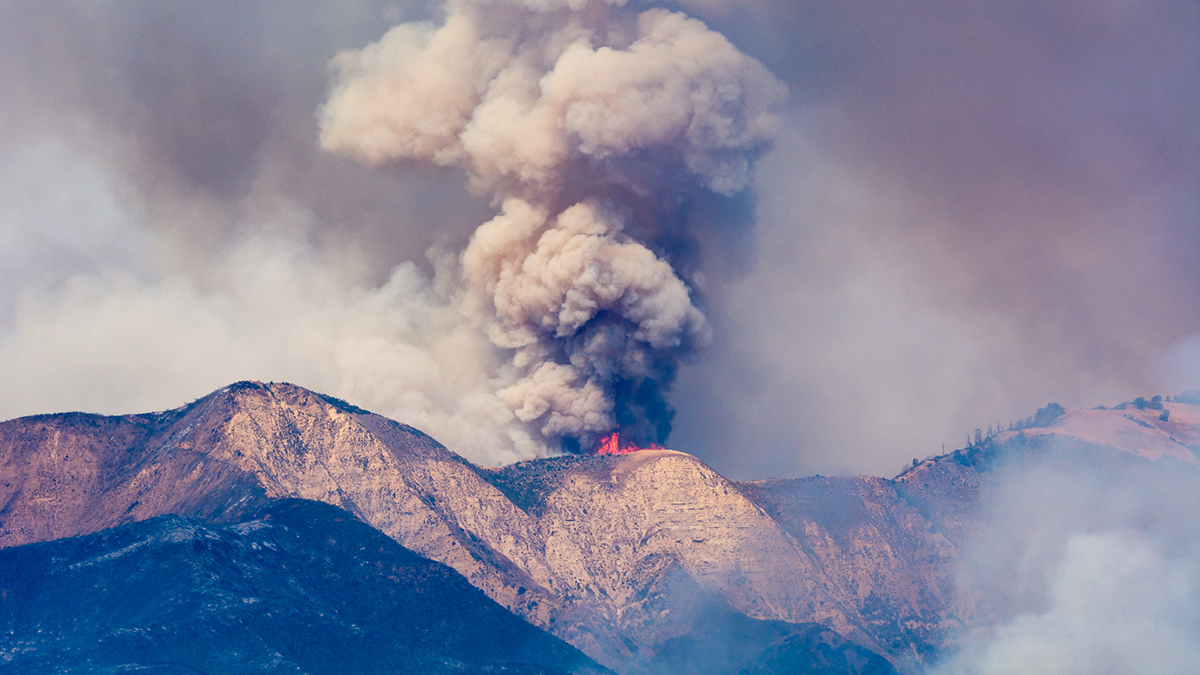
Smoke from wildfires may be responsible for 17,000 strokes each year in the United States, new research suggests.
The study, published in European Heart Journal, examined various sources of particulate matter smaller than 2.5 micrometers in diameter (about 30 times smaller than the width of a human hair). Also known as PM2.5, such particles are so small that they can be inhaled and enter the bloodstream, where they have been linked to an array of health effects, including decreased lung function, cardiovascular diseases, and even neurological disorders. But the new study seems to indicate that PM2.5 from wildfires is particularly harmful.
Scientists examined a cohort of about 25 million people over the age of 65 who were covered by Medicare, a federal health insurance program. Between 2007 and 2018, about 2.9 million of those people experienced a stroke. The researchers calculated the average amount of wildfire smoke, as well as nonsmoke PM2.5, that each study participant was exposed to over the course of each year on the basis of participants’ zip codes.
“The longer you’re exposed to smoke, the greater your stroke risk.”
After 1, 2, or 3 years of exposure to nonsmoke PM2.5, the participants’ risk of stroke didn’t change much.
“But for smoke, this picture is very different,” said Yang Liu, a health and environmental scientist at Emory University and corresponding author of the paper. “It’s like you are seeing some kind of a dose-response effect: The longer you’re exposed to smoke, the greater your stroke risk.”
More specifically, the study found that an increase of 1 microgram per cubic meter in the average concentration of wildfire smoke was associated with a 1.3% increase in stroke risk. Researchers found that Medicaid-eligible individuals (those who qualify for the program have limited income and resources) were especially vulnerable to the effects of wildfire smoke.
Unique Harms of Wildfire Smoke
The researchers input air quality data from several sources, including satellites, ground-based air monitors, and low-cost sensors such as PurpleAir devices, into a machine learning framework. The framework was used to estimate the daily wildfire smoke PM2.5 and nonsmoke PM2.5 concentrations across the contiguous United States at a 1-kilometer resolution. The team then used this information to calculate the average exposure rates within each zip code over 1, 2, and 3 years.
Their model and subsequent analyses of the findings were also designed to control for other factors that could affect stroke risk, including meteorology (extreme heat can increase stroke risk), access to care, Medicaid eligibility, and substance abuse disorders.
Jennifer Stowell, a geohealth scientist at the University of Maryland, said this was an “important” study.
“I really like where this paper has gone because they’ve characterized exposure slightly differently,” she said. “Rather than looking at more acute exposure, they looked at up to 3 years of exposure prior to a stroke. Also, other studies, for the most part, rely on emergency department data. So the fact that this is data in addition to that, from doctors’ offices and all sorts of things, is a big plus.”
The study did not establish the reason for the link between wildfire smoke exposure and stroke risk, but previous studies have suggested that inhaling pollutants can cause oxidative stress that affects the function of the endothelial cells (those lining the blood and lymphatic vessels) and of the cardiovascular system as a whole.
The study’s findings are also in line with previous research: A 2021 study suggested that PM2.5 from wildfires is up to 10 times more harmful than PM2.5 from other sources, such as ambient pollution.
“It all comes down to what [materials] wildfires are burning,” Stowell said. “There is a lot of organic matter, chemicals, and particles that we don’t normally see in air pollution from traffic or from industry that can be emitted during a fire. This is especially true if that fire burns any sort of man-made structures. Then, you start getting some highly toxic, synthetic emissions that we don’t normally breathe.”
Only a Small Part of the Picture
In a world where wildfires are growing both more frequent and more severe, Liu said he hopes a study like this will help guide future research, noting the importance of a large-scale epidemiological study to complement lab-based research.
“Policymakers can look at the disease burden numbers and say, ‘Wow, it may be worthwhile to spend more money on firefighting, or forest management, because it’s a huge disease burden.’”
“I think its real burden is going to be much, much larger than what we show in this paper.”
Liu said he wasn’t at all surprised by his team’s findings because stroke is only one part of the overall picture of how smoke affects overall health.
“I think its real burden is going to be much, much larger than what we show in this paper,” Liu said. In fact, he noted that the study focuses only on the fee-for-service Medicare population and doesn’t account for the more than 40% of the Medicare population enrolled in private insurance.
“So even for the overall Medicare population, or just the elderly population in the U.S., we are underreporting the burden, maybe by half,” he said.
—Emily Gardner (@emfurd.bsky.social), Associate Editor