
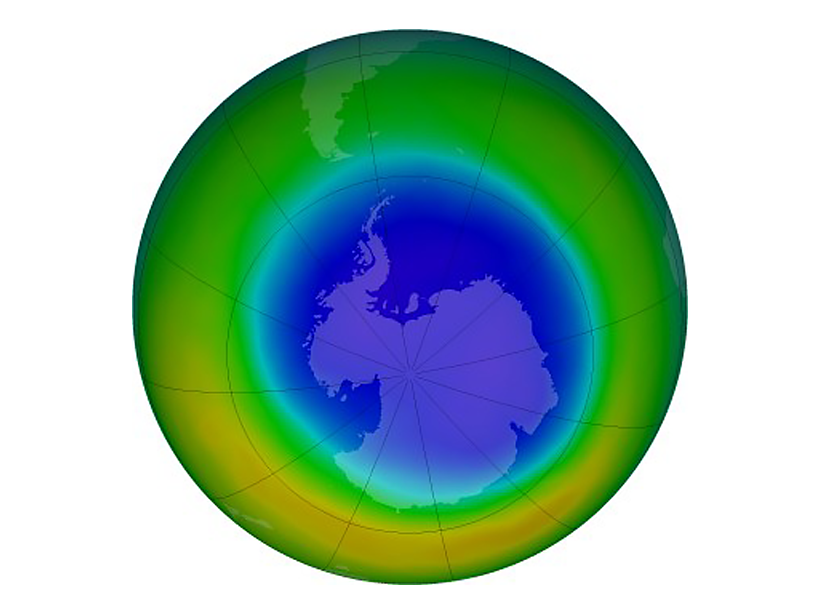

The ozone hole over Antarctica has shrunk by 16% since its peak in 2000, and some suspect it may disappear entirely by midcentury.
CC BY-NC-ND 2016

Posted inResearch Spotlights
What Causes Heavy Rainfall?
Scientists investigate atmospheric conditions that correlate to heavy rainfall in the midlatitudes.

Posted inNews
Academy Head Says Political Rancor Harms Science, Society

The retiring National Academy of Sciences president says allegations that climate change is a fraud are deeply upsetting. But he hopes rabid partisanship can be eased.
Posted inNews
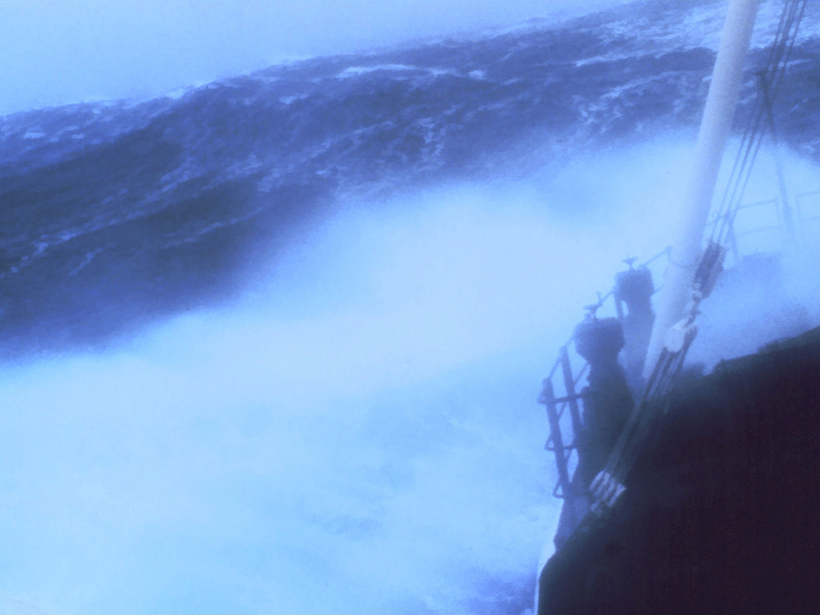
Model Predicts Heights of Rogue Waves

Rogue waves form without warning and can tower more than 25 meters high. A new mathematical approach shows promise at simulating how high these waves can be.

Posted inResearch Spotlights
Novel Technique Finds New Features Under United States

A new high-fidelity tomography harnesses USArray data to expose a wealth of noteworthy crustal and upper mantle structures, including previously unknown anomalies beneath the Appalachians.
Posted inNews
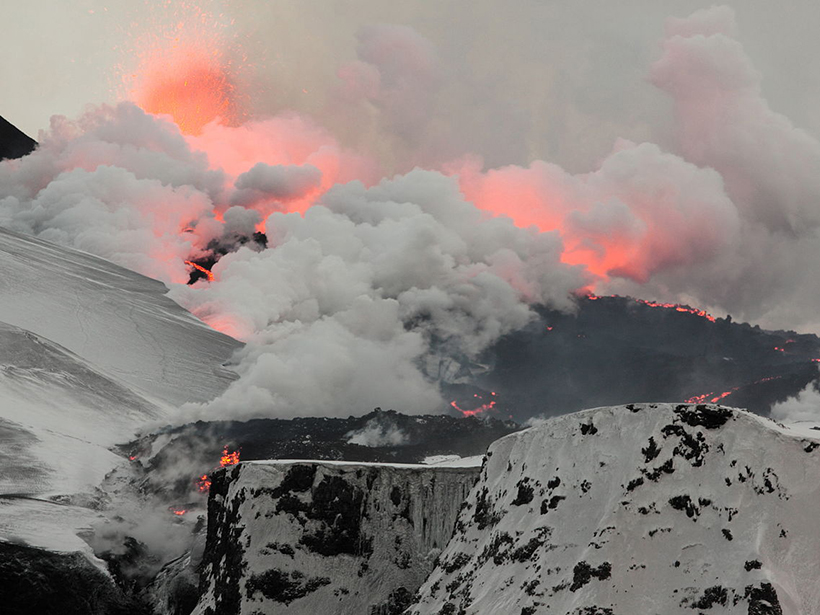
Eyjafjallajökull Gave Lava and Ice Researchers an Eyeful

New insights from the 2010 eruption may help volcanologists determine how glaciers shaped ancient lava flows.

Posted inResearch Spotlights
A River Network Preserved Beneath the Greenland Ice Sheet
An ancient drainage basin covering one fifth of Greenland predates the ice sheet and strongly influences the modern Jakobshavn Glacier, according to a new analysis of ice-penetrating radar data.
Posted inResearch Spotlights
Insights into Long-Standing Bias in Cloud Property Retrieval
A new framework provides a more comprehensive view of how subpixel variations can create biases in a commonly used method of analyzing cloud properties with satellites.

Posted inAGU News
2016 AGU Section and Focus Group Awardees and Named Lecturers

The American Geophysical Union recognizes outstanding scientists in Earth and space sciences ranging from biogeosciences to space physics to volcanology.