
Editors’ Vox is a blog from AGU’s Publications Department.
Advancing our understanding of climate change and its impacts requires a multidisciplinary effort to generate, evaluate, and integrate reliable climate records at appropriate spatiotemporal scales. Reliable and traceable climate observations are essential for evidence-based climate governance.
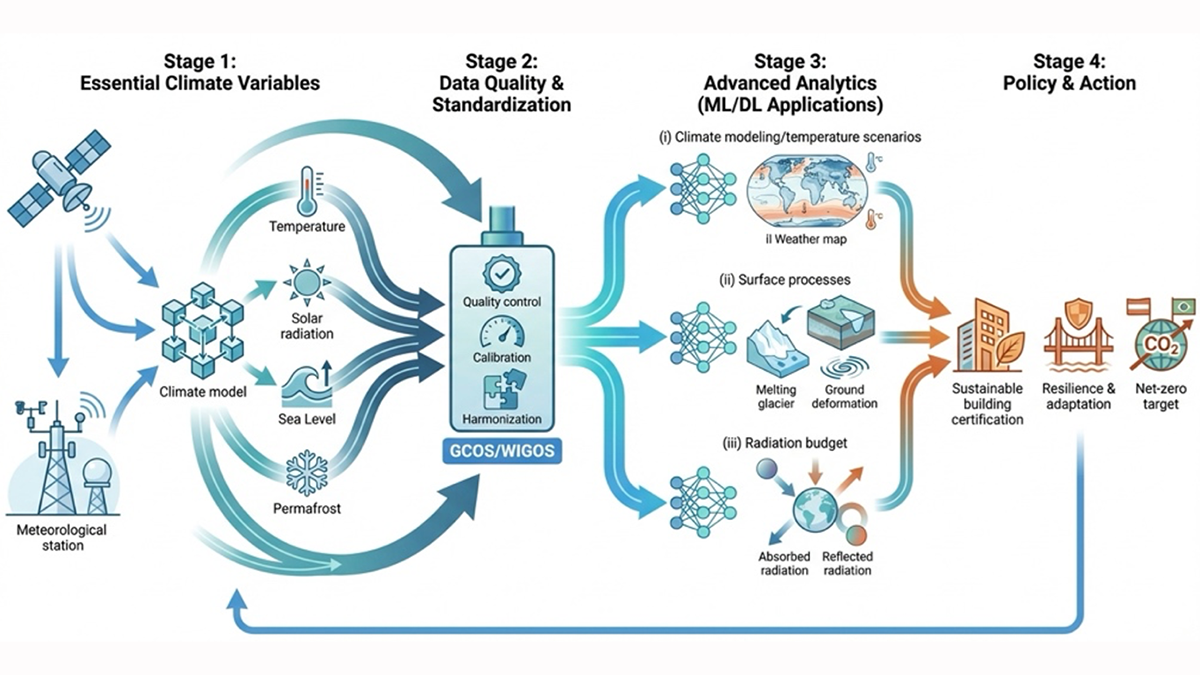
Essential Climate Variables (ECVs) serve as the foundation for monitoring the Earth system. For instance, ECVs such as the Earth Radiation Budget and Total Solar Irradiance (TSI) provide critical information on energy exchanges within the Earth system, underpinning assessments of long-term variability and anthropogenic influences.
These variables are estimated from satellites, ground networks, and models, producing vast datasets whose usefulness depends not on size, but on quality, consistency, and careful integration. As measurement coverage is uneven, instruments differ in calibration, and techniques can yield conflicting results. Thus, transforming raw data into reliable information requires rigorous quality control and collaboration across scientific and technical disciplines.
International frameworks such as the WMO Integrated Global Observing System (WIGOS) set standards for measurement, documentation, uncertainty reporting, and open data sharing. These systems promote traceability and reliability—ensuring the ability to track how each data point was produced and processed—so that scientists can reproduce analyses and policymakers can trust the results. In addition, emerging approaches, including physics-informed Machine Learning (ML) and Deep Learning (DL), enable enhanced detection of patterns, anomaly identification, and quality control in large, heterogeneous datasets. Thereby they are strengthening the role of ECVs in monitoring system integrity.
Moreover, geodetic observations of sea-level rise, cryospheric changes, and solid Earth deformation illustrate the key role of multidisciplinary ECV analysis. By providing a holistic understanding of environmental change, these data streams are foundational for developing next-generation predictive tools, including Earth’s Digital Twin, to monitor global and local dynamics.
In this context, the Global Climate Observing System (GCOS) plays a key role by fostering global collaboration to develop interdisciplinary ECVs that are traceable and reliable. GCOS supports efforts to advance climate science by ensuring high-quality data, which is vital for informed climate action and adaptive policy development. Through innovation and interdisciplinary approaches, this framework enables more effective responses to the challenges posed by climate change.
This special collection serves as a venue for contributions that shed light on the role of continuous monitoring of ECVs, coupled with rigorous quality assurance, as a foundation for policy decisions, ultimately bridging the gap between technical observation and actionable climate governance. We especially welcome novel research that advances the methodologies required to demonstrate how robust, traceable data can empower society to build resilience against a changing climate. Contributions will include (but not be limited to) research into: best practices in observation, collection, and processing and curation of data. It can also include physics-informed machine and deep learning methods to identify relationships and feedback loops between atmosphere, hydrosphere, biosphere, and lithosphere, as well as evidence-based policies and remediation measures.
This is a joint special collection between Earth and Space Science, JGR: Machine and Computation, and Earth’s Future. Manuscripts can be submitted to any of these journals depending on their fit with each journal aims and scope. Submissions are now open and welcome until 7 March 2027.
—Jean-Philippe Montillet ([email protected],  0000-0001-7439-7862), Physikalisch-Meteorologisches Observatorium Davos World Radiation Center, Switzerland; Graziella Caprarelli ([email protected], 0000-0001-9578-3228), University of Southern Queensland, Australia; Gaël Kermarrec (0000-0001-5986-5269), Leibniz Universitat Hannover, Germany; CK Shum (0000-0001-9378-4067), Ohio State University, United States; Ehsan Forootan (0000-0003-3055-041X), Aalborg University, Denmark; Jan Sedlacek (0000-0002-6742-9130), Physikalisch-Meteorologisches Observatorium Davos World Radiation Center, Switzerland; Elizabeth Weatherhead (0000-0002-9252-4228), University of Colorado at Boulder, United States; Orhan Akyilmaz (0000-0002-8499-2654), Istanbul Technical University, Turkey; Wolfgang Finsterle (0000-0002-6672-7523), Physikalisch-Meteorologisches Observatorium Davos World Radiation Center, Switzerland; Yu Zhang, Ohio University, United States; Enrico Camporeale (0000-0002-7862-6383), University of Colorado Boulder, United States; and Kelly K. Caylor (0000-0002-6466-6448), University of California, Santa Barbara, United States