
Editors’ Highlights are summaries of recent papers by AGU’s journal editors.
Source: AGU Advances
Machine learning (ML)-based models hold great potential to enhance and perhaps transform simulations of the Earth’s weather and climate across the range from synoptic to seasonal to annual to multi-decadal time scales. However, ML-based models should also produce results consistent with the physical laws of the Earth system. While ML-based models have been tested for weather forecasting, it remains uncertain whether they can produce reasonable responses in long-term simulations under forcings relevant across weather to climate time scales. Therefore, it is essential to perform a broad evaluation across different timescales. In addition, it is important to understand how well the emergent ML techniques can complement conventional physics-based models.
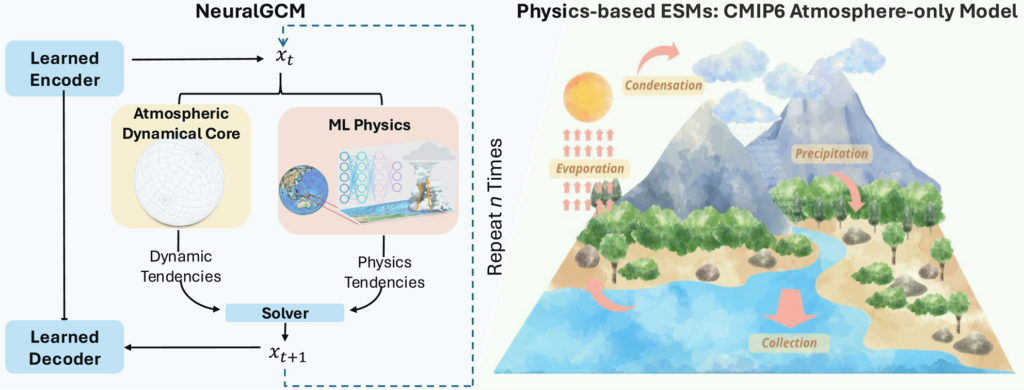
Chen et al. [2026] perform a series of tests that cover systems at the synoptic scale, interannual scale, and under long-term out-of-distribution forcings. This study uses a hybrid model called NeuralGCM, which combines traditional Earth system modeling with ML approaches. For a set of idealized experiments, NeuralGCM produces performs similarly to conventional physics-based Earth system models. However, some limitations were found in simulating extratropical cyclone strength, atmospheric wave responses, and stratospheric warming and circulation responses. In general, the combination of ML with established physics-based modeling represents a promising path forward in achieving weather and climate analyses that require less computing time.
Citation: Chen, Z., Leung, L. R., Zhou, W., Lu, J., Lubis, S. W., Liu, Y., et al. (2026). Hierarchical testing of a hybrid machine learning-physics global atmosphere model. AGU Advances, 7, e2025AV002075. https://doi.org/10.1029/2025AV002075
—Don Wuebbles, Editor, AGU Advances