
Editors’ Highlights are summaries of recent papers by AGU’s journal editors.
Source: AGU Advances
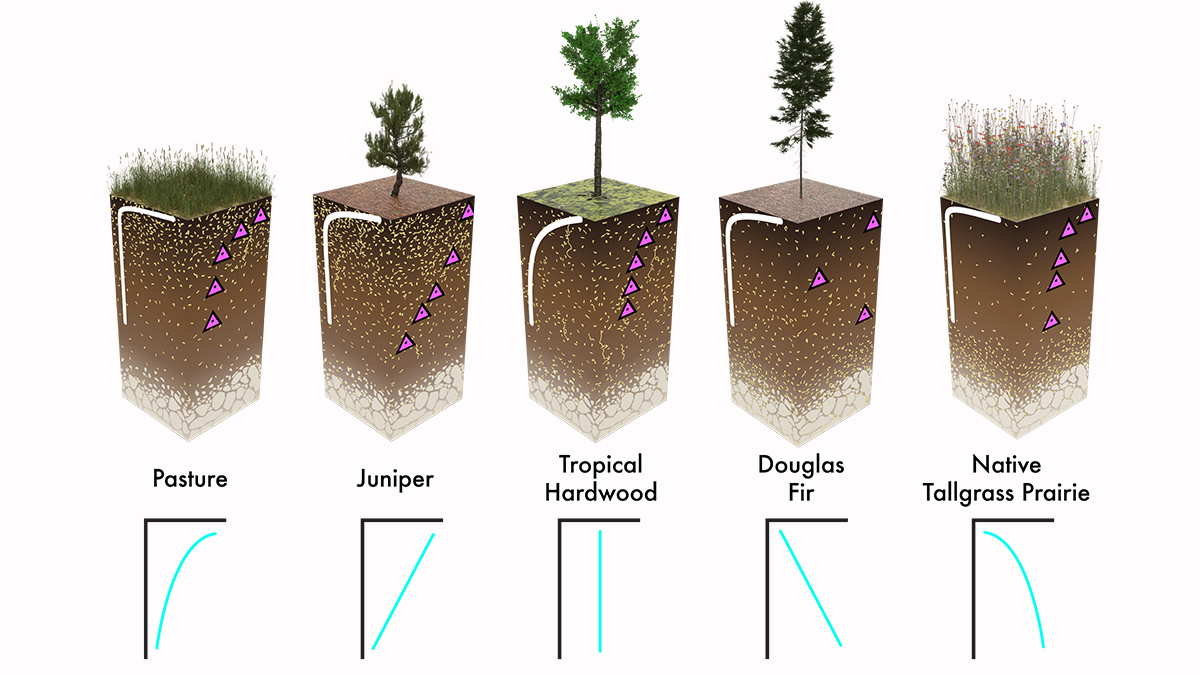
Roots are essential plant organs responsible for the uptake of water and nutrients from soil. However, they are largely hidden from view and notoriously hard to quantify. Roots are often quantified by their mass distribution with depth, which involves separating and weighing roots having a variety of diameters below a cutoff (often 2 millimeters). However, this approach emphasizes the largest roots that contain most of the mass, while the very fine roots with little mass are responsible for most of the biogeochemical functioning.
Billings et al. [2025] have developed a relatively simple method for estimating the volume of soil interacting with fine and coarser roots, by quantifying root abundance instead of mass. They show that the abundance of fine roots does not decline as fast as overall root mass with increasing soil depth. Their results upend the standard paradigm of exponential decline in root functions set by root mass measurements and indicate a new paradigm is needed that links fine-root depth distributions with their hydrological, geochemical and ecological functions.
Citation: Billings, S. A., Sullivan, P. L., Li, L., Hirmas, D. R., Nippert, J. B., Ajami, H., et al. (2025). Contrasting depth dependencies of plant root presence and mass across biomes underscore prolific root-regolith interactions. AGU Advances, 6, e2025AV002072. https://doi.org/10.1029/2025AV002072
—Susan Trumbore, Editor, AGU Advances