
Editors’ Highlights are summaries of recent papers by AGU’s journal editors.
Source: Geophysical Research Letters
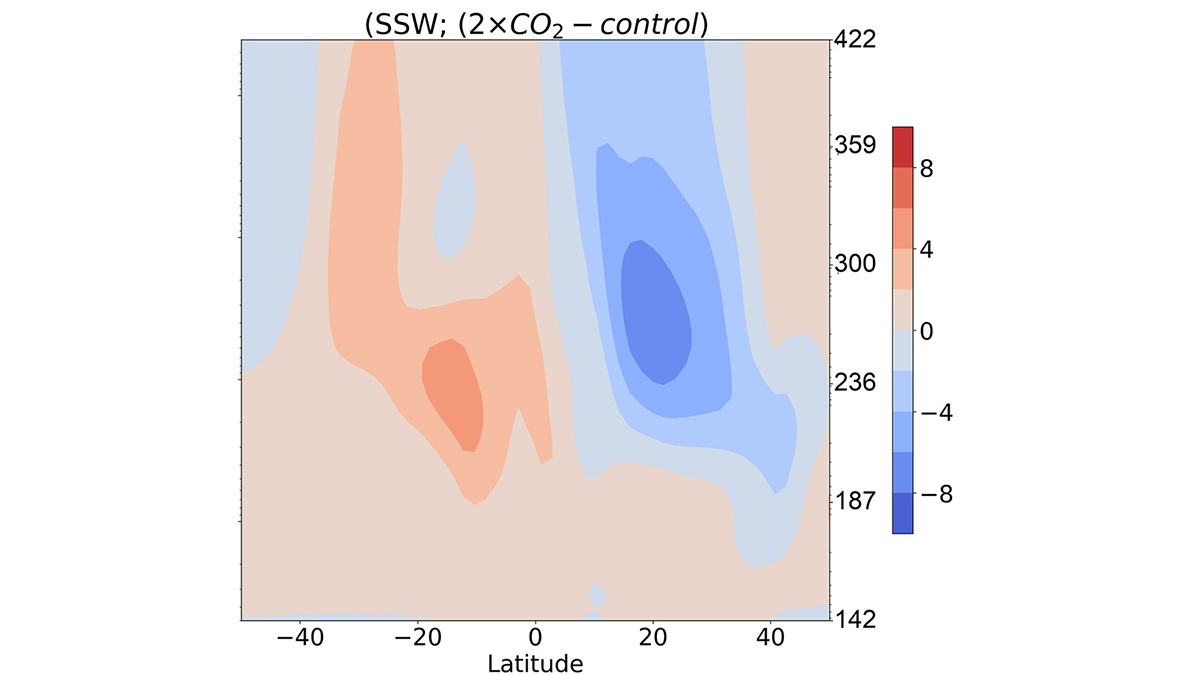
Rising atmospheric carbon dioxide (CO₂) is cooling the upper atmosphere, but it is also changing how the atmosphere responds to natural disturbances. One important example is a sudden stratospheric warming (SSW), a wintertime event that disrupts atmospheric circulation from the stratosphere to the edge of space. Because SSWs can alter the ionosphere, they can affect satellite operations, radio communications, and navigation systems.
Using a whole-atmosphere model, Kumar et al. [2026] investigate how the atmospheric response to strong SSW changes in a future climate with doubled CO₂. They find that CO₂-driven cooling changes upper-atmosphere winds, making the response increasingly different between the Northern and Southern Hemispheres. These changes produce larger hemispheric differences in atmospheric composition and ionospheric plasma density. The study provides new insight into how climate change could influence future space weather and its impacts on modern technology.
Citation: Kumar, S., Oberheide, J., & Martinez, B. C. (2026). Impact of doubled CO2 on the response of the mesosphere, thermosphere, and ionosphere to the 2008–2009 sudden stratospheric warming. Geophysical Research Letters, 53, e2026GL121817. https://doi.org/10.1029/2026GL121817
—Huixin Liu, Editor, Geophysical Research Letters