
Editors’ Highlights are summaries of recent papers by AGU’s journal editors.
Source: AGU Advances
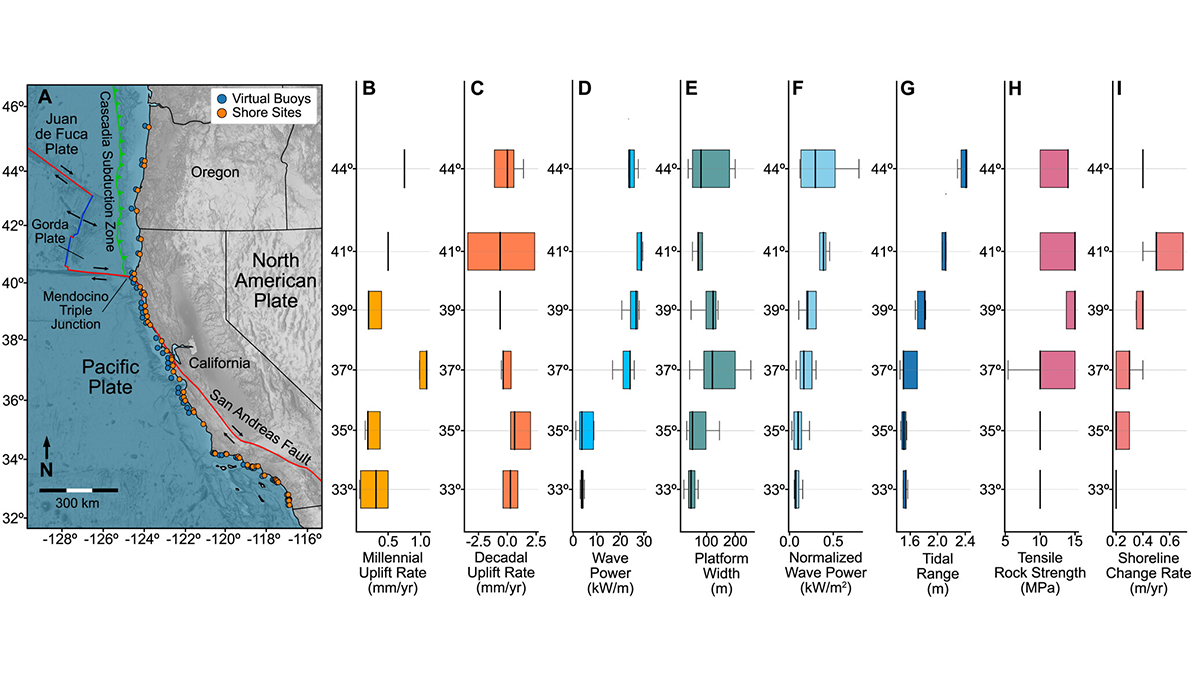
Coastal landscapes evolve under the combined influence of wave action, climatic variations, sea‑level change, and tectonic processes. Shoreline evolution is especially important along rocky coasts such as those of the western United States, where it shapes hazards to people and infrastructure and affects exposure to events like tsunamis. In this context, tectonically driven uplift plays a key role over both individual earthquake cycles and longer timescales associated with fault-system and topographic development.
Using a compilation of coastal change metrics and statistical analyses, Lopez and Masteller [2026] identify a tentative link between tectonics and shoreline change. On decadal timescales, uplift can slow coastline retreat, as might be expected. Over many earthquake cycles, however, higher long-term uplift associated with cumulative subduction-zone deformation appears to enhance shoreline retreat. These findings highlight some of the interactions between coastal and solid earth hazards. They also point toward future models that integrate similar constraints to improve our understanding of how earthquakes build topography and how sea level, coastal processes, and tectonics together modulate short‑ and long‑term coastal risk.
Citation: Lopez, C. G., & Masteller, C. C. (2026). Tectonics as a regulator of shoreline retreat and rocky coast evolution across timescales. AGU Advances, 7, e2025AV002065. https://doi.org/10.1029/2025AV002065
—Thorsten Becker, Editor, AGU Advances