

Editors’ Highlights are summaries of recent papers by AGU’s journal editors.
Source: AGU Advances
The Amazonian forest takes up atmospheric carbon dioxide (CO2), thus helping to buffer the effect of global anthropogenic emissions on climate. As the climate changes, however, this previously reliable carbon sink may be at risk. Extreme weather events, such as the drought of 2023 in the Amazon region, are becoming more common. Although the Amazonian forest is adapted to climatic variation and drought to some extent, severe drought can lead to reduced photosynthesis and greater emissions from fires. Estimating this effect at a scale as large as the Amazon Basin is challenging.
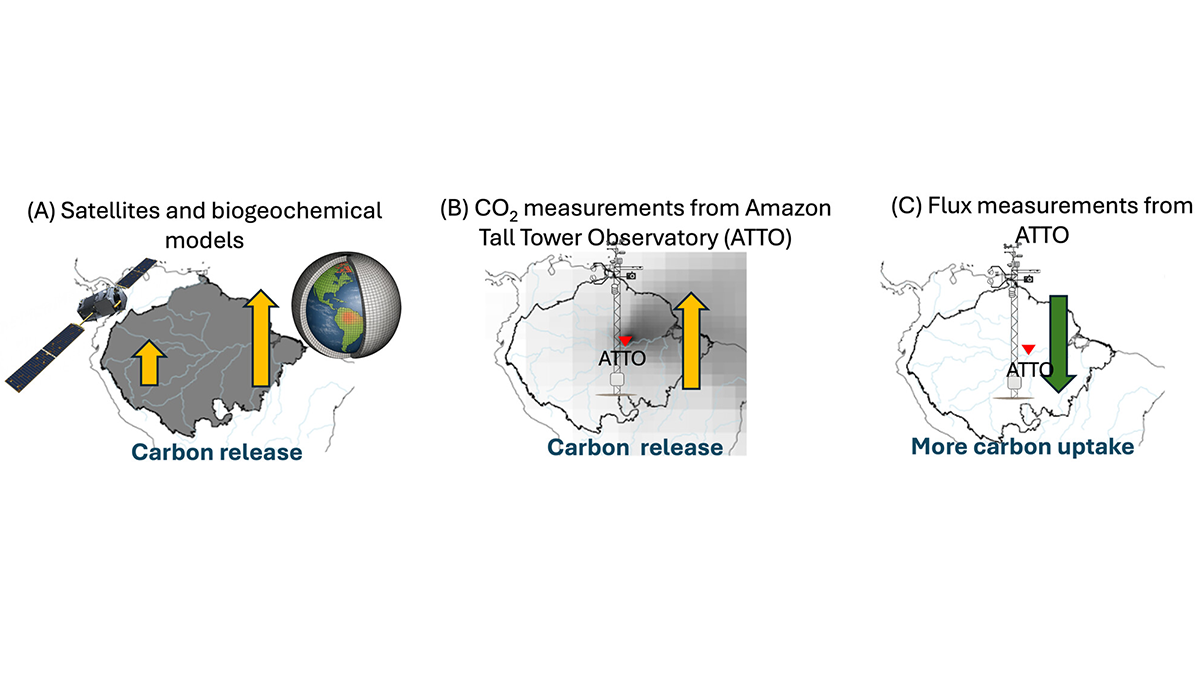
Botía et al. [2026] use multiple approaches that generally show a net release of carbon from the basin during 2023, although there are differences among methodologies. Satellite-based measurements, biogeochemical models, and CO2 concentrations measured at a tall tower indicated a regional net release of carbon, but of varying amounts. A more localized method of tower-based eddy covariance measurements showed a net uptake of CO2, indicating that the local patch of forest was responding differently than the basin-wide estimates. In an accompanying Viewpoint, Liu [2026], these complex responses are nicely explained and summarized by the author.
Citations:
Botía, S., Dias-Júnior, C. Q., Komiya, S., van der Woude, A. M., Terristi, M., de Kok, R. J., et al. (2026). Reduced vegetation uptake during the extreme 2023 drought turns the Amazon into a weak carbon source. AGU Advances, 7, e2025AV001658. https://doi.org/10.1029/2025AV001658
Liu, J. (2026). The growing threat of extreme drought-heat to the Amazon carbon sink. AGU Advances, 7, e2026AV002309. https://doi.org/10.1029/2026AV002309
—Eric Davidson, Editor, AGU Advances
