
Editors’ Highlights are summaries of recent papers by AGU’s journal editors.
Source: AGU Advances
On very large scales, the precipitation response to warming is sometimes summarized as the “wet gets wetter and the dry gets drier.” This wet-gets-wetter response suggests that regions of tropical rainfall contract and intensify with warming. Ample evidence supports this response for the case of the annual-mean thermally driven Hadley circulation, in which moist air ascends near the equator and descends in the subtropics.
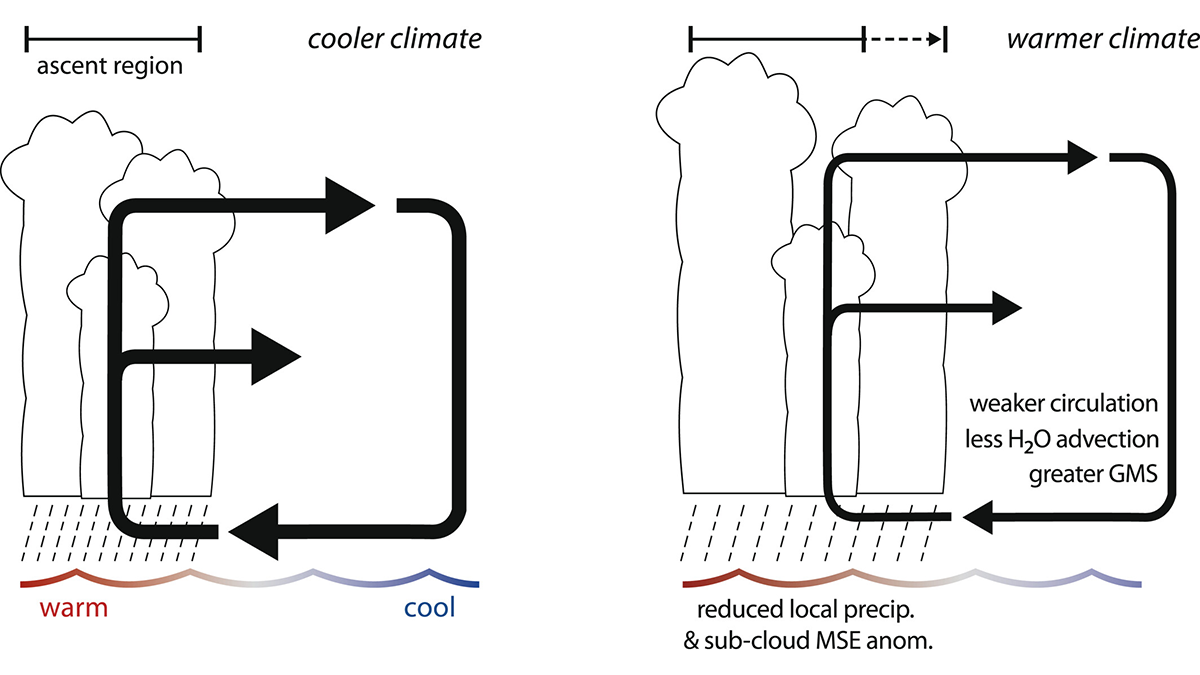
Sokol et al. [2026] test whether this response also applies to east-west overturning circulations, like the Pacific Walker circulation, in which air ascends in the western tropical Pacific and descends in the Eastern Pacific. In their idealized simulations of the Walker circulation, they find the opposite response: rainy regions expand as the surface warms, and the mean rainfall within them decreases, i.e., a “wet-gets-drier” response. They show that this response is driven by a rapid slowdown of the Walker circulation with warming, which is connected to changes in the vertical structure of the circulation.
Citation: Sokol, A. B., Merlis, T. M., & Fueglistaler, S. (2026). No “wet gets wetter” in kilometer-scale mock-Walker circulations. AGU Advances, 7, e2025AV002040. https://doi.org/10.1029/2025AV002040
—Don Wuebbles, Editor, AGU Advances