
Editors’ Highlights are summaries of recent papers by AGU’s journal editors.
Source: AGU Advances
Electrons and ions respond differently to atmospheric winds and to magnetic fields. This generates a large-scale electrical current in the “dynamo” region of the Mars ionosphere, where the electrons preferentially gyrate around the magnetic field while the ions undergo collisions with the neutrals.
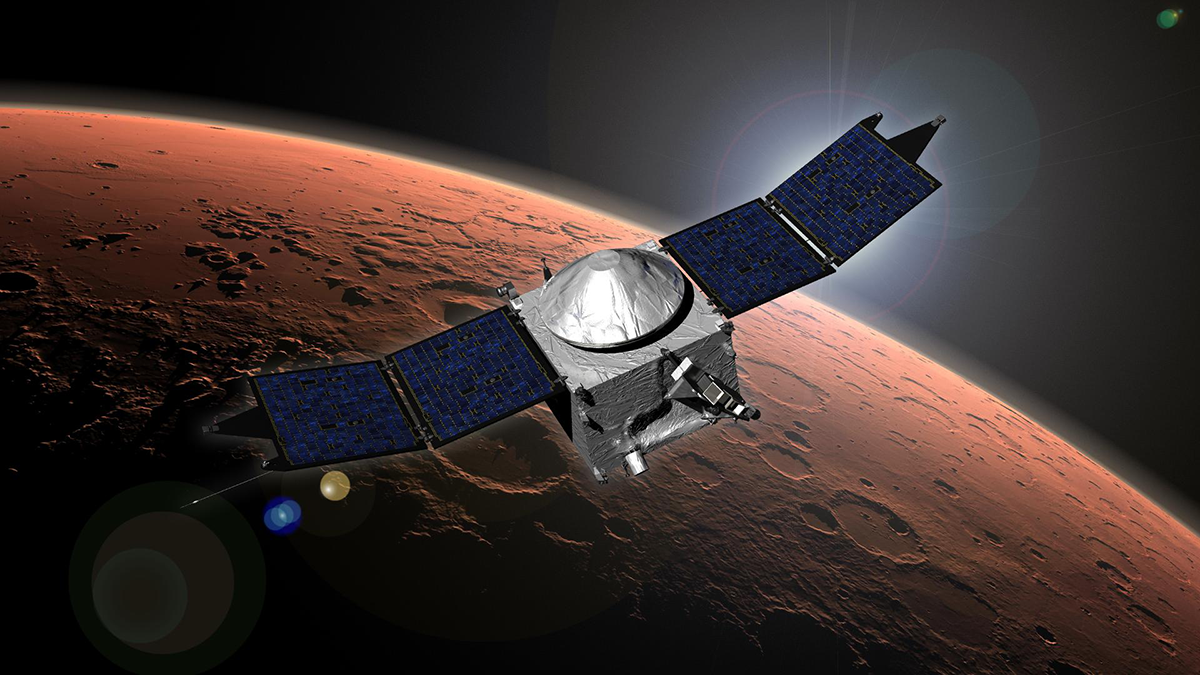
Delcourt and Mittelholz [2026] developed a “Neural-Curlometer” model – a new machine learning (neural network) computer model based on Ampere’s Law and Gauss’s Law, which they apply to analyze the magnetic field resulting from the large-scale dynamo currents and measured onboard NASA’s MAVEN satellite.
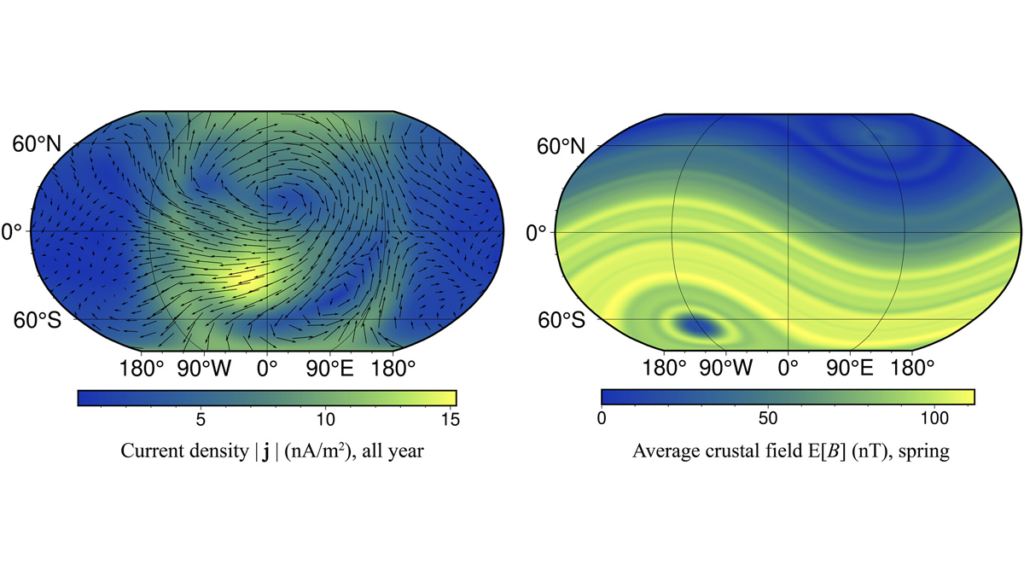
The authors find the reconstructed currents to form a hemispheric, seasonally varying vortex system in the altitude range of 125-220 km, with a transition in direction near 160 km and a correlation in the current density with the crustal magnetic field. Furthermore, the hemispheric vortex pattern is consistent with the predicted atmospheric wind circulation on Mars, as well as the transport driven by the Coriolis force and associated with seasonal CO2 condensation at the poles. The findings provide a data-driven proxy for atmospheric circulation at ionospheric altitudes and potentially serve as important new inputs for Martian general circulation models.
Citation: Delcourt, T. & Mittelholz, A. (2026). Global Circulation of Martian Ionospheric Currents Revealed by Magnetometer Data. AGU Advances, 7, e2026AV002408. https://doi.org/10.1029/2026AV002408
—Andrew Yau, Editor, AGU Advances