
Editors’ Highlights are summaries of recent papers by AGU’s journal editors.
Source: Journal of Geophysical Research: Earth Surface
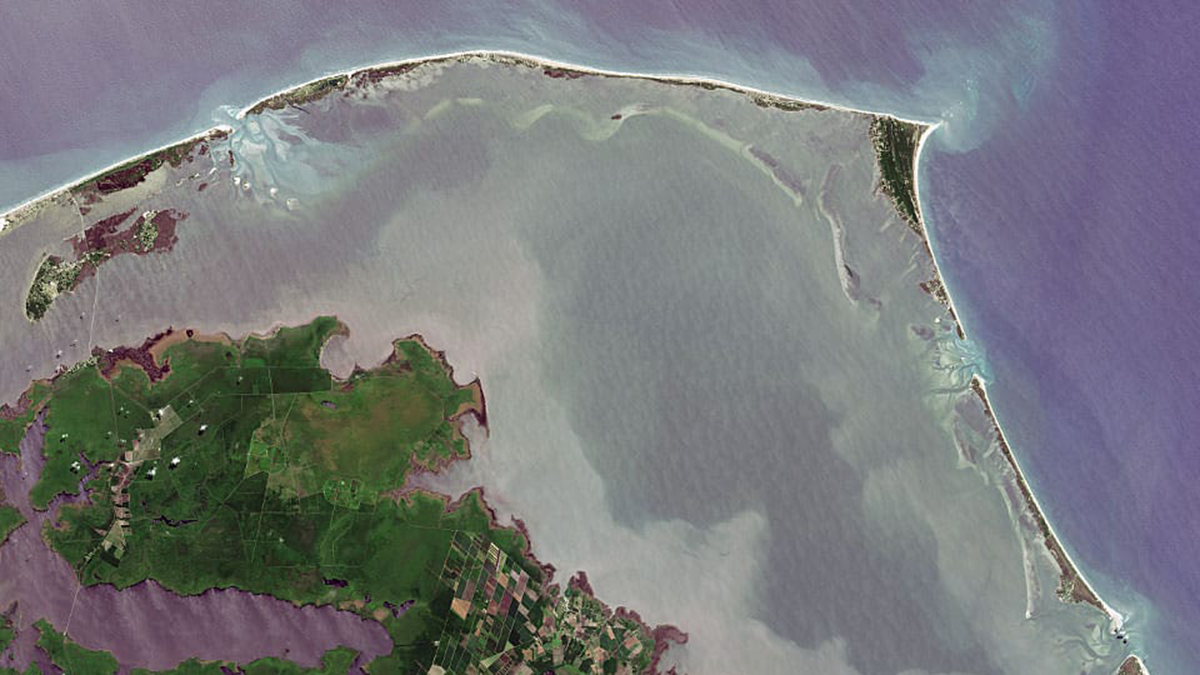
Barrier islands typically form parallel to the coastline, are primarily made of sand, and change shape under the influence of waves and wind. Research has shown that barrier islands can also adjust shape and position when sea level changes, if sea level is not changing too fast. Determining how fast is too fast remains an open problem.
Barrier islands can be schematically divided into three parts. The underwater portion of the island facing the ocean is called shoreface, the emergent part of the island comprises the beach and the dune, and the backbarrier lagoon, which separates the island from the coast. In the presence of rising sea levels, barrier islands tend to migrate landward and increase height to maintain the beach and the dunes above water.
Recent studies have carefully investigated processes and environmental factors that shape the emergent barrier island, such as water and sand movement during storms or due to tides, but shoreface dynamics (what happens under the water) have often been oversimplified. In a new study, Palermo et al. [2025] explore how model predictions of barrier island fate in presence of rising sea levels vary if wave actions and sand transport on the shoreface are explicitly accounted for.
The authors divide the shoreface into two regions: the lower shoreface and the upper shoreface. Flow dynamics and sand transport in these regions are controlled by different interactions between barrier island and waves. Lower shoreface processes depend on wave deformation caused by the reduction in water depth towards the beach. These processes are typically slow and changes in lower shoreline shape are observed at 10s to 1000s of years. Conversely, flow and sediment dynamics on the upper shoreface primarily depend on wave breaking and changes in shoreline change occur from one season to the other or from one year to the next.
With the aid of numerical modeling, the authors demonstrate that the different paces at which upper and lower shoreline shape respond to wave climate plays an important role on barrier island fate in presence of rising sea levels. In particular, the difference between response pace results in slower sediment transport from the lower shoreface to the emergent part of the barrier island. This can reduce predicted barrier island resilience to rising sea levels compared to models that ignore shoreface-wide changes in sediment transport rates and dynamics. Consequently, shoreline processes should be carefully monitored and accounted for to accurately predict barrier island fate and effectively manage costal zones.
Citation: Palermo, R. V., Miselis, J. L., Ciarletta, D. J., & Wei, E. (2025). Modeling the influence of upper and lower shoreface dynamics on barrier island evolution. Journal of Geophysical Research: Earth Surface, 130, e2025JF008391. https://doi.org/10.1029/2025JF008391
—Enrica Viparelli, Associate Editor, JGR: Earth Surface