

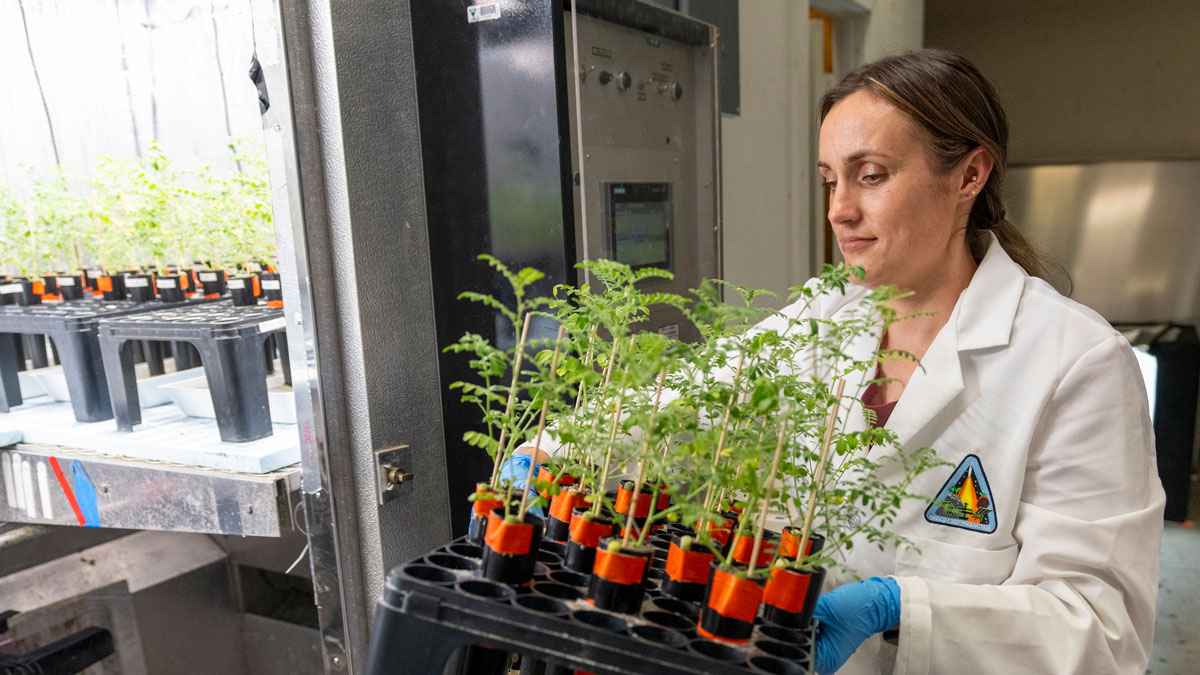

Space biologist Jess Atkin often finds herself talking about The Martian, the movie (based on the book by Andy Weir) in which Matt Damon plays fictional astronaut and botanist Mark Watney, marooned on Mars and surviving on his feces-fertilized potatoes. Though Atkin doesn’t nourish her plants in quite the same way, she does consider how to use microbes to turn lunar regolith into a healthy soil suitable for crops.
Atkin’s interest in plants and the Moon took root during her childhood in Utah. Raised by ranchers, she and her family grew alfalfa for their dairy cows, cultivated orchards, and raced quarter horses. She’d join her grandmother in the greenhouse to grow plants. And every night that she could, she looked to the Moon, talking to the orb the way that only children can.
What is one book, movie, or piece of media about your field you would recommend to young scientists?
“I’d actually recommend A Man on the Moon by Andrew Chaikin. For young scientists, I think it’s important to approach science as something driven by our innate curiosity. This book beautifully captures the wonder of exploring and understanding the Moon. Hands down, one of my favorite books!”
To pay for college, Atkin joined the Air Force. She was deployed to Baghdad during the 2006 surge, where she served in a combat role. “Most people who come back from that come back a little bit changed,” she said. Returning to her family’s ranch to recover, Atkin spent time with a feisty horse whose trust she had to earn. “It brought me back,” she said. After that experience, Atkin became certified in equine therapy to help other veterans.
After 5 years, Atkin decided to attend Texas A&M University, where she pursued a degree in horticulture. Between classes, she continued to provide therapy to veterans and people with disabilities. As she completed her degree in 2021, she began to formulate a plan for her future studies, inspired by what she learned during her undergraduate studies. “Plants don’t grow alone on Earth,” she said. “They grow with microbes.” She realized that microbes might be required to remediate real, toxic lunar regolith.
Unfortunately, no graduate program suitable for Atkin (with nearby ranches to house her horses and pig) had funding for her idea. Undaunted, she set up a grow tent in her living room, obtained some simulated lunar regolith, and began to grow plants and write grants. Around the same time, the first paper came out showing that plants could survive in lunar regolith, which gave Atkin confidence that she was on the right track.
“[The horses] give me roots…I know how they have helped me. So I’ll continue to share that with others for as long as I can.”
Eventually, she found a mentor and adviser at Texas A&M and won a Future Investigators in NASA Earth and Space Science and Technology, or FINESST, award to pursue her research: growing chickpeas in simulated lunar regolith with fungi or bacteria mixed into the soil.
Now she’s on her way to wrapping up her dissertation. “I don’t know what’s next,” she said, but this rancher-therapist-biologist won’t leave her horses behind. Like the microbes that enrich the soil in ways we don’t fully understand, her horses connect with people, no words necessary. “They continue to heal me just about every day,” she said. “They give me roots.”
“I know how they have helped me,” she continued. “So I’ll continue to share that with others for as long as I can.”
—Alka Tripathy-Lang (@dralkatrip.bsky.social), Science Writer
This profile is part of a special series in our August 2026 issue on science careers.