
On 31 March 2026, the U.S. Department of Agriculture announced the closure of 57 of its 77 U.S. Forest Service research facilities. The scientific community’s response was warranted: Save the science, restore the funding, protect the researchers.
All of that is correct. But it misses a structural problem inherent in agency governance, one that will recur at every reorganization until the Earth science community builds an instrument to prevent it.
In massive reorganizations like the ones federal agencies are currently experiencing, the threat to long-term research facilities is not primarily a lack of funding. The true threat is an oversight of administrative architecture. There appears to be no general federal requirement to have a successor stewardship plan in place before reducing the output or outreach of a long-term research facility—or closing it entirely.
The Physical Archive Is Not a Digital File
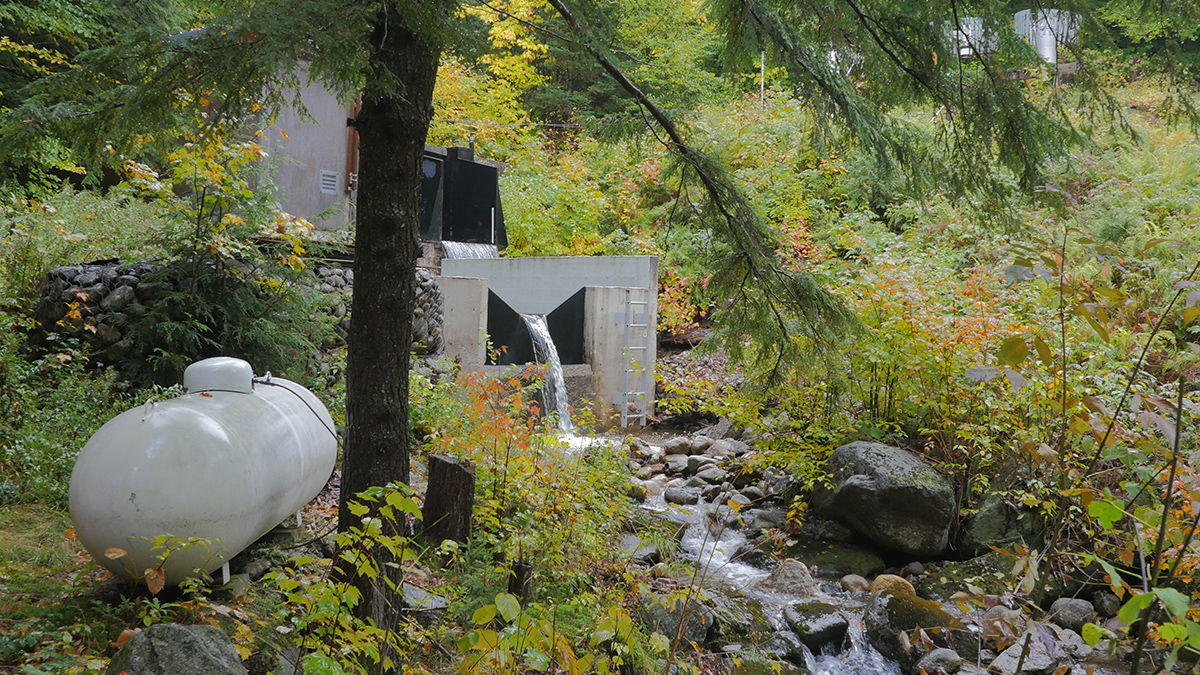
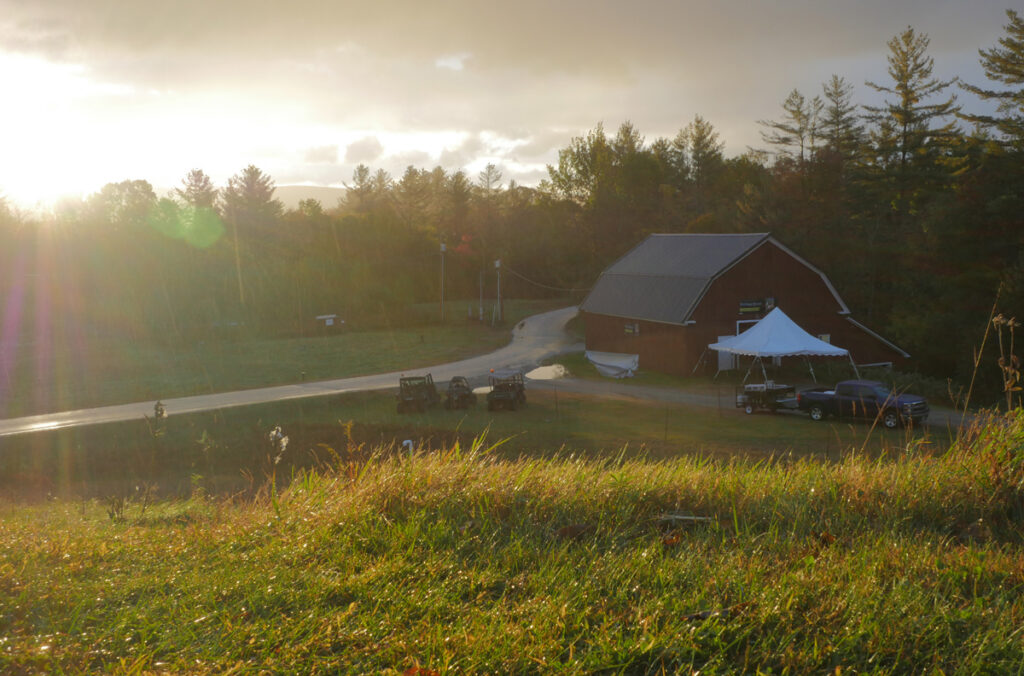
Hubbard Brook Experimental Forest in New Hampshire was among the sites under review during the Forest Service restructuring but has since received a public reprieve. The future of Bartlett Experimental Forest, also in New Hampshire, remains unresolved. The governance problem, however, extends beyond either site.
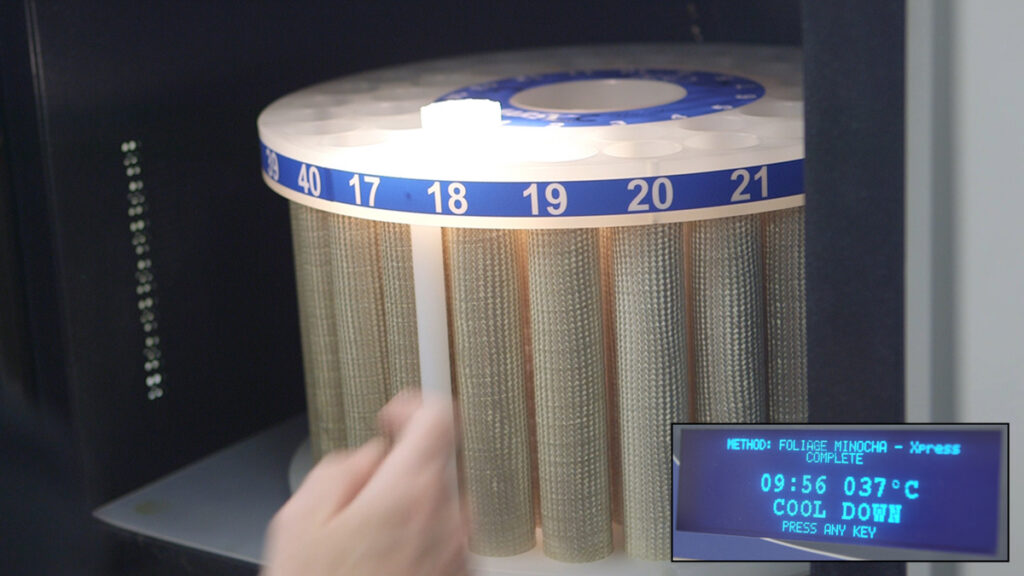
Hubbard Brook’s physical archive holds more than 60,000 barcoded and cataloged samples: water, soils, plant material, and physical cores spanning 7 decades of continuous collection and stored under active environmental controls in a dedicated building on site.
These samples cannot be digitized. They cannot be migrated to a remote server, backed up to cloud storage, or emailed to a university partner. The samples require a functioning building, active temperature management, and a named human steward responsible for their integrity.
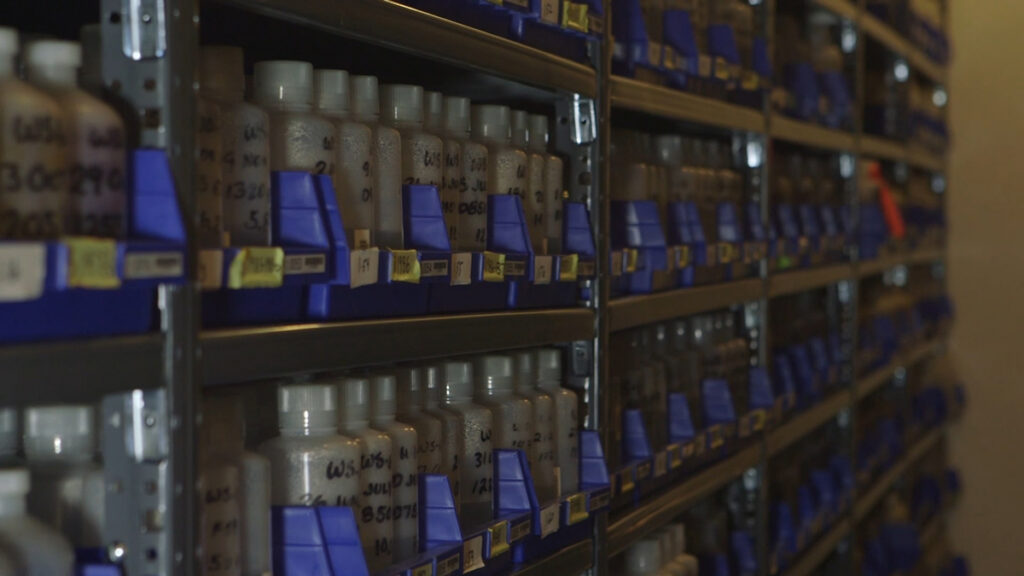
The physical archive at Hubbard Brook holds more than 60,000 barcoded and cataloged samples stretching back to the founding of the facility in 1955. Credit: Anthony Veltri 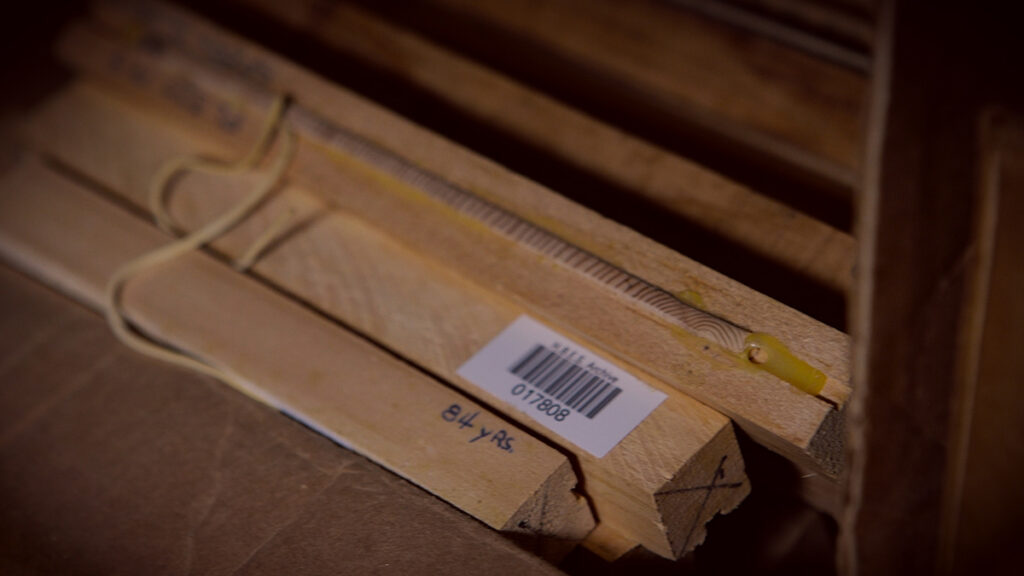
The archive includes core samples of trees dating to long before the experimental forest was established, and the archive maintains each as a managed scientific record with continuity of custody. Credit: Anthony Veltri 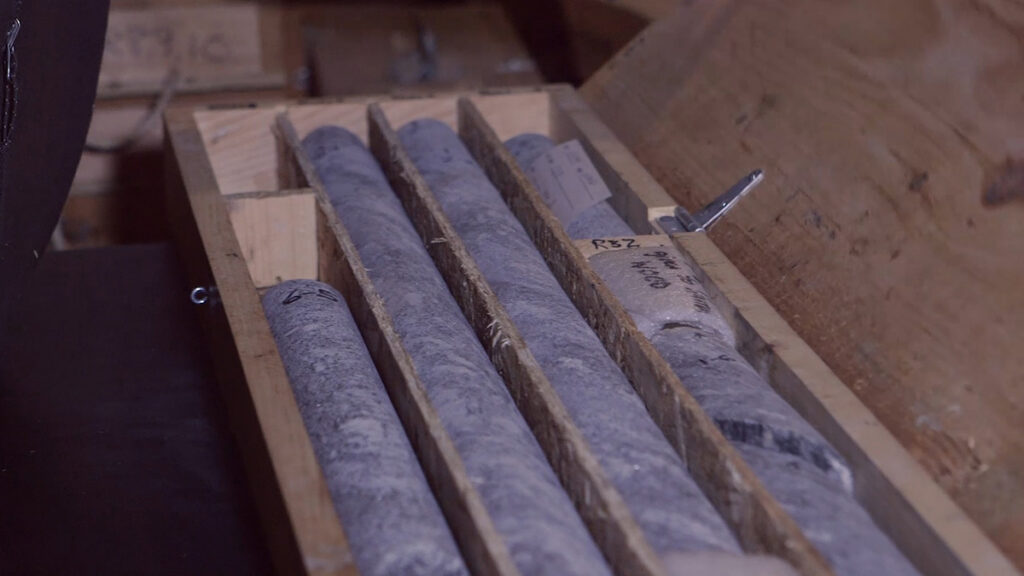
Core samples like these document the watershed at Hubbard Brook and anchor long-term understanding of system processes. Credit: Anthony Veltri
The archive at Hubbard Brook is impressive, but a governed record is defined by continuity, provenance, and stewardship, not by the number of observations it contains: Data volume is not data value. A 70-year unbroken record of watershed chemistry, maintained by named stewards who documented what they were measuring and why, is a governed product. Without that stewardship and physical anchor, volume can become noise.
The failure to maintain archives like this is likely not malicious; it is an example of administrative indifference or perhaps a lack of awareness or understanding. Environmental controls, for example, get zeroed out of a budget line item, and nobody notices until the temperature in the facility drifts. By then, the sample record has degraded in ways that cannot be reversed.
This Is Not a Hubbard Brook Problem
Many physical archives, calibration sites, and long-duration sampling programs operate without a formal requirement for stewardship continuity.
Hubbard Brook is the most visible instance of a pattern—the lack of a successor stewardship plan—that runs across the entire 84-site federal Experimental Forests, Ranges, and Watersheds network. The March order that identified Bartlett Experimental Forest and 56 other research facilities across 31 states for closure was executed without a mandatory requirement to identify successor stewards for what gets left behind.
Nor is the pattern unique to experimental forests. The Long Term Ecological Research network spans 28 core sites. AmeriFlux includes more than 500 monitoring locations across North America.
Throughout all these systems, many physical archives, calibration sites, and long-duration sampling programs operate without a formal requirement for stewardship continuity under agency reorganization.
What We Stand to Lose
Long-term physical archives provide scientists and other stakeholders the ability to ask future questions of past reality. Nobody collecting water samples at Hubbard Brook in 1963 was thinking about PFAS (per- and polyfluoroalkyl substances), for instance, but the baseline its site samples provide is why we can track the chemicals today. The same continuous record was central to the regulatory science behind the Clean Air Act amendments of 1990.
Archival value compounds silently and becomes visible only when someone needs it.
Archival value compounds silently for decades and becomes visible only when someone needs it.
When these archives fail, the loss is not historical. It is operational. Regulatory agencies rely on long-baseline records to determine whether interventions are working. Without a continuous physical reference, observed changes cannot be distinguished from measurement drift, instrumentation bias, or natural variability. The results are policy decisions made without a defensible scientific baseline.
Federal investment in continuous collection at a site like Hubbard Brook runs to tens of millions of dollars over decades. That investment is not recoverable once continuity is broken.
Unlike a paused research grant, a degraded physical archive cannot be restarted. You can photograph a sample, but you cannot rerun its chemistry 40 years from now if the physical sample has degraded.
In 2017, a double mechanical failure at the University of Alberta destroyed 12.8% of the Canadian Ice Core Archive over a single weekend, permanently erasing records dating back 12,000 years. That incident was accidental. A mechanical malfunction is a failure of equipment. Administrative disposal without a named successor steward is a failure of governance. One arrives without warning. The other can be prevented.
The Community Already Knows How to Do This
The Earth observation community has already built the governance model we need. We are not yet applying it to long-term ecological research infrastructure.
GRUAN, the Global Climate Observing System (GCOS) Reference Upper-Air Network, operates under the World Meteorological Organization and GCOS, with explicit named stewardship obligations. Upper-air observations—measurements of temperature, humidity, and wind through the atmosphere—are foundational inputs to weather forecasting and climate monitoring. Each GRUAN station has a designated principal investigator with a documented succession obligation.
ICOS, the Integrated Carbon Observation System operating across Europe, applies the same logic to terrestrial ecosystem observations through formal site-level stewardship agreements and named succession requirements.
In the United States, the National Ecological Observatory Network is funded by the National Science Foundation (NSF) and operated by Battelle, a science and technology nonprofit, under a contract that includes explicit data continuity obligations.
These systems did not emerge by accident. They were explicitly designed to solve a known failure mode: Distributed observational networks cannot maintain their own calibration integrity without a separately governed reference layer. That design decision is documented, enforced, and funded. The absence of an equivalent requirement in long-term ecological research infrastructure is not a technical limitation. It is a governance omission.
The pattern is consistent across every network that has solved this problem: Named continuity obligations must be written into the governance structure before the need becomes acute.
The Governance Instrument
The best outcome is the continued, uninterrupted operation of facilities like Hubbard Brook.
Any federal agency action that would reduce operational support for a long-term research facility should require a formal continuity plan before the action takes effect.
If reductions move forward, however, the proposed fix is specific and not novel: Any federal agency action that would reduce or eliminate operational support for a long-term research facility should require a formal continuity plan before the action takes effect. That plan must name a successor steward for each active long-term dataset and for each physical archive under active environmental control.
In practice this means specificity: the name and institutional affiliation of the successor, a funded maintenance budget sufficient to sustain environmental controls and sample integrity, documented protocols for custody transfer, and a timeline for uninterrupted handoff. The plan must demonstrate that the successor steward has the operational capacity and funded mandate to preserve the archive’s physical integrity and continuity.
The default should be continued stewardship by the responsible federal entity. If a change in custody is legally permitted and genuinely unavoidable, any successor steward, whether another federal unit, a university partner, a consortium, or another entity, must have a funded mandate, demonstrated technical capacity, enforceable continuity obligations, and the ability to maintain the archive without interruption.
Protocol demands that if the agency cannot name a viable successor steward, the agency cannot execute the closure. This requirement does not prohibit closure; it prohibits closure without continuity of custody.
The instrument requiring a research facility to have a formal continuity plan should be applied not on a site-by-site basis, but uniformly across networks. A limitation narrowly written to protect a named facility invites the agency to execute the same administrative disposal at adjacent sites while technically complying with the specific requirement. The governance is structurally sound only if it applies across the network.
How This Actually Happens
The pathways that would make such an instrument possible already exist.
Agencies can impose continuity requirements through policy directives, appropriations language, or funding conditions. The federal Office of Science and Technology Policy and the Office of Management and Budget have coordinated interagency data management guidance before, and a directive requiring named successor stewardship before any facility reduction does not require legislation. Sen. Jeanne Shaheen (D-NH) has already secured fiscal year 2026 language directing the Forest Service to prioritize staffing at long-standing experimental forests; attaching successor stewardship language is the logical next step. NSF, the Department of Energy, and NOAA could require stewardship continuity guarantees from partner agencies as a condition of incorporating facility data into federally funded continental-scale products.
What is missing is the requirement itself—and the strategic initiative to establish it. The Earth science community has the standing, the documented models, and the mechanisms to close those gaps.
This is not an argument against reorganization. Agencies reorganize. Budgets shift. Research priorities evolve.
The argument is that reorganization cannot be permitted to destroy multigenerational scientific infrastructure through administrative indifference when a specific, enforceable governance requirement can prevent it. The Earth observation community built GRUAN because it recognized that no federation of climate datasets can be a substitute for a governed anchor point. Long-term ecological research infrastructure needs the same recognition applied to the administrative layer that governs its continuity.
The scientific enterprise already knows how to do this. The governance has not caught up yet.
Author Information
Anthony Veltri ([email protected]) is an independent practitioner and former physical scientist and senior policy analyst with the USDA Forest Service Washington Office, where he worked on enterprise architecture and governance in federal programs, including those supporting scientific research.