Research & Developments is a blog for brief updates that provide context for the flurry of news that impacts science and scientists today.
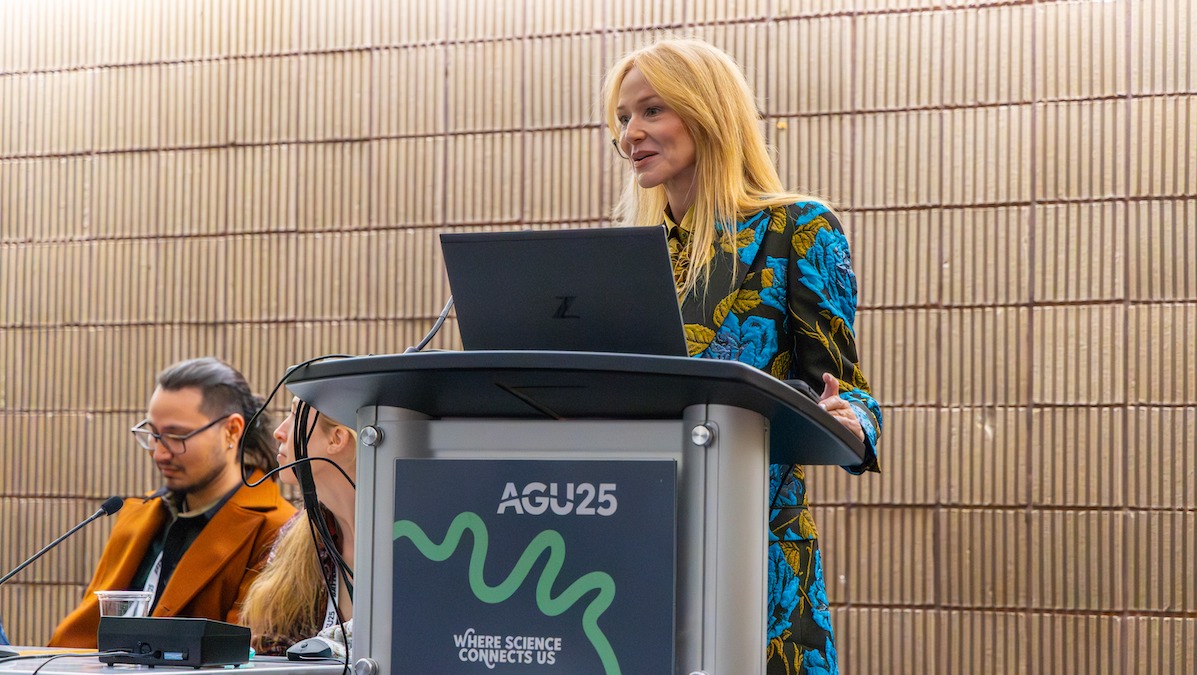
Images and audio samples of an eight-foot tall resin sculpture created by singer and artist Jewel, emitting a soundscape informed by ocean data from NASA, were shown at AGU’s annual meeting in New Orleans on 16 December.
“The entire sculpture is entirely data,” Jewel said at a press event where she discussed the piece’s development. Jewel was joined by Chelle Gentemann, program scientist at NASA’s Office of the Chief Science Data Officer, and Kevin Murphy, NASA’s Chief Science Data Officer.
The sculpture and soundscape, together named Heart of the Ocean, will debut at the Venice Biennale in 2026 along with other works by Jewel.
Jewel worked closely with NASA to select data that would translate well into an art piece. The soundscape is constructed with tones, sounds, and a tempo informed by open-source NASA data on the Atlantic Ocean’s wave height, precipitation, salinity, currents, seismicity, and wildlife. Datapoints are translated into a “sound library” created by Jewel that then comes together to form music.
The soundscape “travels” to the deep ocean, slowing as ocean temperatures drop. Then, the piece quickens, and “ascends” to convey ocean surface data. Cloud cover and ocean current data inform how the soundscape moves from one ear to another, simulating a 3-dimensional experience.
“I learned so much,” working with NASA, Jewel said. “It was an incredible intellectual exercise to take that data and not want to alter it,” but still transform it into meaningful music. “I felt I had to be really honest about the data … I wanted it to be pure. I wanted it to be nature, talking to you,” she said.
The soundscape changes in accordance with near real-time Atlantic Ocean conditions, as the data update every 12 minutes. “If it’s raining, the piece looks and sounds different. If it’s stormy, the piece is different. It’s a living instrument that the ocean gets to play in real time,” Jewel said. She particularly likes to experience the piece under full moon conditions.
Jewel hopes the piece raises awareness about the accessibility of NASA data. “It was only because of open data” that she was able to build the piece, she said.
Gentemann, the NASA program scientist, said the experience was a valued opportunity to explore the artistic side of an otherwise very technically focused career.
When asked for advice to scientists looking to collaborate with artists, Jewel said: “If there’s an artist that you’re inspired by or a storyteller that you’re inspired by, just reach out.”
—Grace van Deelen (@gvd.bsky.social), Staff Writer
These updates are made possible through information from the scientific community. Do you have a story about science or scientists? Send us a tip at [email protected].