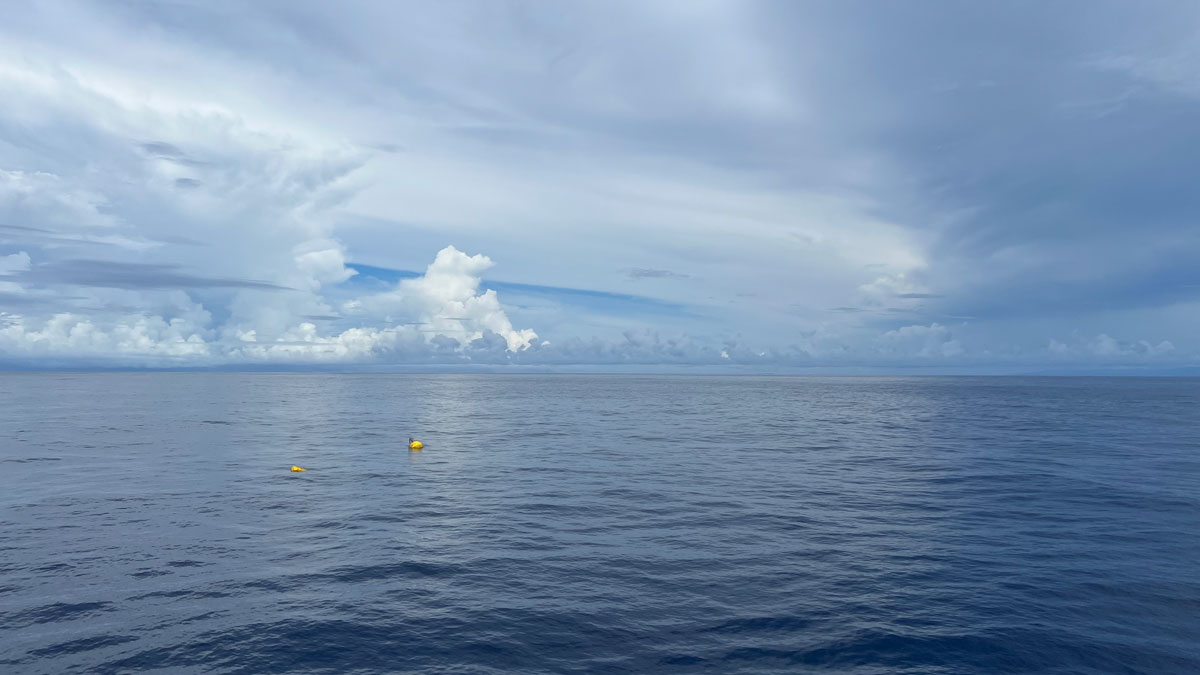
Source: Journal of Geophysical Research: Machine Learning and Computation
The Indonesian Throughflow carries both warm water and fresh water from the Pacific into the Indian Ocean. As the only low-latitude current that connects the two bodies of water, it plays a key role in ocean circulation and sea surface temperature worldwide.
The current is as complex as it is important: The seas surrounding Indonesia are home to deep basins and sills and a hodgepodge of ocean processes that make the Indonesian Throughflow difficult to measure. On-the-ground—or, rather, on-the-sea—observations are scarce as well because such observational systems are expensive and difficult to design and maintain.
Wang et al. combined artificial intelligence (AI) modeling techniques with observing system simulation experiment design concepts. Their method used sea surface height measurements to predict the behavior of this influential current and its individual passages and estimate which strait has the greatest effect on the current’s behavior.
The researchers developed a deep learning model that uses two types of networks to conduct observing system simulation experiments. The first, called a convolutional neural network (CNN), is often used for image classification and, in this case, was used to extract trends from data about the Indonesian Throughflow. The second, called a recurrent neural network (RNN), is most commonly used to sort through sequential data. In this work, the RNN processed the trends identified by the CNN and analyzed their changes over time. The approach proved to be much less computationally costly than running a traditional observing system simulation experiment.
The results recapitulated observed water transport trends and showed that sea surface height is a key predictor of conditions in some of the shallower straits between Indonesian islands. The Maluku Strait emerged as a passage where water conditions have a strong influence on the entire system and thus as a strong candidate for future monitoring efforts, the researchers found. Combining information about the Maluku and Halmahera Straits was even more effective at predicting system-wide conditions. (Journal of Geophysical Research: Machine Learning and Computation, https://doi.org/10.1029/2025JH000808, 2025)
—Saima May Sidik (@saimamay.bsky.social), Science Writer