Source: AGU Advances
A translation of this article was made by Wiley. 本文由Wiley提供翻译稿。
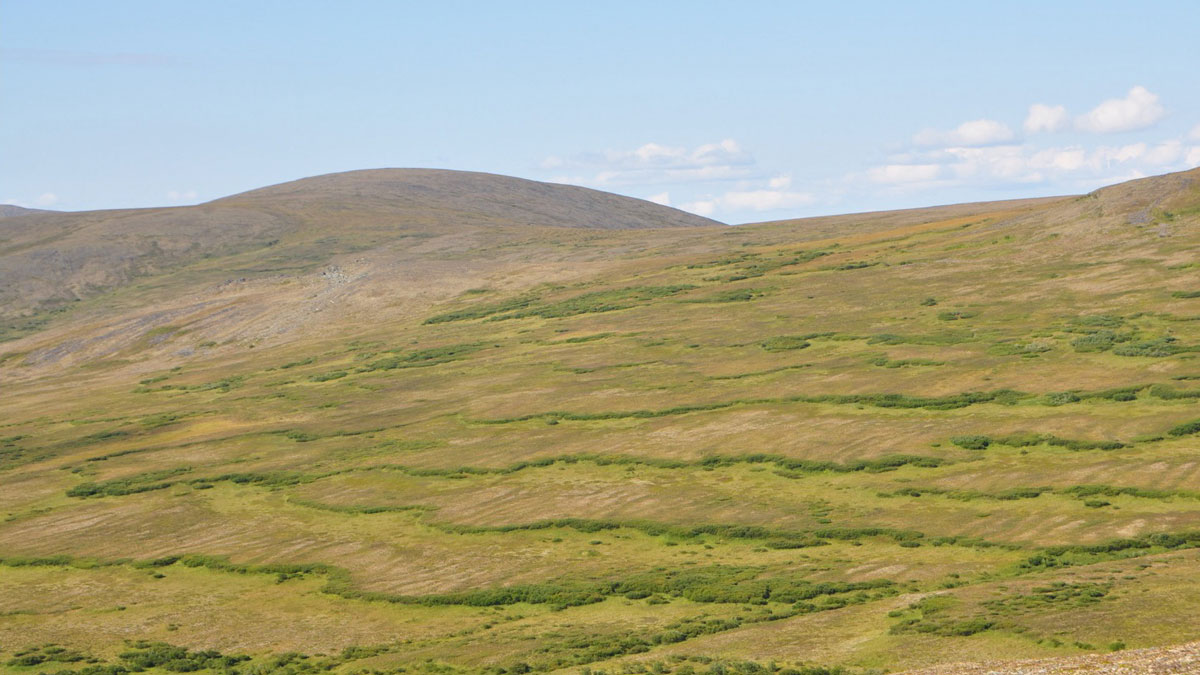
Hillslopes in Arctic regions with frozen soils can host a suite of geometric patterns, from circles and stripes to polygonal patterned ground. They can also have solifluction patterns, or markings left behind when partially thawed permafrost slips and flows down a slope. Solifluction patterns look like pairings of flat, terraced soil—like a big staircase—and rounded lobes of soil at the terrace’s base.
Understanding how these patterns form is important for predicting and working to fix unstable slopes in Arctic environments as climate change increases the rates at which frozen ground thaws. It could also be useful for understanding past climates on Mars, as scientists have spotted similar patterns on the planet’s surface. But solifluction patterns have defied explanation, and in a new study, Glade et al. use mathematical and physical models along with remote sensing to explain how they form.
Icy soil moves very slowly, just millimeters to centimeters per year, and behaves in complex ways, acting at times like a fluid and at others like a solid. This complexity is due to seasonal variability in water and temperature, as well as the fundamental physics of soil.
The researchers ruled out other common fluid analogues, including paint dripping down a wall, buckling instabilities seen in folding lava, and roll waves; reviewed the soil literature; ran physics-based computer models of terrace and lobe formation; and ran mathematical models of different fluid behaviors. After all that, they landed at last on a suitable analogue: waves that form in Oobleck, a non-Newtonian fluid made of cornstarch mixed with water. Its velocity changes under different stresses, and counterintuitively, it becomes harder to move the harder you push on it.
Oobleck’s unique properties make it a common classroom experiment, and it matched up the best with the frozen features researchers have observed in nature. Differences in soil moisture could lead to differences in soil velocity, creating a spatially variable buildup of soil that eventually collapses before the process of solifluction begins again.
It’s still not a perfect fit, the researchers noted. The Oobleck waves reflect only rheology, or the material makeup of the soil (or fluid) in question. Real-world frozen soil is more complex than a simple mixture of cornstarch and water.
Additionally, factors like topography and vegetation affect the pattern, not only the material’s composition. There must be a bump to begin with for soil to build up behind, and there must be enough soil moisture to accumulate ice.
The researchers would like to validate their model in the field, but because it takes hundreds of years or more for the features to form, observing that is difficult, but not impossible, and they’re determined to try. (AGU Advances, https://doi.org/10.1029/2026AV002392, 2026)
—Rebecca Dzombak, Science Writer