• About
  • Special Reports
  • Topics
    • Climate
    • Earth Science
    • Oceans
    • Space & Planets
    • Health & Ecosystems
    • Culture & Policy
    • Education & Careers
    • Opinions
  • Projects
    • Postcards From the Field
    • ENGAGE
    • Editors’ Highlights
    • Editors’ Vox
    • Eos en Español
    • Eos 简体中文版
    • Print Archive: 2015–2025
  • Policy Tracker
  • Blogs
    • Research & Developments
    • The Landslide Blog
  • Newsletter
  • Submit to Eos
  • AGU.org
  • Career Center
  • Join AGU
  • Give to AGU
  • About
  • Special Reports
  • Topics
    • Climate
    • Earth Science
    • Oceans
    • Space & Planets
    • Health & Ecosystems
    • Culture & Policy
    • Education & Careers
    • Opinions
  • Projects
    • Postcards From the Field
    • ENGAGE
    • Editors’ Highlights
    • Editors’ Vox
    • Eos en Español
    • Eos 简体中文版
    • Print Archive: 2015–2025
  • Policy Tracker
  • Blogs
    • Research & Developments
    • The Landslide Blog
  • Newsletter
  • Submit to Eos
Skip to content
  • AGU.org
  • Career Center
  • Join AGU
  • Give to AGU
Eos

Eos

Science News by AGU

Support Eos
Sign Up for Newsletter
  • About
  • Special Reports
  • Topics
    • Climate
    • Earth Science
    • Oceans
    • Space & Planets
    • Health & Ecosystems
    • Culture & Policy
    • Education & Careers
    • Opinions
  • Projects
    • Postcards From the Field
    • ENGAGE
    • Editors’ Highlights
    • Editors’ Vox
    • Eos en Español
    • Eos 简体中文版
    • Print Archive: 2015–2025
  • Policy Tracker
  • Blogs
    • Research & Developments
    • The Landslide Blog
  • Newsletter
  • Submit to Eos

landslides

Map of the study site in the northern California Coast Ranges.
Posted inEditors' Highlights

Thickness and Strength of Slow-moving Landslides Revealed

by O. Marc 22 April 20216 February 2023

Hundreds of slow-moving landslides’ deformation patterns were inverted to obtain their thickness and frictional strength, revealing that larger landslides are weaker and thinner than smaller ones.

People stand atop debris from a huge slump landslide in Uganda.
Posted inNews

Landslides Mar the “Pearl of Africa”

by H. Mafaranga 19 April 20212 August 2022

Behind Uganda’s lavish beauty, climate change has taken its toll: Death, destroyed properties, and displaced communities increase as above-normal rainfall floods the country.

Buildings cling to a soil cliff cut away by a flood.
Posted inNews

Development and Climate Change Contribute to a Himalayan Tragedy

by T. V. Padma 3 March 202112 April 2022

Infrastructure projects like roads and dams destabilize slopes and compound the effects of glacial floods and avalanches, scientists say.
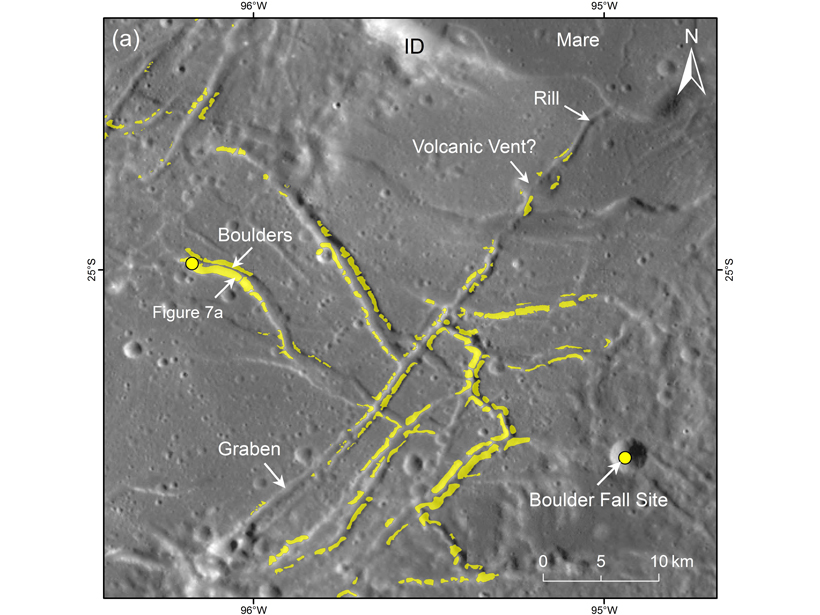
Image of the southern part of the Orientale Basin with yellow patches indicating boulders fields
Posted inEditors' Highlights

The Tumbling Boulders of Orientale Basin

by Laurent G. J. Montési 8 February 20213 May 2022

Mapping boulder fields and boulder tracks highlights the seismic hazard still present on the Moon.

View up a 95-meter-long debris flow flume facility, with cameras and other instruments in the foreground
Posted inScience Updates

A New Era of Debris Flow Experiments in the Oregon Woods

by M. K. Obryk, D. L. George and B. B. Mirus 26 January 202129 September 2021

What do a backhoe, expanding foam, half-ton concrete blocks, and a 100-meter-long hillslope slide have in common? All were part of reviving the U.S. Geological Survey’s experimental debris flow flume.
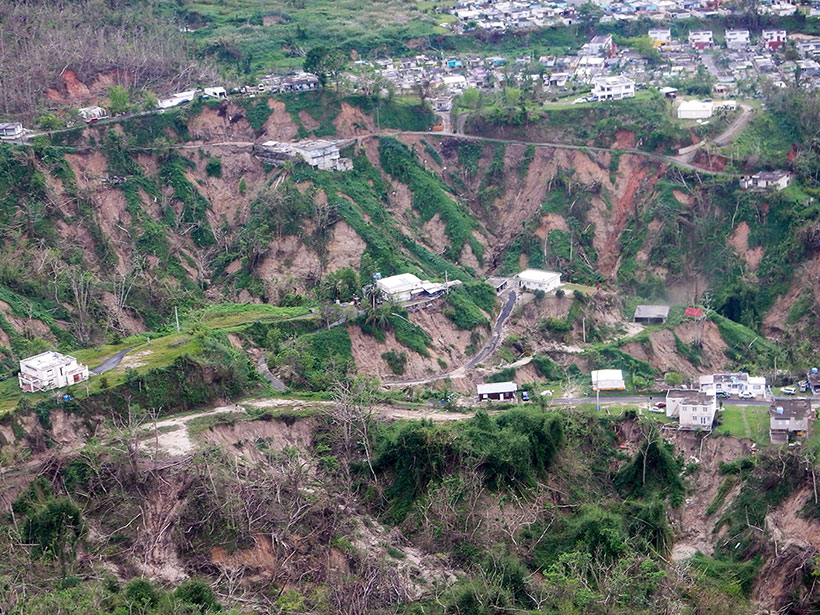
A view of landslides in the mountains of Puerto Rico after the extreme rainfall from Hurricane Maria in 2017
Posted inFeatures

A Slippery Slope: Could Climate Change Lead to More Landslides?

Jane Palmer, Science Writer by Jane Palmer 23 November 202031 March 2022

Scientists investigate whether warming temperatures and changing rainfall patterns could be triggering more landslides in mountainous areas.

Aerial photo showing the extent of the Oso landslide
Posted inResearch Spotlights

Simple Actions Can Help People Survive Landslides

by Jack Lee 27 October 202020 May 2022

New research provides practical advice to minimize landslide risk for individuals before, during, and after an event.
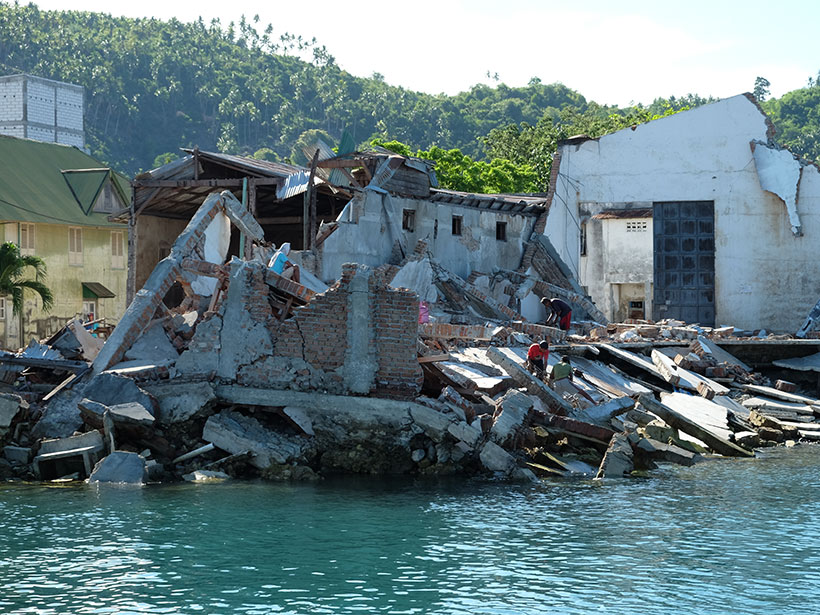
The toppled remains of a building on the shore of Palu Bay in Indonesia following a 2018 earthquake and tsunami
Posted inResearch Spotlights

Redes Sociales Ayudan a Revelar la Causa del Tsunami en Indonesia en el 2018

Aaron Sidder, freelance science writer by Aaron Sidder 21 October 20206 October 2021

Videos de Twitter y YouTube ayudaron a los científicos a descubrir los mecanismos físicos que generaron el gran tsunami en Palu Bay después de un terremoto de magnitud 7.5.
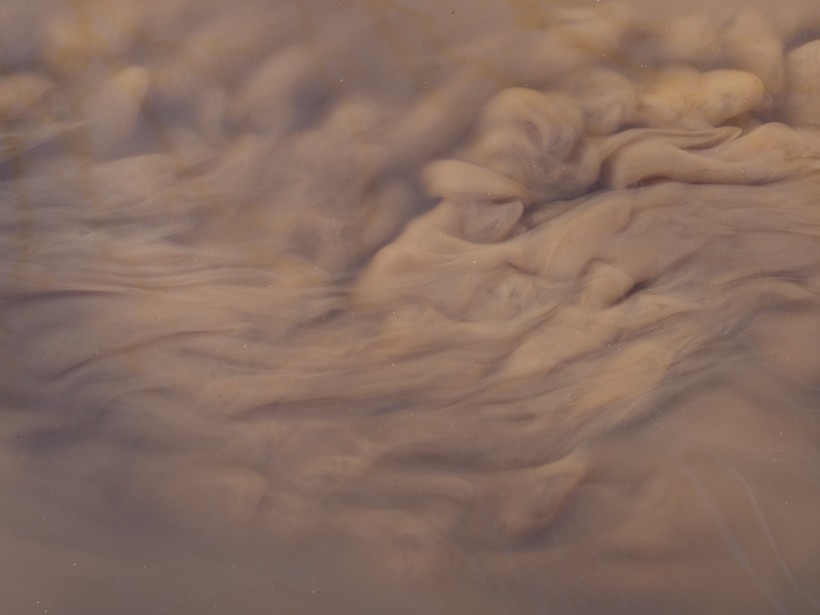
Sediment swirls and mixes with water in a brown slurry
Posted inResearch Spotlights

Experimenting with Underwater Sediment Slides

by Terri Cook 8 October 202014 March 2024

Sediment-laden currents caused by breaching flow slides are hazardous to flood defenses and seabed infrastructure. New research shows that these phenomena must be accounted for in erosion simulations.

The toppled remains of a building on the shore of Palu Bay in Indonesia following a 2018 earthquake and tsunami
Posted inResearch Spotlights

Social Media Helps Reveal Cause of 2018 Indonesian Tsunami

Aaron Sidder, freelance science writer by Aaron Sidder 26 June 202030 August 2022

Videos from Twitter and YouTube helped scientists tease out the physical mechanisms that generated the large tsunami in Palu Bay after a magnitude 7.5 earthquake.

Posts pagination

Newer posts 1 … 44 45 46 47 48 … 51 Older posts
Over a dark blue-green square appear the words Special Report: The State of the Science 1 Year On.

Features from AGU Publications

Research Spotlights

What Triggered an Ancient Magma Surge in the North Cascades?

6 November 20266 November 2026
Editors' Highlights

Trash to Treasure? Increased Soil Phosphorus in Farmed Urban Soils

5 November 20264 November 2026
Editors' Vox

Announcing the New AGU Publications Editors-in-Chief Starting in 2027

6 November 20266 November 2026
Eos logo at left; AGU logo at right

About Eos
ENGAGE
Awards
Contact

Advertise
Submit
Career Center
Sitemap

© 2026 American Geophysical Union. All rights reserved Powered by Newspack