• About
  • Special Reports
  • Topics
    • Climate
    • Earth Science
    • Oceans
    • Space & Planets
    • Health & Ecosystems
    • Culture & Policy
    • Education & Careers
    • Opinions
  • Projects
    • Postcards From the Field
    • ENGAGE
    • Editors’ Highlights
    • Editors’ Vox
    • Eos en Español
    • Eos 简体中文版
    • Print Archive: 2015–2025
  • Policy Tracker
  • Blogs
    • Research & Developments
    • The Landslide Blog
  • Newsletter
  • Submit to Eos
  • AGU.org
  • Career Center
  • Join AGU
  • Give to AGU
  • About
  • Special Reports
  • Topics
    • Climate
    • Earth Science
    • Oceans
    • Space & Planets
    • Health & Ecosystems
    • Culture & Policy
    • Education & Careers
    • Opinions
  • Projects
    • Postcards From the Field
    • ENGAGE
    • Editors’ Highlights
    • Editors’ Vox
    • Eos en Español
    • Eos 简体中文版
    • Print Archive: 2015–2025
  • Policy Tracker
  • Blogs
    • Research & Developments
    • The Landslide Blog
  • Newsletter
  • Submit to Eos
Skip to content
  • AGU.org
  • Career Center
  • Join AGU
  • Give to AGU
Eos

Eos

Science News by AGU

Support Eos
Sign Up for Newsletter
  • About
  • Special Reports
  • Topics
    • Climate
    • Earth Science
    • Oceans
    • Space & Planets
    • Health & Ecosystems
    • Culture & Policy
    • Education & Careers
    • Opinions
  • Projects
    • Postcards From the Field
    • ENGAGE
    • Editors’ Highlights
    • Editors’ Vox
    • Eos en Español
    • Eos 简体中文版
    • Print Archive: 2015–2025
  • Policy Tracker
  • Blogs
    • Research & Developments
    • The Landslide Blog
  • Newsletter
  • Submit to Eos

magnetic fields & magnetism

Modern continents mapped onto Pangaea.
Posted inNews

Paleomagnetic Data Hint at Link from Earth’s Core to Continents

Bas den Hond, Science Writer by Bas den Hond 15 June 20177 October 2021

Earth’s magnetic field waxes and wanes as supercontinents form and break up, suggests a new study postulating a direct connection between our planet’s crust and its core.

Researchers explore the links between climate change and ocean tides
Posted inResearch Spotlights

Can Ocean Tides Be Powerful Indicators of Climate Change?

by S. Witman 6 June 201729 March 2023

A new study simulates how ocean warming due to climate change will affect the electromagnetic signal emitted by ocean tides over the next century.

Posted inEditors' Vox

Close Encounter with Jupiter

by Andrew Yau, A. Dombard, W. K. Peterson and P. D. Williams 25 May 201715 March 2022

First results from the Juno mission shed new light on Jupiter’s atmosphere, gravity, magnetic field, aurora, history, and more.

Auroral physicist Dave Evans relaxes in his garden in Boulder, Colo
Posted inNews

David S. Evans (1936–2016)

by T. E. Moore and T. Fuller-Rowell 25 May 201721 February 2023

Evans, a pioneer of auroral physics, changed the way scientists thought about the aurora and magnetic fields and guided a new generation of researchers.

An aurora glows above Tromso, Norway, in 2010.
Posted inNews

Mining Ancient Texts Reveals Clues to Space Weather of Yore

Tim Hornyak, Science Writer by Tim Hornyak 24 May 201718 April 2022

Low-latitude sightings of colorful hues in the sky likely to have been auroras indicate powerful geomagnetic storms buffeted Earth when some old chronicles were written, researchers report.

The impact of solar storms on power grids might be determined by the conductivity of the ground.
Posted inResearch Spotlights

Ground Surveys Reveal Space Weather Risk to Spain’s Power Grid

by Mark Zastrow 23 May 201713 October 2021

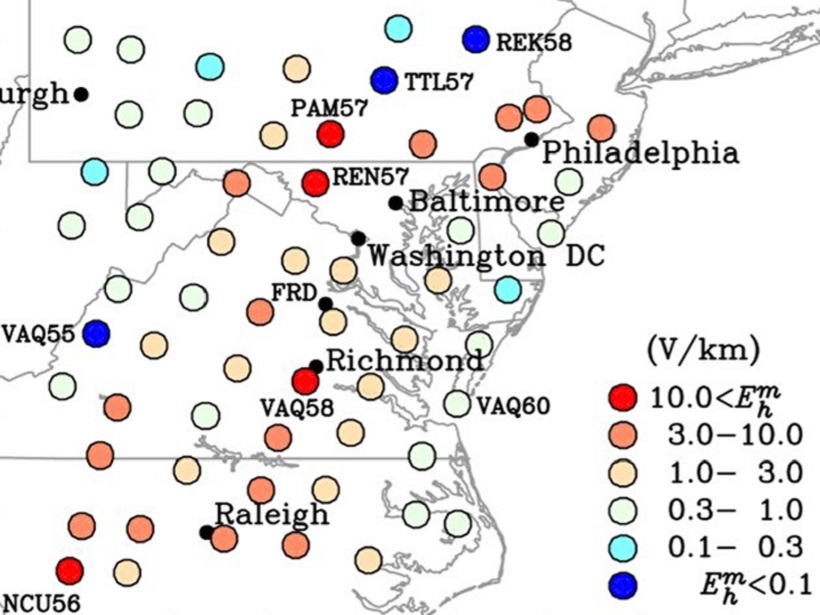
A survey of bedrock conductivity across Spain improves predictions of how vulnerable the nation’s power grid is to solar storms.

Four identical MMS spacecraft—one of which is pictured in this illustration—were launched in 2015 to study the process of magnetic reconnection.
Posted inResearch Spotlights

New Explanation for “Meandering” Electrons Orbiting Earth

by Mark Zastrow 11 May 201718 July 2023

A new study proposes a simpler theory to explain a class of electrons zipping around Earth, propelled by magnetic explosions.

A rendering of the sunset from space.
Posted inScience Updates

Integrating Research of the Sun-Earth System

by V. K. Jordanova, J. E. Borovsky and V. T. Jordanov 2 May 20174 May 2022

International Symposium on Recent Observations and Simulations of the Sun-Earth System III; 11–16 September 2016, Varna, Bulgaria

Testing the bike-mag system across the shoulder of the Dead Sea fault valley in northeastern Israel.
Posted inScience Updates

A Bike Built for Magnetic Mapping

by U. Schattner 25 April 201712 January 2022

Mounting a magnetic sensor on a bicycle offers an efficient, low-cost method of collecting ground magnetic field data over rough terrain where conventional vehicles dare not venture.

Artist’s illustration of events on the Sun changing the conditions in near-Earth space.
Posted inResearch Spotlights

For Magnetic Reconnection Energy, O—not X—Might Mark the Spot

by Mark Zastrow 10 April 201718 July 2023

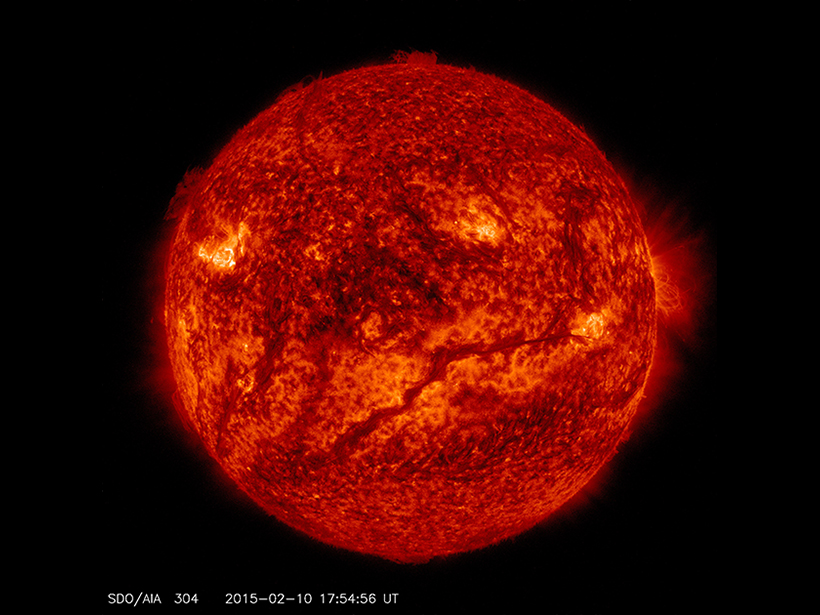
A new analysis of satellite data could upend conventional wisdom about how solar storms produce their dangerous radiation—not from X-shaped mergers of magnetic field lines but from swirling vortices.

Posts pagination

Newer posts 1 … 23 24 25 26 27 … 33 Older posts
Over a dark blue-green square appear the words Special Report: The State of the Science 1 Year On.

Features from AGU Publications

Research Spotlights

Bacteria Decide the Ocean’s Dissolved Organic Carbon Abundance

3 March 20263 March 2026
Editors' Highlights

The “Wet-Gets-Wetter” Response to Climate Change Does Not Always Apply

4 March 20263 March 2026
Editors' Vox

Editorial Handover at Tectonics

4 March 20264 March 2026
Eos logo at left; AGU logo at right

About Eos
ENGAGE
Awards
Contact

Advertise
Submit
Career Center
Sitemap

© 2026 American Geophysical Union. All rights reserved Powered by Newspack