• About
  • Special Reports
  • Topics
    • Climate
    • Earth Science
    • Oceans
    • Space & Planets
    • Health & Ecosystems
    • Culture & Policy
    • Education & Careers
    • Opinions
  • Projects
    • Postcards From the Field
    • ENGAGE
    • Editors’ Highlights
    • Editors’ Vox
    • Eos en Español
    • Eos 简体中文版
    • Print Archive: 2015–2025
  • Policy Tracker
  • Blogs
    • Research & Developments
    • The Landslide Blog
  • Newsletter
  • Submit to Eos
  • AGU.org
  • Career Center
  • Join AGU
  • Give to AGU
  • About
  • Special Reports
  • Topics
    • Climate
    • Earth Science
    • Oceans
    • Space & Planets
    • Health & Ecosystems
    • Culture & Policy
    • Education & Careers
    • Opinions
  • Projects
    • Postcards From the Field
    • ENGAGE
    • Editors’ Highlights
    • Editors’ Vox
    • Eos en Español
    • Eos 简体中文版
    • Print Archive: 2015–2025
  • Policy Tracker
  • Blogs
    • Research & Developments
    • The Landslide Blog
  • Newsletter
  • Submit to Eos
Skip to content
  • AGU.org
  • Career Center
  • Join AGU
  • Give to AGU
Eos

Eos

Science News by AGU

Support Eos
Sign Up for Newsletter
  • About
  • Special Reports
  • Topics
    • Climate
    • Earth Science
    • Oceans
    • Space & Planets
    • Health & Ecosystems
    • Culture & Policy
    • Education & Careers
    • Opinions
  • Projects
    • Postcards From the Field
    • ENGAGE
    • Editors’ Highlights
    • Editors’ Vox
    • Eos en Español
    • Eos 简体中文版
    • Print Archive: 2015–2025
  • Policy Tracker
  • Blogs
    • Research & Developments
    • The Landslide Blog
  • Newsletter
  • Submit to Eos

Papua New Guinea

Posted inEditors' Highlights

Low-angle Normal Fault in Papua New Guinea is Rolling Along

by N. Niemi 22 May 20196 October 2021

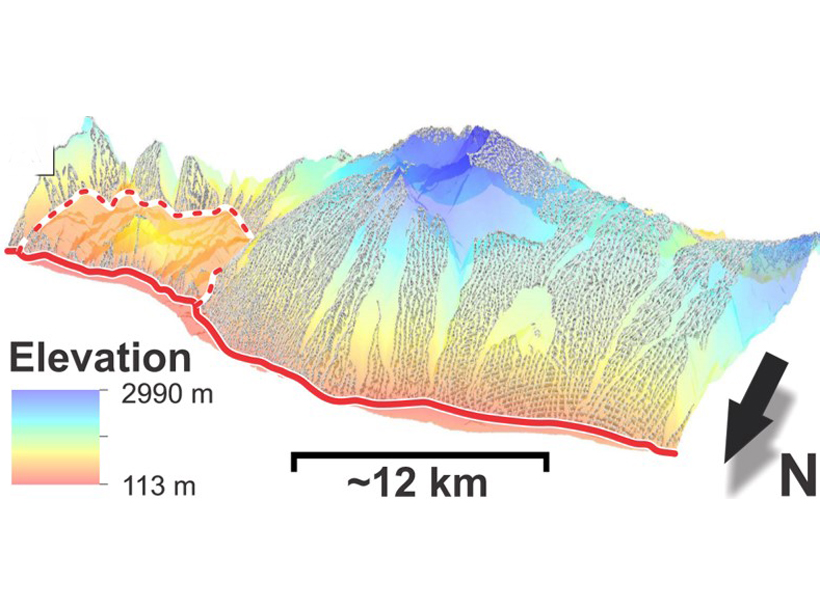
Geologic and geomorphic observations of an active low-angle normal fault reveal a rolling-hinge mechanism accommodating the exhumation of a metamorphic core complex in Papua New Guinea.

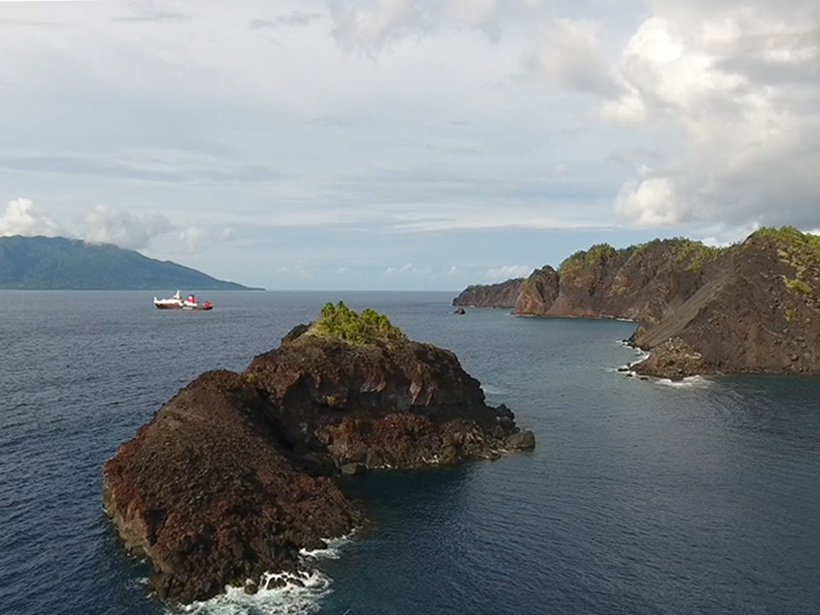
Scientists aboard the R/V Sonne profiled the seafloor and subsurface near Ritter Island, north of New Guinea, in 2016.
Posted inScience Updates

An 1888 Volcanic Collapse Becomes a Benchmark for Tsunami Models

by A. Micallef, S. F. L. Watt, C. Berndt, M. Urlaub, S.Brune, I. Klaucke, C. Böttner, J. Karstens and J. Elger 10 October 201718 November 2022

When volcanic mountains slide into the sea, they trigger tsunamis. How big are these waves, and how far away can they do damage? Ritter Island provides some answers.

Posts pagination

Newer posts 1 2
Over a dark blue-green square appear the words Special Report: The State of the Science 1 Year On.

Features from AGU Publications

Research Spotlights

What Australian Lakes Showed Us About Martian Hydrology

27 July 202627 July 2026
Editors' Highlights

A New Pathway for Energy Redistribution in Near-Earth Space

30 July 202629 July 2026
Editors' Vox

The Hidden Costs of Mining River Sand

27 July 202627 July 2026
Eos logo at left; AGU logo at right

About Eos
ENGAGE
Awards
Contact

Advertise
Submit
Career Center
Sitemap

© 2026 American Geophysical Union. All rights reserved Powered by Newspack