
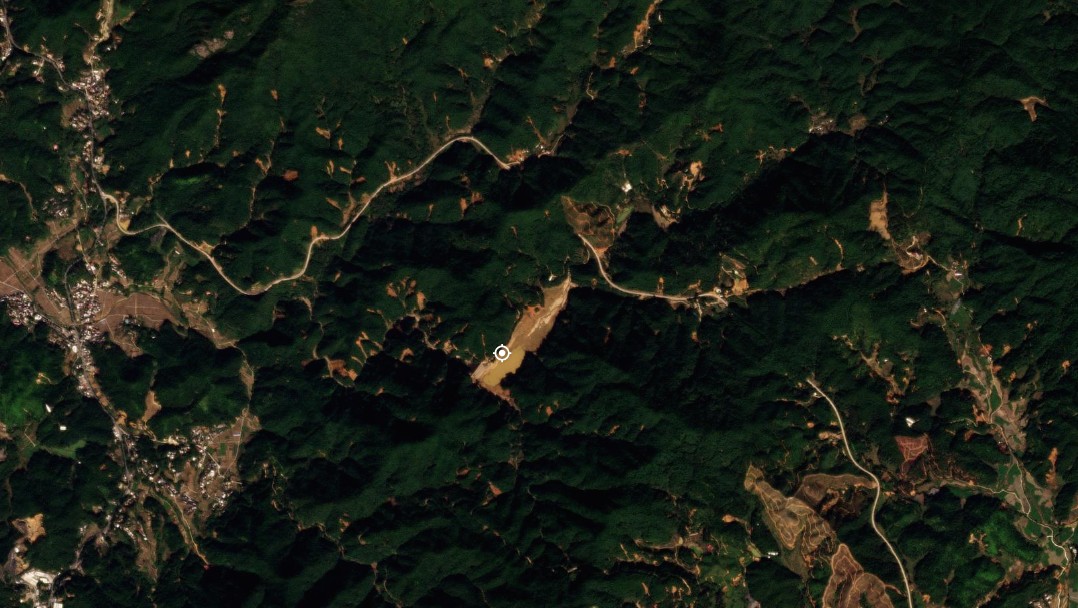
Six people were killed when intense rainfall triggered over 6,500 landslides

On 16 June 2024, an extreme rainfall event triggered a dense cluster of landslides and channelised debris flows in Wuping County, Fujian Province, China. This is one of many such events in recent years – anecdotally at least, these events are becoming more common and more severe.
Thus, I very much welcome a paper in the journal Landslides (Liao et al. 2026) that describes this event. The paper is not open access, but this link should allow you to read the full manuscript. The authors highlight the impact of the event – six people were killed (two of whom were never recovered) and hundreds of houses were damaged.
The cluster of landslides centres on the area around [24.94745, 116.29172]. This Planet Labs image, captured on 27 November 2024 after the event, shows some of the landslides triggered:-
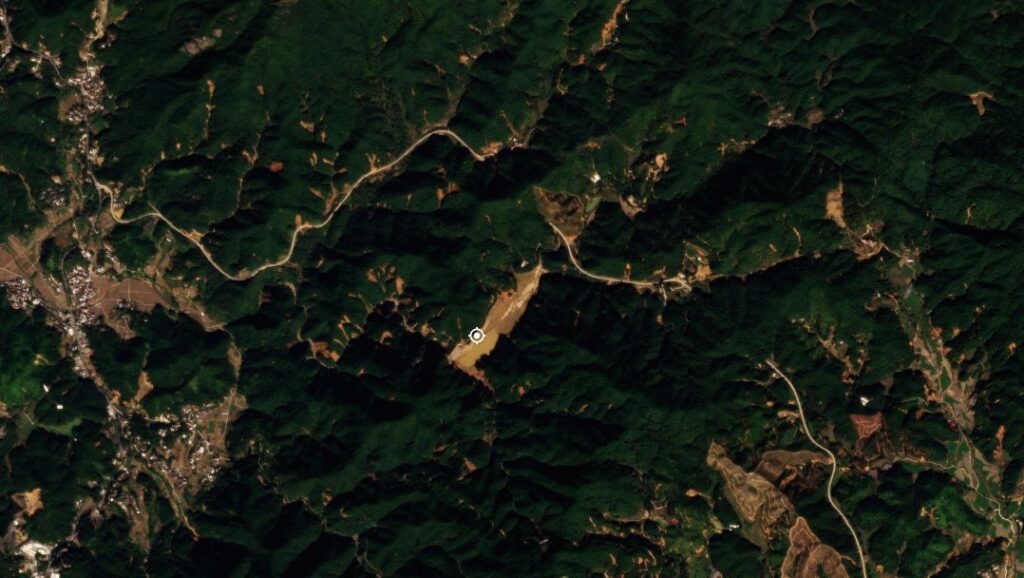
Note the presence of multiple shallow landslides that have combined to form channelised debris flows. In the centre of the image, by the marker, there is a small reservoir that has been almost entirely infilled by debris from the landslides.
In total, Liao et al. (2026) have mapped 6,526 landslide triggered by the rainfall event. The main initiating rainfall appears to have been a period between 14:00 and 18:00 on 16 June 2024, during which 161 mm was recorded, with a peak intensity of 55 mm per hour. Interestingly, though, the landslide density correlates with rainfall total prior to the main initiating event, rather than to the total rainfall. I wonder whether this indicates that the key parameter (the distribution of peak rainfall intensity, for example) is not being captured in the data?
Very helpfully, Liao et al. (2026) have investigated the mechanism of the landslides in some detail. They find that behaviour differed according to the bedrock lithology. In areas underlain by granite, failure occurred on the interface between the weathered and the unweathered materials, a common situation. In most cases, granitic landslides did not generate channelised debris flows.
On the other hand, in areas underlain by greywacke, failures also occurred in these interface areas, but channelised debris flows were more common. This may be related to the steeper local topography in the greywacke areas.
The paper by Liao et al. (2026) further helps us to understand these clusters of landslides and channelised debris flows, which are proving to be so very destructive. Expect more of these events in the coming months and beyond.
Reference and acknowledgement
Liao, Z., Wu, J., Ma, J. et al. 2026. Characteristics and initiation mechanism of clustered landslides triggered by an extreme rainfall in Wuping County, Fujian Province, China. Landslides. https://doi.org/10.1007/s10346-026-02712-1.
Many thanks to the wonderful people at Planet Labs for providing access to the satellite imagery.