
The Landslide Blog is written by Dave Petley, who is widely recognized as a world leader in the study and management of landslides.

The news this morning of the “double tap” M=7.2 and M=7.5 earthquakes in Venezuela late on 24 June 2026 is grim. These are large earthquakes in their own right occurring at a shallow depth, with inevitable high levels of consequence. This will be hugely magnified by the vulnerability of the population and infrastructure in Venezuela that have been the consequence of the societal and political dysfunction in recent decades. This will have resulted in a population living in vulnerable buildings (and already images are emerging of large-scale collapses in Caracas), a suboptimal capacity for response and rescue, and limitations on the capacity of the medical system to provide the necessary support to large numbers of injured people.
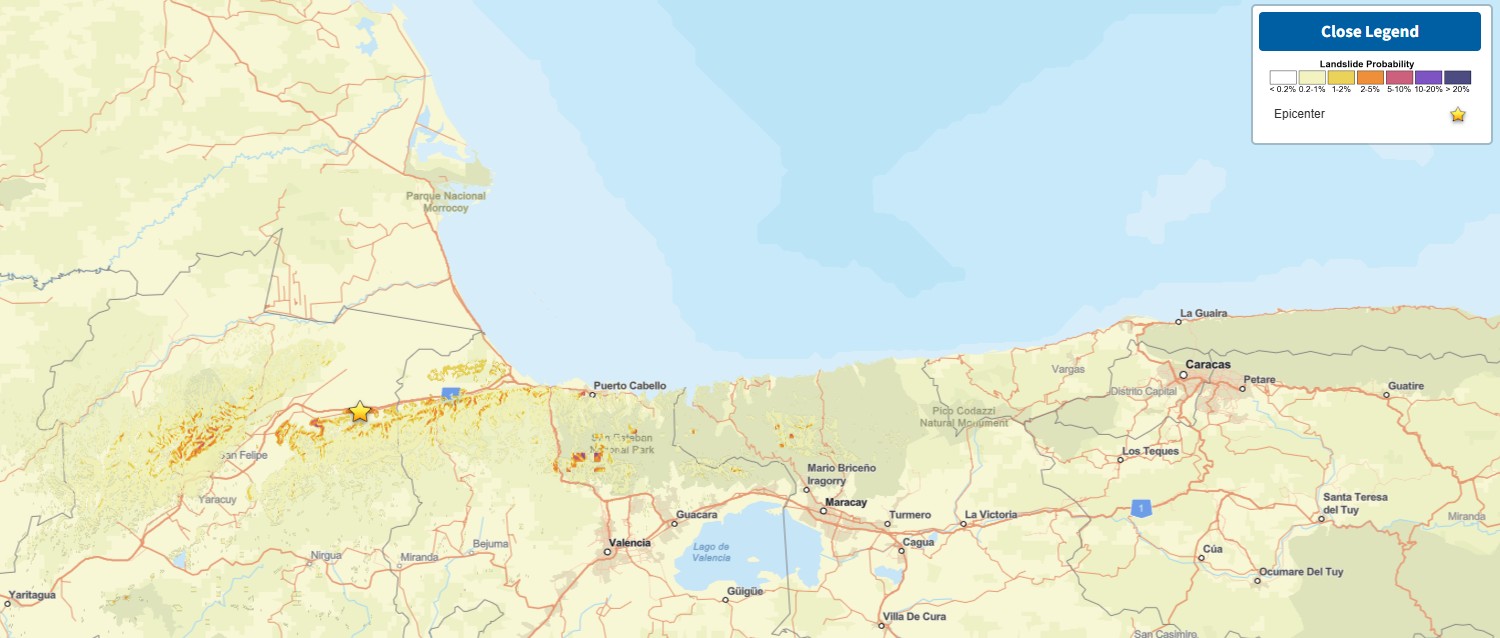
Landslides are likely to have been an issue in the epicentral area to the west of Caracas. As usual, the USGS Pager analysis is the best that we have, noting that it is only a first order estimation. This is the current Pager Landslide map for the larger (M=7.5) of the two earthquakes:-
There is also a high potential for liquefaction:-
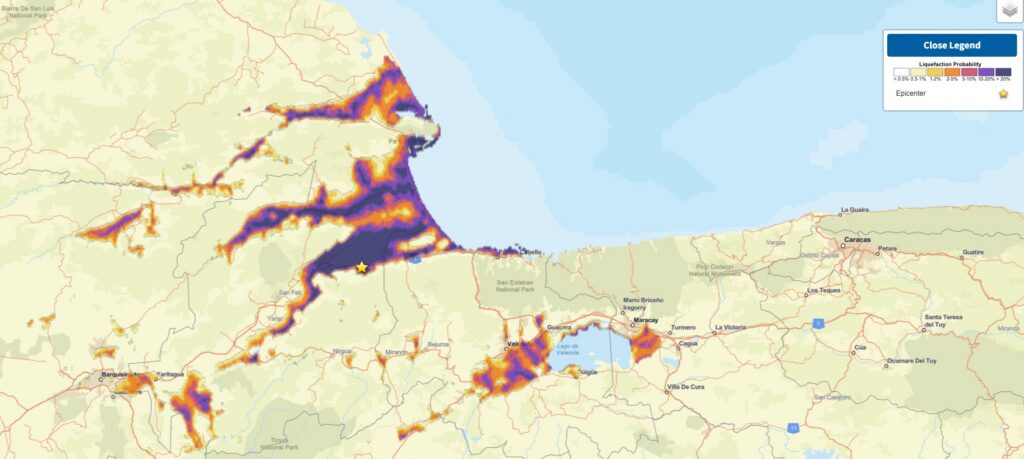
The USGS analysis is that the estimated population exposure for landslides is in the range of 1,000 to 10,000 and for liquefaction it is in the top of the range of 10,000-100,000 people.
Technically, there is also considerable uncertainty about the potential effects of this double tap event. Does the occurrence of an M=7.2 event very shortly before a M=7.5 mean that the impacts of the latter are likely to be increased? I think the answer is that they probably are, but time will tell.
News reporting will be a challenge in a country that has an unusual relationship with the wider world. Way back in 2010, I wrote about the likely biases in the immediate reporting of the Haiti earthquake. I repeat them here; it is easy to substitute Venezuela for Haiti:-
1. Everything stops at night. At the time of writing it is still night time in Haiti. In the aftermath of an earthquake, electricity and power supplies are wiped out, so for the night time period it appears that the disaster is not as bad as is feared. As the sun comes up so the reports on the true picture start to emerge, and the fatality statistics start to increase rapidly. This increase will continue for several days at least, but may ultimately exceed the final toll;
2. The initial focus is often wrong. In the immediate aftermath of a disaster the initial focus of the media reports is often on the biggest city. This is rarely where the biggest impact has occurred, but it is most accessible so will be the focus of the reports.
3. No news is very, very bad news. The biggest impacts are often in rural areas with the highest levels of shaking. These areas had poor communications to start with, but when an earthquake strikes the roads become blocked, power is lost and there is no telephone service. Therefore, no news comes out for some time after the quake. The picture is actually the opposite of the obvious. If news starts to emerge quickly from those areas with the highest shaking then the picture is not as bad as we feared – at least some communications are open – although it may still be quite grim. If there is almost no news at all from the rural areas for a day or two, then the picture is probably very bad indeed, with almost all of the communications wiped out.
4. The media focus will quickly change to the foreign rescue teams. However, although these efforts are valuable, their overall impact is very small. The real work is actually done by local people – most rescues are made by untrained people in the first 24 hours – this should really be the focus.
Every earthquake is different, and the dynamics play out differently each time. It is possible that Caracas will have the highest levels of loss. However, the situation to the west of Caracas is likely to be very, very difficult.
My plea to media organisations is twofold. First, please do not chase initial reports of the loss of life (already the BBC and others have started to do this):-
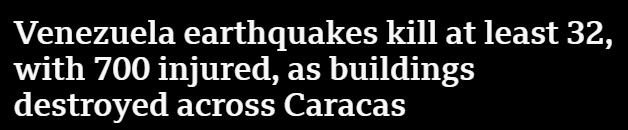
This earthquake has killed hundreds, and probably thousands, of people (the current Pager estimate for the M=7.5 earthquake alone is that there is a 87% probability that it has killed more than 1,000 people and an 11% probability that it has killed more than 100,000 people).
Reporting 32 fatalities risks trivialising a major crisis at a crucial point in the news cycle.
And second, try to get a picture of what is happening in the epicentral area. The needs here are likely to be very large.
Addressing these two issues from the can make a major, positive impact on the response to this disaster.