
Editors’ Highlights are summaries of recent papers by AGU’s journal editors.
Source: Water Resources Research
Ionic Compounds: Worth Their Salt?
Salt of the Earth: Vast Underground Salt Caverns Are Preserving Our History—and Just Might Power Our Future
How the Rise of a Salty Blob Led to the Fall of the Last Ice Age
Insights for Making Quick Clay Landslides Less Quick
Snowball Earth’s Liquid Seas Dipped Way Below Freezing
Episodic Tales of Salt
What Salty Water Means for Wild Horses
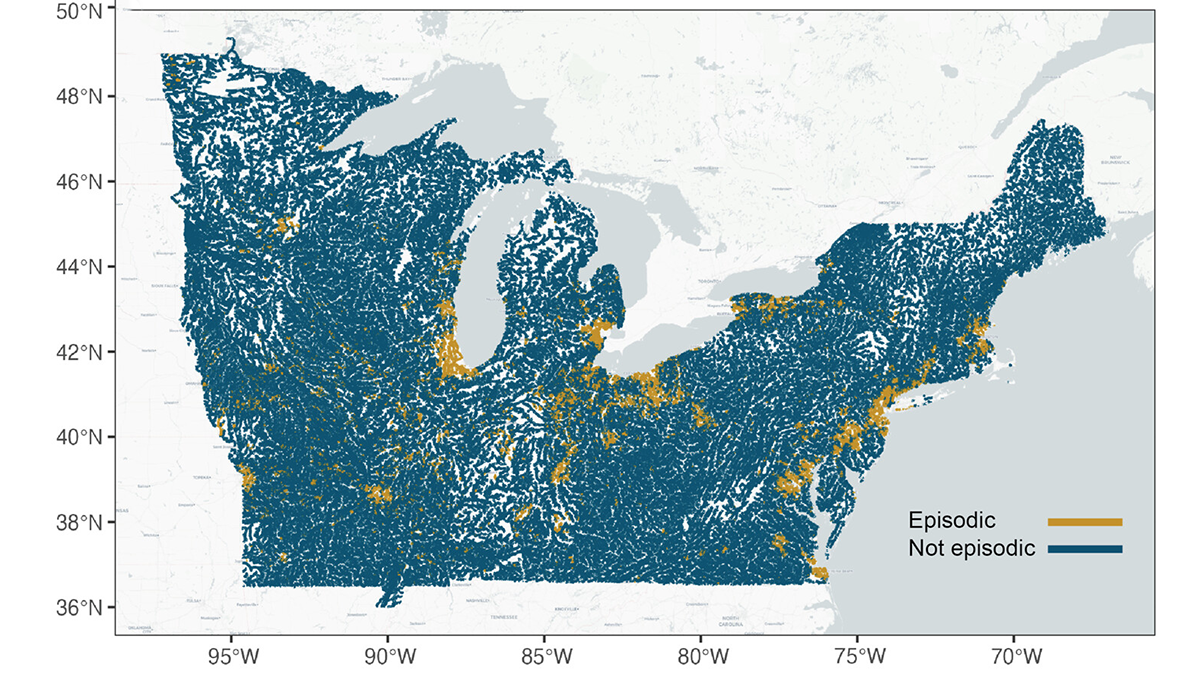
Using a combination of innovative approaches including observations and models, Platt and Dugan [2025] demonstrate how post-winter storm pulses of road salt lead to high concentrations of toxic substances in runoff water.
Surprisingly, the authors find that dilution is not an effective solution in this case, as discharge and snowfall magnitudes do not significantly impact concentrations. Key factors instead include the amount of road salt applied, land use, groundwater recharge and the base flow index. Thus, under conditions of increased groundwater recharge, road salt is stored in groundwater rather than running off.
However, this is not good news either, as it contributes to legacy effects. The authors use a random forest model with available data to show that smaller, ecologically important streams in the study region are at risk, providing a map of potential regions of road salt lightning strikes.
Citation: Platt, L. R. C., & Dugan, H. A. (2025). Episodic salinization of midwestern and northeastern US rivers by road salt. Water Resources Research, 61, e2024WR039496. https://doi.org/10.1029/2024WR039496
—Stefan Kollet, Editor, Water Resources Research