
This article is Part 2 of “The State of the Science 1 Year On,” a report from Eos and AGU.
The State of the Science 1 Year On

• Executive Summary
• Climate Change and Energy
• Health and Safety
• The Federal Workforce
• Academia and Research
• Environment
• Concluding Remarks
• Joint Report
• Joint Report PDF
• Tracking Science Policy Decisions and Approaches
In the first year of his second term, President Donald Trump worked across agencies to roll back practical and political momentum to address the climate crisis.
Experts say the array of administration policies supporting the fossil fuel industry could halve U.S. progress on reducing carbon emissions, and actions such as withdrawing the United States from the Paris Agreement are projected to erase at least 0.1°C (0.18°F) of international efforts to limit warming by 2100.
Rolling Back Climate Policy
Trump’s interagency effort to roll back critical climate policies began immediately. An executive order (EO) signed on the first day of Trump’s second term titled “Unleashing American Energy” ordered additional oil and gas exploration, accelerated permitting for such drilling, eliminated credits and regulations favoring electric vehicles, and revoked 12 climate- and energy-related EOs issued by the administration of President Joe Biden.
In March, the EPA indicated it would move to reconsider the 2009 Endangerment Finding, which states that greenhouse gases “threaten the public health and welfare of current and future generations.” The Endangerment Finding underpins the federal government’s authority to regulate greenhouse gas emissions from vehicles, power plants, oil and gas facilities, and factories.
On 29 July, the EPA formally proposed to rescind the finding, and the Department of Energy (DOE) published a report finding that carbon dioxide–induced warming “appears to be less damaging economically than commonly believed,” that U.S. policy actions have “undetectably small direct impacts on the global climate,” and that claims of increased frequency or intensity of storms are “not supported” by historical data.
In September, the National Academies of Sciences, Engineering, and Medicine conducted their own review, stating that “EPA’s 2009 finding that the human-caused emissions of greenhouse gases threaten human health and welfare was accurate” and is “beyond scientific dispute.” In a letter to the National Academies, House Oversight Chair James Comer (R-KY) dismissed the review as a “blatant partisan act to undermine the Trump Administration.”
In August, the American Meteorological Society published a report identifying “five foundational flaws” in the DOE report that each place the report “at odds with scientific principles and practices.”
In addition to reconsidering the Endangerment Finding, the Trump administration immediately began to dismantle the Greenhouse Gas Reduction Fund, a $27 billion lending program meant to spur private investment in clean energy. In March, EPA Administrator Lee Zeldin terminated $20 billion of this funding. Numerous lawsuits followed, but in July, Trump rescinded all funding for the program.
In February, Congress repealed a Biden era rule implementing a federal tax on methane pollution, which would have been the United States’ first tax on greenhouse gases. In June, the administration also proposed to rescind all greenhouse gas emissions standards for coal-, oil-, and gas-fired power plants.
The One Big Beautiful Bill, the omnibus spending bill that became law on 4 July, removes or rapidly phases out most clean energy, electric vehicle, and clean manufacturing tax credits introduced by Biden’s key climate bill, the Inflation Reduction Act. While reducing support for clean energy projects, the law also grants $40 billion in new subsidies and tax credits to the fossil fuel industry through 2035, according to a report from Oil Change International, an anti–fossil fuel advocacy group.
In total, the One Big Beautiful Bill is expected to cut the development of new clean-power-generating capacity by up to 59% through 2035, according to a report by the Rhodium Group. An analysis by Carbon Brief and Princeton University found the passage of the law will set the United States up to drop emissions to 3% below current levels by 2030 rather than the 40% mandated by the Paris Agreement.
In November, the EPA announced it would delay methane emissions reduction requirements set by the Biden administration, giving oil and gas companies until January 2027 to comply. In December, the White House and Department of Transportation announced a proposal to revoke vehicle fuel efficiency standards that were tightened in 2024. The administration is expected to finalize this proposal in 2026.
Boosting Fossil Fuels, Obstructing Renewables
Trump’s declaration of a “national energy emergency” gave federal agency heads authority to grant emergency approvals to expedite the completion of energy projects.
“We’re going to drill, baby, drill,” Trump said after being sworn in. That day, Trump issued an executive order (EO) to resume processing permit applications for new liquefied natural gas projects, which had been halted under Biden.
“It is the policy of the United States that coal is essential to our national and economic security.”
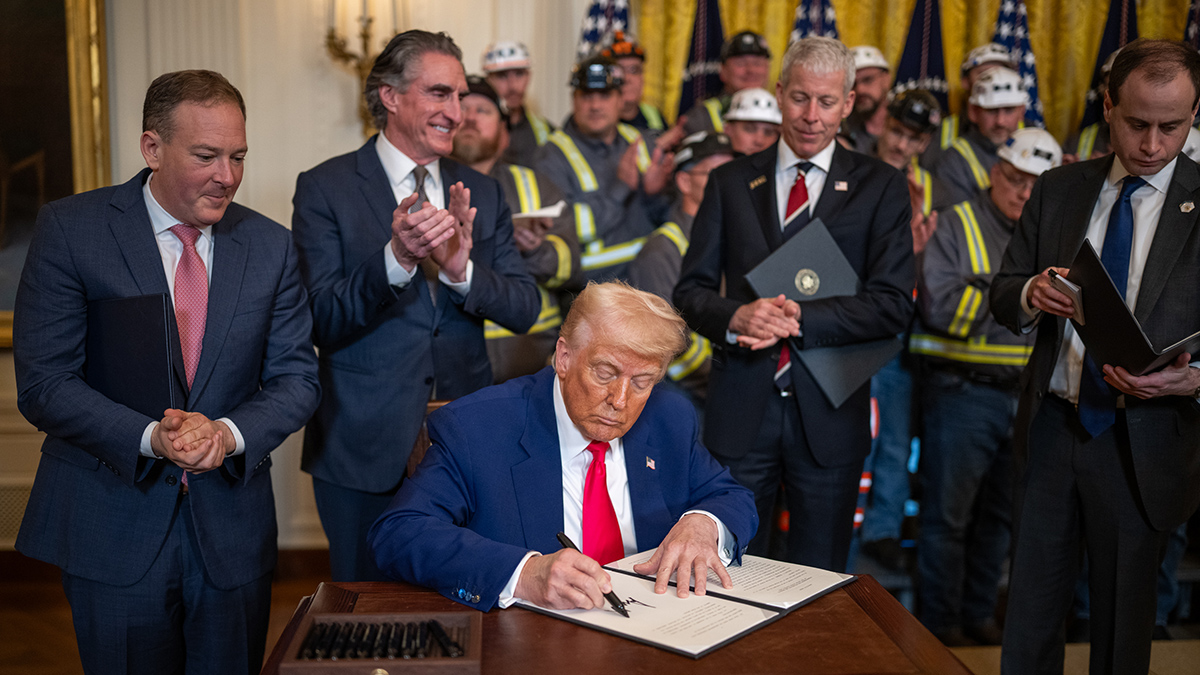
In an April EO seeking to revive the “beautiful clean coal industry,” the Trump administration directed agencies to identify possible new coal resources on federal lands. The order also laid out plans to identify and revise existing regulations and policies that might lead the country away from coal power or coal production. “It is the policy of the United States that coal is essential to our national and economic security,” the EO states.
Also in April, the Department of the Interior said it intended to fast-track approvals for coal, gas, oil, and mineral projects. The administration opened up millions of acres of federal land to oil and gas companies and additional millions of acres to potential coal mining projects. In September, the DOE announced it would invest $625 million to retrofit and modernize aging coal power plants, followed by an additional $100 million in federal funding for similar projects. In May, the administration ordered a coal power plant in Michigan to abandon its plans to shut down, citing a “shortage of electric energy” in the Midwest. In December, it also ordered two coal plants in Indiana, two in Colorado, and one in Washington to remain open.
Among the federal land opened to oil drilling is the Arctic National Wildlife Refuge, an iconic wilderness area in northern Alaska. In October, Interior Secretary Doug Burgum announced the federal government would open 1.56 million acres (631,000 hectares) of the refuge to oil and gas leasing, reversing a Biden moratorium on drilling activity there.
In November, the administration announced it planned to open almost 1.3 billion additional acres (526 million hectares) of U.S. coastal waters to new oil and gas drilling. The One Big Beautiful Bill mandated at least 36 oil and gas lease sales in federal waters.
“An offshore lease issued next year could keep pumping carbon into the atmosphere for the next 40 years,” Rebecca Loomis, an attorney at the Natural Resources Defense Council, told The New York Times.
Renewable energy projects have mostly received the opposite treatment, as federal agencies made a concerted effort to halt existing solar and wind energy projects and slow the permitting and approval process for new ones. Trump took particular aim at wind energy: An EO on the first day of his term withdrew all new offshore wind energy lease opportunities and suggested the possibility of terminating or amending existing leases. A coalition of state attorneys sued the administration, saying Trump does not have the authority to unilaterally make such mandates. In December, a federal judge wrote that the EO violated federal law.
“This arbitrary and unnecessary directive threatens the loss of thousands of good-paying jobs and billions in investments, and it is delaying our transition away from the fossil fuels that harm our health and our planet,” New York Attorney General Letitia James said of the EO.
Solar projects have suffered, too. The Trump administration slowed development on a solar project in Nevada that, if built, would be one of the world’s largest. In October, the EPA canceled $7 billion in grants for a popular clean energy program, Solar for All, meant to help low- and moderate-income households install solar.
Oil and gas permitting, but not renewable energy permitting, continued during the 44-day government shutdown this fall, as the Trump administration approved more than 470 permits to drill on public land. After the January 2026 military action in Venezuela, President Trump announced the country “will be turning over” 30-50 million barrels of oil and that the federal government would maintain control over Venezuela’s oil industry.
Hindering Climate Science
As the Trump administration hindered clean energy projects and boosted fossil fuels, it also targeted climate science. In February, Trump prohibited federal scientists from traveling to take part in a planning meeting of the Intergovernmental Panel on Climate Change (IPCC). Federal scientists were reportedly told to stop work on all IPCC-related activities, though some nonfederal U.S. scientists are still involved.
In April, the administration dismissed all scientists working on the United States’ own National Climate Assessment (NCA). In July, a spokeswoman for NASA told The New York Times that NASA would no longer host previous NCAs online. AGU and the American Meteorological Society have responded by creating a special collection on climate change to help catalyze and advance synthesis science to inform our understanding of risks and solutions for U.S. climate research and assessments. In December, the Trump administration asked a group of scientists known for their climate skepticism—the same group that authored the DOE report undermining the 2009 Endangerment Finding—to write the next installment of the NCA.
Additionally, many programs and offices collecting and analyzing climate data were shuttered this year because budgets were cut and staff were fired, creating a widening climate data void. In April, for example, the EPA failed for the first time to meet the obligations of a 1992 treaty setting greenhouse gas reporting requirements for wealthy countries. The Environmental Defense Fund released the data after filing a Freedom of Information Act request. The same month, political appointees told EPA staff that they planned to virtually eliminate the Greenhouse Gas Reporting Program, which requires the country’s largest industrial sites to report their emissions of carbon dioxide, methane, and nitrous oxide.
“The public has a right to know how much climate pollution is being emitted.”
“The public has a right to know how much climate pollution is being emitted,” Vickie Patton, an attorney at the Environmental Defense Fund, told The New York Times. “The attack on the data, the attack on the science, is irresponsible.”
Pieces of signature energy reports from the Energy Information Administration, a data-tracking arm of the Department of Energy, were removed, while the publication of its International Energy Outlook for 2025 was scrapped.
NOAA, once identified as “one of the main drivers of the climate change alarm industry,” has come under intense scrutiny. Under the Trump administration, the agency ended support for key data products at the National Snow and Ice Data Center, retired its Billion-Dollar Weather and Climate Disasters data product (though the nonprofit Climate Central is bringing it back to life), suspended work on a massive dataset meant to predict extreme rainfall, and consolidated climate data hosted on Climate.gov on another NOAA domain. The administration also canceled its lease for NOAA’s Global Monitoring Laboratory in Hilo, Hawaii, an important site for scientists tracking carbon dioxide in the atmosphere.
Trump proposed cutting virtually all funding for climate research at NOAA, though Congress is considering spending bills that include much more modest cuts. Congress is also considering a bill that would ensure the uninterrupted storage of NOAA datasets indefinitely.
NASA’s climate programs suffered, too: This spring, the Trump administration began the process of shrinking the NASA Goddard Institute for Space Studies, which maintains critical climate data records. And over the summer, the administration directed NASA employees to draw up plans to end satellite missions designed to monitor carbon dioxide emissions. Acting Administrator Sean Duffy made clear the agency will deprioritize all climate science.
The Department of the Interior cut funding to a third of the U.S. Geological Survey’s Climate Adaptation Science Centers, which funds projects aimed to help people, wildlife, land, and water adapt to local effects of climate change. This includes mapping risks of wildfire and flooding, maintaining infrastructure such as storm drains, and assessing fish and wildlife populations for both hunting and conservation.
The Trump administration also axed funding for the U.S. Global Change Research Program, a decades-old congressionally mandated interagency climate research program. And in November, a new organizational plan for the Energy Department no longer showed various offices that had overseen clean energy technology development.
More than 100 National Science Foundation (NSF) grants for climate-related science have been canceled as well. In December, the Trump administration announced that it would dismantle the NSF-funded National Center for Atmospheric Research (NCAR), one of the world’s leading climate and Earth science laboratories.
The administration also systematically removed mentions of climate change and related language from agency websites and directed the Department of Energy not to use certain language, including the words “green” and “decarbonization.” The EPA also erased references linking human activities to climate change from sections of its website.
And while geoengineering has not been a priority of the Trump administration, Rep. Marjorie Tayler Greene (R-GA) introduced the Clear Skies Act in July, which would impose $100,000 fines and potential jail time for anyone conducting “weather modification” activities.
Stalling Global Progress
The Trump administration’s approach to climate and energy policy has reverberated globally. The administration’s decision to pull out of the Paris Agreement (to take effect in January 2026) will set global projected emissions back 0.1°C (0.18°F) by 2100, according to a United Nations report.
The same EO that withdraws the United States from the Paris Agreement also directs the administration to revoke contributions to international climate finance funds. This directive means the global climate finance goal agreed upon at COP29 (the 29th Conference of the Parties to the U.N. Framework Convention on Climate Change) will be much more difficult to meet. In March, the administration also pulled the United States out of the Board of the Fund for Responding to Loss and Damage, a U.N. climate damage fund created at COP28 dedicated to helping finance developing countries’ climate adaptation efforts. The same month, the United States withdrew from the Just Energy Transition Partnership, an international collaboration formed at COP26 meant to help developing countries implement clean energy.
The Trump administration did not attend COP30 in Belém, Brazil, a move that other leaders admonished. “Mr. Trump is against humankind,” said Colombian President Gustavo Petro. It was the first time in COP history that the United States did not send a delegation.
In January 2026, the White House issued an EO ordering the withdrawal of the United States from the U.N. Framework Convention on Climate Change, a 1992 treaty that set the legal framework for international negotiations on climate change. According to the terms of the treaty, the formal withdrawal will occur one year after the government submits paperwork to the U.N., after which the United States will be the only country not engaged in the global agreement. The EO also ordered the withdrawal of the United States from the IPCC.
At an International Energy Agency meeting held in London in April, Trump administration staff members opposed policies to regulate fossil fuels. In September, Secretary of Energy Chris Wright traveled to Italy to attend the world’s largest natural gas conference. While in Europe, Wright urged European governments to ditch methane regulations, called net-zero goals “a colossal train wreck,” and downplayed the risks of climate change. “It’s turned out that not only does climate change not look to be an urgent threat…but doing something about it has proven remarkably difficult,” Wright told reporters in Brussels.
The Trump administration also attempted to use economic levers to encourage other nations to walk back their climate goals. In July, for instance, the administration agreed to reduce some tariffs on the European Union (EU) if the EU purchased $750 billion in American oil and gas. In December, the Trump administration asked the EU to exempt US oil and gas companies that sell oil and gas to Europe from European methane regulations.
Next Steps
Despite criticism of the DOE report and widespread opposition to the reconsideration of the rule—even Tesla wants to preserve it—the EPA is expected to move forward with revoking the Endangerment Finding in early 2026. The decision is expected to face serious legal challenges, and the Trump administration faces an ongoing lawsuit from the Environmental Defense Fund and the Union of Concerned Scientists over the controversial DOE report. Final repeals of federal vehicle fuel economy standards and power plant emissions limits are also expected in early 2026.
The future of climate programs like the Greenhouse Gas Reduction Fund, Solar for All, electric vehicle infrastructure funds, and other climate-related grants likely lies in the courts, not the ballot box. Environmental groups and other stakeholders have filed multiple lawsuits challenging these actions, and they are still proceeding through the legal system. A coalition of states has even sued Trump and his administration over the president’s initial declaration of a “national energy emergency.”
Curated Links
Key resources for this report and people interested in this topic:
American Geophysical Union (2025), Science societies take action after NCA authors’ dismissal this week, 2 May, news.agu.org/press-release/agu-and-ams-join-forces-on-special-collection-to-maintain-momentum-of-research-supporting-the-u-s-national-climate-assessment/.
American Meteorological Society (2025), The practice and assessment of science: Five foundational flaws in the Department of Energy’s 2025 climate report, 27 Aug., www.ametsoc.org/ams/about-ams/ams-statements/statements-of-the-ams-in-force/the-practice-and-assessment-of-science-five-foundational-flaws-in-the-department-of-energys-2025-climate-report/.
Carbon Brief (2025), Chart: Trump’s ‘big beautiful bill’ blows US emissions goal by 7bn tonnes, 4 July, www.carbonbrief.org/chart-trumps-big-beautiful-bill-blows-us-emissions-goal-by-7bn-tonnes/.
Cartier, K. M. S. (2025), NASA planning for unauthorized shutdown of carbon monitoring satellites, Eos, 5 Aug., eos.org/research-and-developments/nasa-planning-for-unauthorized-shutdown-of-carbon-monitoring-satellites.
Colman, Z. (2025), Energy Dept. adds ‘climate change’ and ‘emissions’ to banned words list, Politico, 28 Sept., www.politico.com/news/2025/09/28/energy-department-climate-change-emissions-banned-words-00583649.
Chemnick, J. (2025), Trump gutted climate rules in 2025. He could make it permanent in 2026. E&E News, 17 Dec., www.eenews.net/articles/trump-gutted-climate-rules-in-2025-he-could-make-it-permanent-in-2026/.
Dieckman, E. (2025), Executive order seeks to revive “America’s Beautiful, Clean Coal Industry,” Eos, 9 Apr., eos.org/research-and-developments/executive-order-seeks-to-revive-americas-beautiful-clean-coal-industry.
Dzomback, R. (2025), NASA website will not provide previous National Climate Reports, New York Times, 14 July, www.nytimes.com/2025/07/14/climate/nasa-website-climate-report.html.
Friedman, L. (2025), Interior Department to fast-track oil, gas and mining projects, New York Times, 23 Apr., www.nytimes.com/2025/04/23/climate/interior-department-gas-and-mining-projects.html.
Janis, B., and C. Richards (2025), Who will fill the climate-data void left by the Trump administration?, Nature, 14 Nov., https://doi.org/10.1038/d41586-025-03532-4.
Perez, N., and R. Waldholz (2025), Trump is withdrawing from the Paris Agreement (again), reversing U.S. climate policy, NPR, 21 Jan., www.npr.org/2025/01/21/nx-s1-5266207/trump-paris-agreement-biden-climate-change.
U.S. Department of Energy (2025), A Critical Review of Impacts of Greenhouse Gas Emissions on the U.S. Climate, Climate Working Group, Washington, D.C., www.energy.gov/topics/climate.
U.S. Environmental Protection Agency (2025), Proposed rule: Reconsideration of 2009 Endangerment Finding and greenhouse gas vehicle standards, 22 Aug., www.epa.gov/regulations-emissions-vehicles-and-engines/proposed-rule-reconsideration-2009-endangerment-finding.
van Deelen, G. (2025), NOAA halts maintenance of key Arctic data at National Snow and Ice Data Center, Eos, 8 May, eos.org/research-and-developments/noaa-halts-maintenance-of-key-arctic-data-at-national-snow-and-ice-data-center.
van Deelen, G. (2025), Proposed NOAA budget calls for $0 for climate research, Eos, 2 July, eos.org/research-and-developments/proposed-noaa-budget-calls-for-0-for-climate-research.
van Deelen, G. (2025), Public speaks out against EPA plan to rescind Endangerment Finding, Eos, 25 Aug., eos.org/research-and-developments/public-speaks-out-against-epa-plan-to-rescind-endangerment-finding.
van Deelen, G. (2025), Trump proposes weakening fuel economy rules for vehicles, Eos, 3 Dec., eos.org/research-and-developments/trump-proposes-to-weaken-fuel-economy-rules-for-vehicles.
Waldman, S. (2025), It’s the gold standard of US climate research. Contratians could write the next one., E&E News, 22 Dec., www.eenews.net/articles/its-the-gold-standard-of-us-climate-research-contrarians-could-write-the-next-one/.
—Eos (@eos.org)