Research & Developments is a blog for brief updates that provide context for the flurry of news regarding law and policy changes that impact science and scientists today.
Update, 11 March: Bidders have begun lining up to take over management of NCAR, Science reported. These bidders include the University of Oklahoma and the NOAA contractor Lynker. At the request of NSF, the University of Wyoming (UW) will propose taking over an NCAR supercomputing facility in Cheyenne. NSF is also expected to transfer two research aircraft currently operated by NCAR to either NASA or NOAA. Proposals are due by 13 March.
Some are concerned that NSF could direct UW to focus only on weather, rather than on climate models that forecast how atmospheric and weather conditions will change in the face of global warming.
“If we don’t maintain our ability to know what’s coming, we’re going to end up paying for it in the end,” Robert Goldhammer, former emergency manager of Iowa’s Polk County, told Science.
Update, 23 January: The National Science Foundation (NSF) today posted a Dear Colleague Letter soliciting ideas from the research community for how to proceed with restructuring of the National Center for Atmospheric Research (NCAR).
In the letter, NSF says it is “seeking transformative and creative concepts that enable efficient and cost-effective operations, management and continued evolution” of several NCAR capabilities, such as atmospheric observing platforms, atmospheric and space weather modeling and forecasting research, and training programs related to weather and space weather modeling and forecasting.
The letter also notes that NSF is “exploring options to transfer stewardship” of the NCAR-Wyoming Supercomputing Center and two research aircraft but that those plans “are being considered separately.”
Although NCAR is widely credited as a global leader in climate science and modeling, the Dear Colleague Letter makes no mention of these capabilities—or of the word “climate” at all.
Update, 16 January: The U.S. Senate passed a spending package on 15 January by a 85-14 vote without an amendment that would have safeguarded funding for the National Center for Atmospheric Research (NCAR). The spending package now goes to President Donald Trump’s desk to be signed into law.
The amendment was put forth by U.S. senators John Hickenlooper (D-CO) and Michael Bennet (D-CO).
In his floor speech before the vote, Hickenlooper noted that all Americans rely on NCAR data: “Here are a few more reasons why all of us should want NCAR to stick around: If you’re an American who likes to know whether a tornado is headed your way. If you’re one of the people who appreciates an early text alert before you get an oncoming winter storm. If you prefer to be on high ground, instead of stuck in your car, during a flash flood. Or, if you’d like to look at maps to show you where and when extreme weather is going to hit, then you need NCAR.”
In a statement after the vote, Hickenlooper said, “In the face of unrelenting political attacks from President Trump, we are standing together to protect institutions like NCAR that are vital to our state and our economy. Our government funding hold was one step in that effort.”
Senator Susan Collins (R-ME) spoke against the NCAR amendment.
17 December: The Trump administration is planning to dismantle the National Center for Atmospheric Research (NCAR), one of the world’s leading climate and Earth science research laboratories, according to a statement from Russ Vought, director of the White House Office of Management and Budget, to USA Today.
Vought called the facility “one of the largest sources of climate alarmism in the country” and said the administration had already started a comprehensive review of activities at the laboratory.
“Vital activities such as weather research will be moved to another entity or location,” Vought said.
The National Science Foundation established NCAR in 1960 as the foundation’s first federally funded research and development center. Among other work, NCAR researchers use both models and observations to study weather, air quality, water management, and solar storms. NCAR’s Derecho supercomputer, housed in Wyoming, allows researchers across the country to run detailed models stimulating phenomena such as cyclones and major wildfires.
Among other innovations, scientists at NCAR invented dropsondes, devices that drop from aircraft to measure pressure, temperature, and humidity during storms. They use models that predict how inclement weather will affect road safety. They are developing a turbulence detection system to allow aircraft to avoid rough spots, working to improve hurricane prediction, and projecting atmospheric conditions months in advance to provide guidance for U.S. military planners.
In a statement shared with Eos, Pamitha Weerasinghe, a science policy professional and director of a campaign to strengthen federal science called Knowledge for a Competitive America, said that the work conducted at NCAR has “formed the scientific bedrock on which modern America was built. To propose ‘breaking up’ NSF NCAR is to ignore the needs of American families and industries, and deny them the information and tools they need to prosper.”
The news comes as international Earth and space scientists, many of whom will likely be affected by the news, gather at AGU’s annual conference in New Orleans. Some took to social media to express their disappointment.
“NCAR is quite literally our global mothership,” climate scientist Katherine Hayhoe wrote on Bluesky. “Everyone who works in climate and weather has passed through its doors and benefited from its incredible resources. Dismantling NCAR is like taking a sledgehammer to the keystone holding up our scientific understanding of the planet.”
Other scientists expressed similar sentiments.
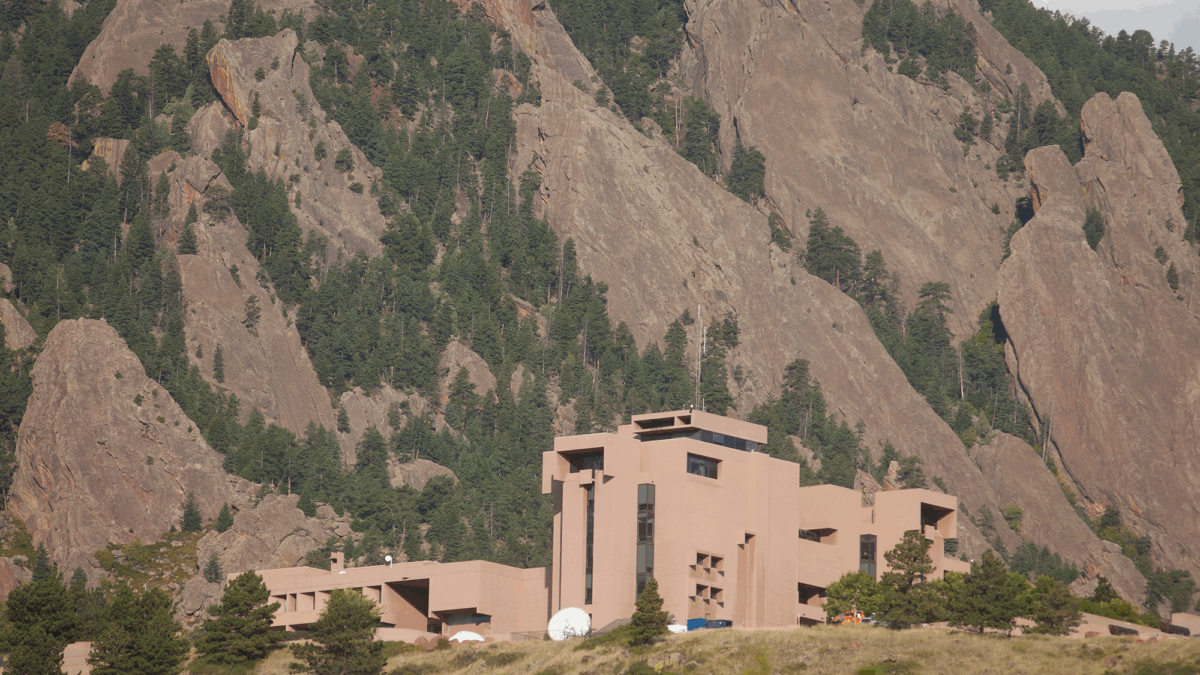
NCAR is home to about 830 employees, but it is not clear how many employees or programs the dismantling will affect. According to a senior White House official who spoke to USA Today, the effort will begin immediately, and includes closing the center’s headquarters: the Mesa Laboratory in Boulder, Colo. The official also flagged several programs the administration considers wasteful, such as efforts to make the sciences more inclusive and research into wind turbines.
In a 16 December statement posted on the NCAR website, Antonio Busalacchi, president of the University Corporation for Atmospheric Research, which manages NCAR, said the center was aware of the Trump administration’s proposal, but had not received additional information.
“NSF NCAR’s research is crucial for building American prosperity by protecting lives and property, supporting the economy, and strengthening national security,” he wrote. “Any plans to dismantle NSF NCAR would set back our nation’s ability to predict, prepare for, and respond to severe weather and other natural disasters.”
In a livestream about the news on Wednesday morning, weather and climate scientist Daniel Swain said NCAR is set to be dismantled for “reasons that do not align with the interests of Americans, which do not align with the interests of really anybody, anywhere in the world.”
“I think this is the moment to be reaching out to your lawmakers and speaking with journalists about the value of NCAR and what would be lost, what will be lost, if the current plan is fully put into motion,” he said.
To voice your support for NCAR, visit this AGU page, where you can find email text and a call script to share with your representatives.
—Emily Gardner (@[email protected]), Associate Editor, and Grace van Deelen (@gvd.bsky.social), Staff Writer
These updates are made possible through information from the scientific community. Do you have a story about how changes in law or policy are affecting scientists or research? Send us a tip at [email protected].