

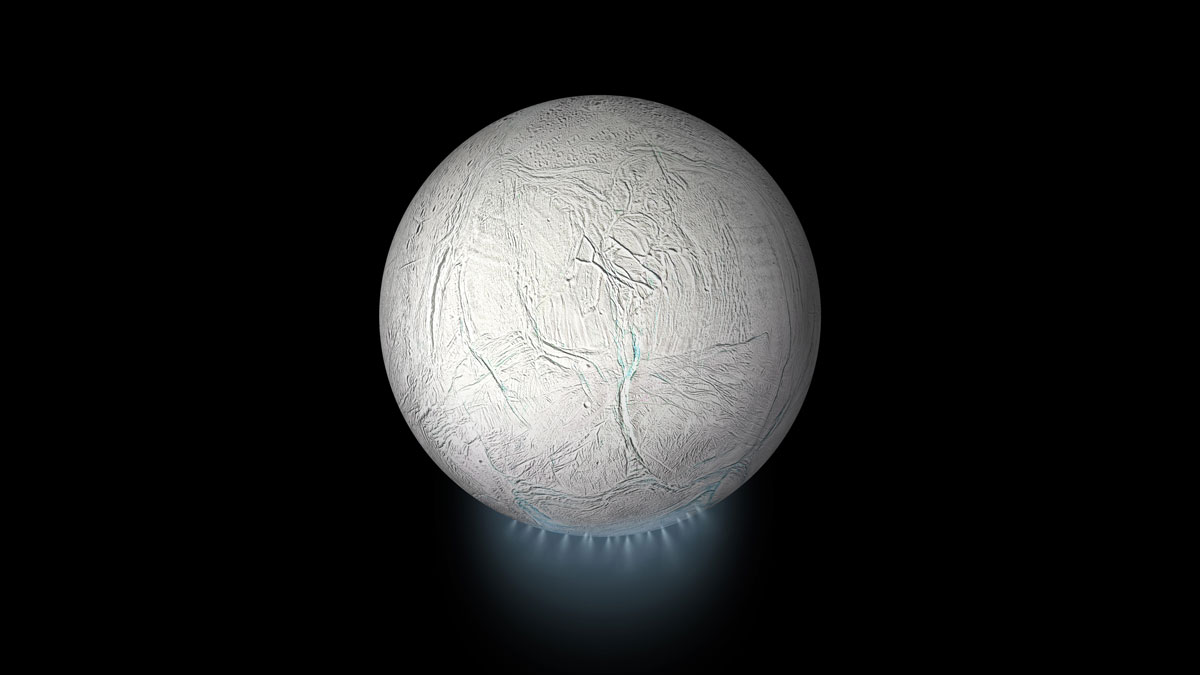
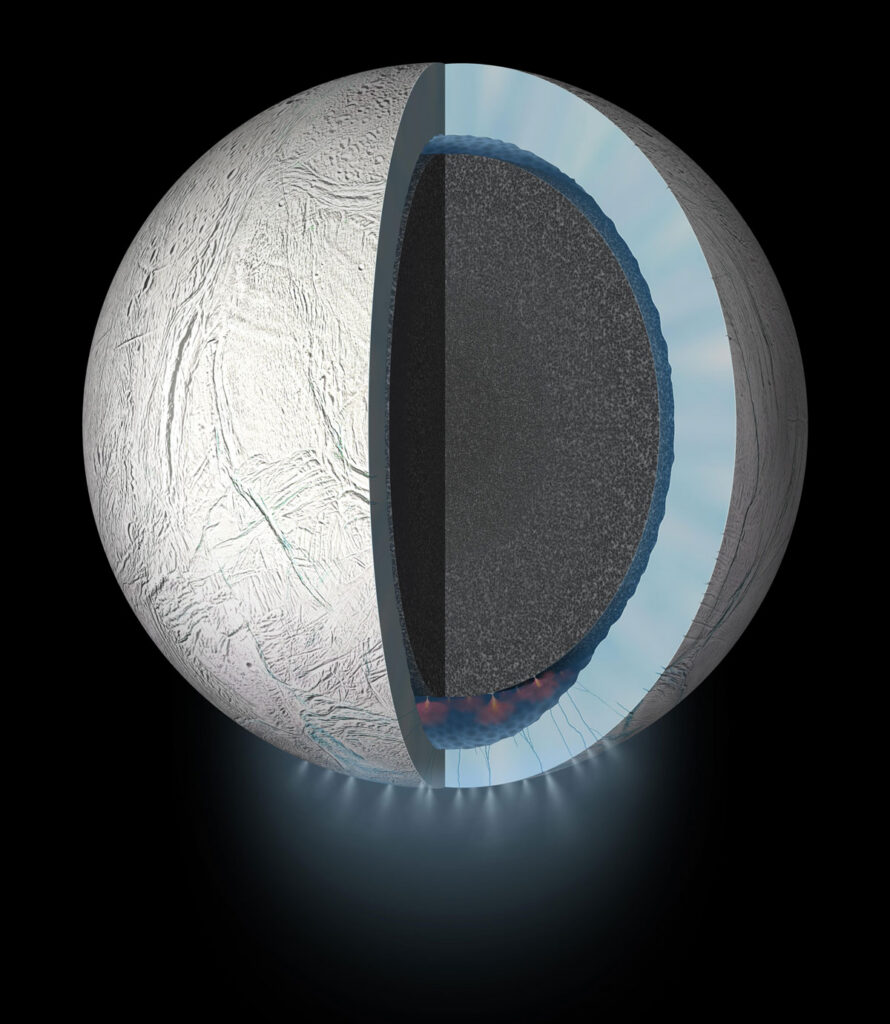
Saturn’s moon Enceladus sends signal flares into space that say, “Look here for life!” with every spray of its southern hemisphere geysers. The Cassini mission flew through and sampled the geyser spray in 2015, revealing that beneath Enceladus’s icy crust is a liquid water ocean with high concentrations of dissolved inorganic carbon (DIC), molecular hydrogen (H2), and methane (CH4). These properties make Enceladus a prime candidate for astrobiology missions.
But Enceladus’s subsurface ocean is far more alkaline than Earth’s ocean, with a pH closer to that of baking soda or ammonia-based cleaners than to terrestrial seawater. Too, Enceladus’s ocean is low on dissolved carbon dioxide (CO2), an essential foodstuff for methanogens, tiny organisms that create methane.
A team of researchers tested whether a terrestrial methanogen harvested from one of the most extreme locations on the seafloor could survive in a highly alkaline, low-CO2 liquid, multiply, and produce methane. The experiments showed that, yes, this particular archaeon could survive in the harsh environment of Enceladus’s ocean, expanding the range of what scientists might consider “habitable.”
Life at the Extremes
The presence of methane in Enceladus’s plume has long fueled speculation that a methane-producing organism might be creating it. On Earth, microorganisms that live in hydrothermal vents on the ocean floor use H2 and DIC as nutrients to grow and release methane as a waste product.
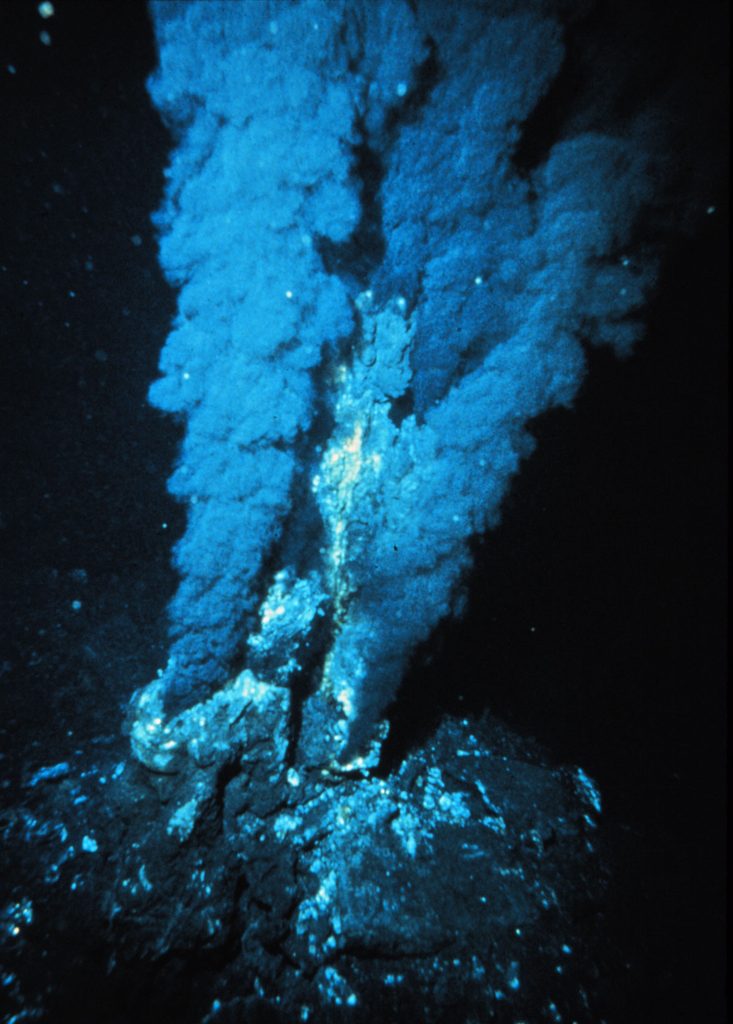
Both H2 and DIC have been detected in Enceladus’s plume, and past research has shown that a rock-water interaction called serpentinization might be generating H2 on Enceladus’s seafloor.
But Enceladus’s high alkalinity, a pH anywhere from 8 to 11.6, would be hard for any organism to survive, let alone maintain a stable or growing population. At those pH levels, DIC is mostly locked up in forms that organisms can’t access. Could the lack of CO2 starve methanogens out?
A team of researchers turned to archaea, microbes that live in some of the most extreme places on Earth, including volcanic hot springs, acid mine drainage, and hydrothermal vents. All methanogens are archaea (but not all archaea are methanogens).
“Archaea are known to be among the oldest cellular organisms that we know from Earth. They are quite ancient,” said Vanessa Helmbrecht, the new paper’s lead researcher and a doctoral student in paleontology and geobiology at Ludwig-Maximilians-Universität (LMU) in Munich, Germany.
One methanogen species of archaea from a hydrothermal system in Japan’s Okinawa Trough called Methanothermococcus okinawensis grows at a pH of 8.5. The team decided to push it to even greater extremes.
“If we had to pick one methanogen archaea that could grow in super alkaline conditions in Enceladus, this might be the one.”
“We thought, ‘Well, if we had to pick one methanogen archaea that could grow in super alkaline conditions in Enceladus, this might be the one,’” said coauthor William Orsi, an LMU geomicrobiologist.
In laboratory experiments, the researchers prepared mixtures that mimicked Enceladus’s ocean chemistry, serpentinization, and range of potential pH. They added M. okinawensis and observed its behavior over 48-hour periods.
The experiments showed that the archaea survived, reproduced, and created methane in the Enceladus simulant better than in control mixtures at the same pH. In the Enceladus simulant, M. okinawensis produced methane at pH levels up to 11, while the control groups died out at lower pH. That suggests serpentinization created enough H2 to feed the archaea despite the low availability of CO2.
Not only do these experiments expand the boundaries within which we know M. okinawensis can survive, said Helmbrecht, but they show that life as we know it might survive on Enceladus, too.
The team published these results in Science Advances in September.
Exploring the Common Ground
“Even so,” Berne added, “the study reframes habitability in terms of the combined pH, DIC, and H2 content of the ocean rather than pH alone, which directly informs the chemical measurements we are considering for future missions to Enceladus.”
The team noted that while the archaea survived in the Enceladus simulants at high pH, they exhibited signs of stress, and the populations did not grow as fast as they did at lower pH.
“They didn’t like it, but they grew anyways.”
“They weren’t necessarily happy,” Orsi said. At high pH, “they didn’t like it, but they grew anyways.”
Now that they have shown that one type of archaea can live in Enceladus-like conditions, the researchers hope to explore whether M. okinawensis would eventually adapt to the high pH and whether a more complex ecosystem could survive, too.
There’s no guarantee that organisms that may live on Enceladus resemble terrestrial life at all or use the same chemical pathways to consume energy to grow and reproduce, Helmbrecht emphasized. In experiments like these, she added, “we have to assume a common ground.”
Still, “we now have all the necessary elements that we need to [support] Earth-like life,” Helmbrecht said. “We have a liquid solvent, which is water, we have all the building blocks to make it. So, assuming that [life] looks like ours, it could potentially happen.”
—Kimberly M. S. Cartier (@astrokimcartier.bsky.social), Staff Writer