

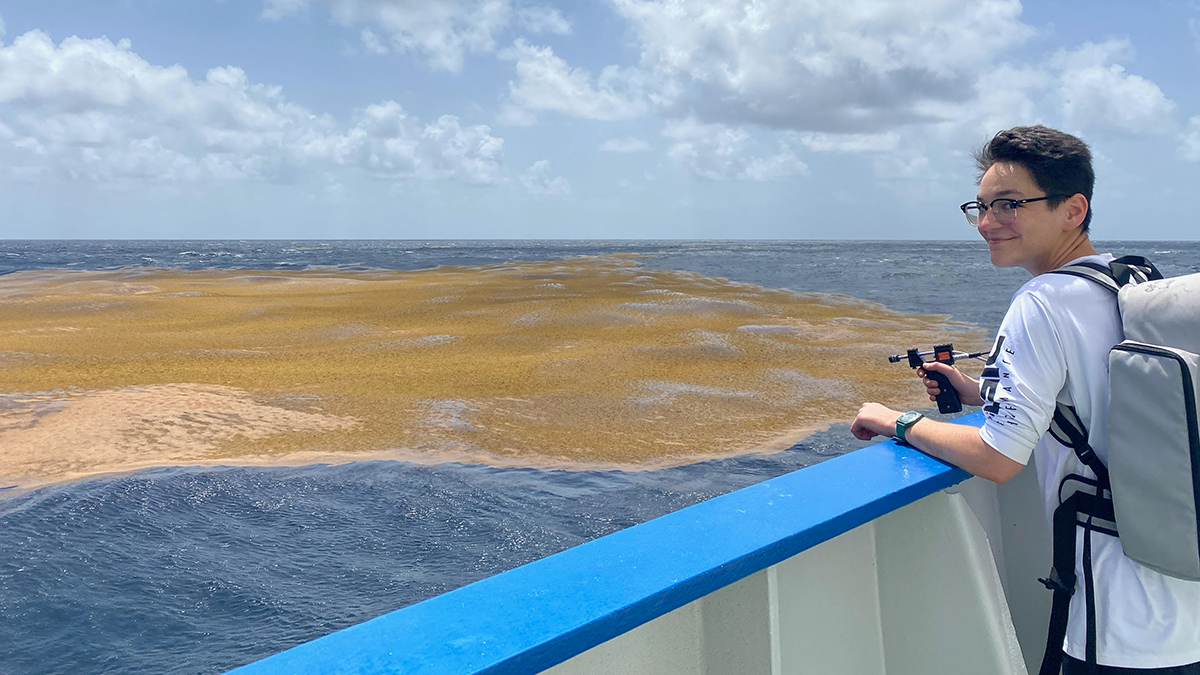
Sargassum has a bad reputation for washing up on shorelines, rotting on the beach, and creating a stinky mess. But this marine algae also functions as a habitat for many marine species, and new research published in Nature Geoscience indicates that its biomass has significantly declined where it once flourished: Since 2015, the amount of Sargassum in the northern Sargasso Sea has decreased by more than 90%. That change is likely caused by a reduced supply of healthy algae from the Gulf of Mexico, where water temperatures are rising, the researchers suggest.
“This is the only sea on Earth that has no physical boundaries.”
The floating brown algae known as Sargassum is found throughout the Atlantic Ocean, the Caribbean Sea, and the Gulf of Mexico. (Other species exist in the Pacific.) A region of the subtropical North Atlantic Ocean is even named in its honor: the Sargasso Sea. Rafts of Sargassum measuring tens of meters wide and several kilometers long frequently form in the Sargasso Sea, and marine life ranging from crabs to shrimp to sea turtles takes refuge in the nooks and crannies afforded by its leaves and air-filled bladders.
The Sargasso Sea is a geographical anomaly when it comes to bodies of water—it’s bounded by ocean currents, not land. “This is the only sea on Earth that has no physical boundaries,” said Chuanmin Hu, an optical oceanographer at the University of South Florida in Tampa and the senior author of the new study.
Spotting Algae from Space
To better understand how Sargassum populations have shifted over time in the Sargasso Sea and beyond, Hu and his colleagues mined archival satellite data. The team focused on observations made from 2000 to 2023 with the Moderate Resolution Imaging Spectroradiometer (MODIS) instrument, which collects data in the near- and midinfrared ranges of the electromagnetic spectrum. That spectral coverage is important because Sargassum, like all other vegetation, strongly reflects near-infrared light; ocean water, on the other hand, does not.
“Sargassum has a different signal than the background ocean water,” said Hu.
The team, coled by Yingjun Zhang, Brian Barnes, and Deborah Goodwin, exploited that telltale sign to estimate the amount of algae present in various swaths of water. The researchers focused on six geographic regions that cumulatively spanned more than 40° in latitude and 90° in longitude. The team was able to detect Sargassum where the fractional areal coverage of the algae was as low as 1 part in 500. There can be up to about 5 times that much Sargassum in a pixel, said Barnes, a satellite oceanographer at the University of South Florida in St. Petersburg.
The Northern Sargasso Sea, with Less Sargassum
The researchers found that Sargassum populations in the northern part of the Sargasso Sea have decreased dramatically since 2015—the satellite data revealed a roughly twelvefold drop in average biomass between 2000–2014 datasets and 2015–2023 datasets. (Measurements from the team’s shipboard surveys showed that Sargassum density declined by only about 50% over the same time period, but the team noted that those in situ data are sparse and potentially suffer from sampling bias.) If the satellite data are reflecting reality—and it’s likely that they are—that’s a substantial decrease in Sargassum, said Barnes. “There’s so much less now.”
At the same time, there’s been a proliferation of Sargassum in the so-called Great Atlantic Sargassum Belt. This 9,000-kilometer-wide swath of the ocean stretching from western Africa to the Gulf of Mexico saw an uptick in Sargassum beginning in 2011 that hasn’t abated. But it’s not as though the Great Atlantic Sargassum Belt is robbing the northern Sargasso Sea of its algae. The Great Atlantic Sargassum Belt is playing a role in the demise in the northern Sargasso Sea, but the largest changes are likely caused by shifting conditions in the Gulf of Mexico, the team surmised.
The agent that facilitates all of these connections? That’s ocean currents, said Zhang, an oceanographer at the Scripps Institution of Oceanography at the University of California, San Diego. The Sargasso Sea and the Gulf of Mexico may be thousands of kilometers apart, but they’re nonetheless linked by waters on the move.
Algae on a Journey
Satellite data have shown that the Gulf of Mexico is one of the key sources of Sargassum that ultimately ends up in the northern Sargasso Sea. The algae makes a journey that lasts several months: From the Gulf of Mexico, Sargassum hitches a ride on ocean currents—namely, the Loop Current and the Florida Current—before getting swept up in the Gulf Stream. It then makes its way along the East Coast of the United States before finally reaching the northern Sargasso Sea.
But sea surface temperatures have been rising in the Gulf of Mexico in recent years, often reaching more than 30°C in the summertime. Sargassum prefers temperatures ranging from 23°C to 28°C, and heat-stressed algae are less likely to survive the monthslong journey to the northern Sargasso Sea, said Hu. “During the long-distant transport, most of it will die.”
“You have a one-two punch.”
That makes sense, said William Hernandez, an oceanographer at the University of Puerto Rico–Mayaguez who was not involved in the research. Sargassum stressed by high temperature is less likely to take up nutrients and grow adequately, he said. “It’s the same thing that you see in terrestrial vegetation.”
In addition to heat stress, Sargassum in the Gulf of Mexico is also likely suffering from a lack of nutrients. That’s because the plentiful Sargassum in the Great Atlantic Sargassum Belt is gobbling up necessary compounds like phosphorus and sulfates, said Hernandez. So when currents off the coast of South America and in the Caribbean sweep water into the Gulf of Mexico, they’re transporting something that’s essentially already been picked over, he said. “By the time those waters reach that area, they’ve already been depleted of their nutrients.”
The combined effects of heat stress and limited nutrients really wallop Sargassum populations, said Hernandez. “You have a one-two punch.” There might well be ecological repercussions to having less Sargassum in the northern Sargasso Sea, the team suggests. Fish and other creatures rely on Sargassum for habitat, so less algae could translate into measurable impacts on other animals. Collecting in situ animal data in the Sargasso Sea will help answer that question, said Hu. “There should be impacts on other animals. Is that the case?”
—Katherine Kornei (@KatherineKornei), Science Writer