
Editors’ Highlights are summaries of recent papers by AGU’s journal editors.
Source: AGU Advances
Methane is the second-most important greenhouse gas and is increasing in the atmosphere. Unlike CO2, which is taken up by the land and oceans, CH4 (methane) is destroyed in the atmosphere, mostly by reaction with OH (methane-hydroxyl radical). As methane is one of the largest sinks for the OH radical, it is also a control over atmospheric OH concentration, which in turn controls the lifetime of CH4 in the atmosphere, creating a feedback.
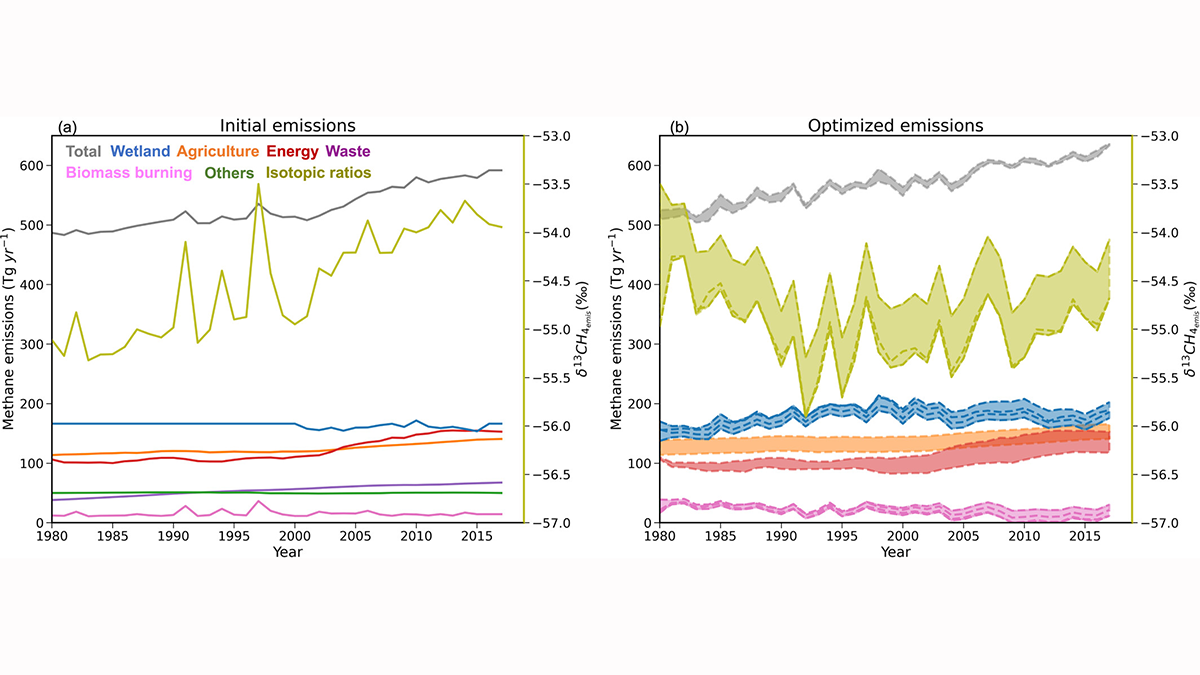
He et al. [2026] shows how the recent increases can best be explained by enforcing consistence between three terms: the CH4 concentration itself, the isotopic concentration of CH4 which reflects sources with different signatures, and the abundance of OH simulated with a state-of-the art chemistry model. The results show that changes to atmospheric CH4 are best explained by a mix of increasing (tropical agriculture), and decreasing (biomass burning) sinks, modulated by the global OH trend. The authors also find that that the fate of emitted CH4 in the atmosphere is sensitive to chemical feedbacks, which, if ignored, could lead to incorrect assumptions about sources, and hence, diminish the effectiveness of mitigation.
Citation: He, J., Naik, V., & Horowitz, L. W. (2026). Interpreting changes in global methane budget in a chemistry-climate model constrained with methane and isotopic observations. AGU Advances, 7, e2025AV001822. https://doi.org/10.1029/2025AV001822
—David Schimel, Editor, AGU Advances