
Editors’ Highlights are summaries of recent papers by AGU’s journal editors.
Source: AGU Advances
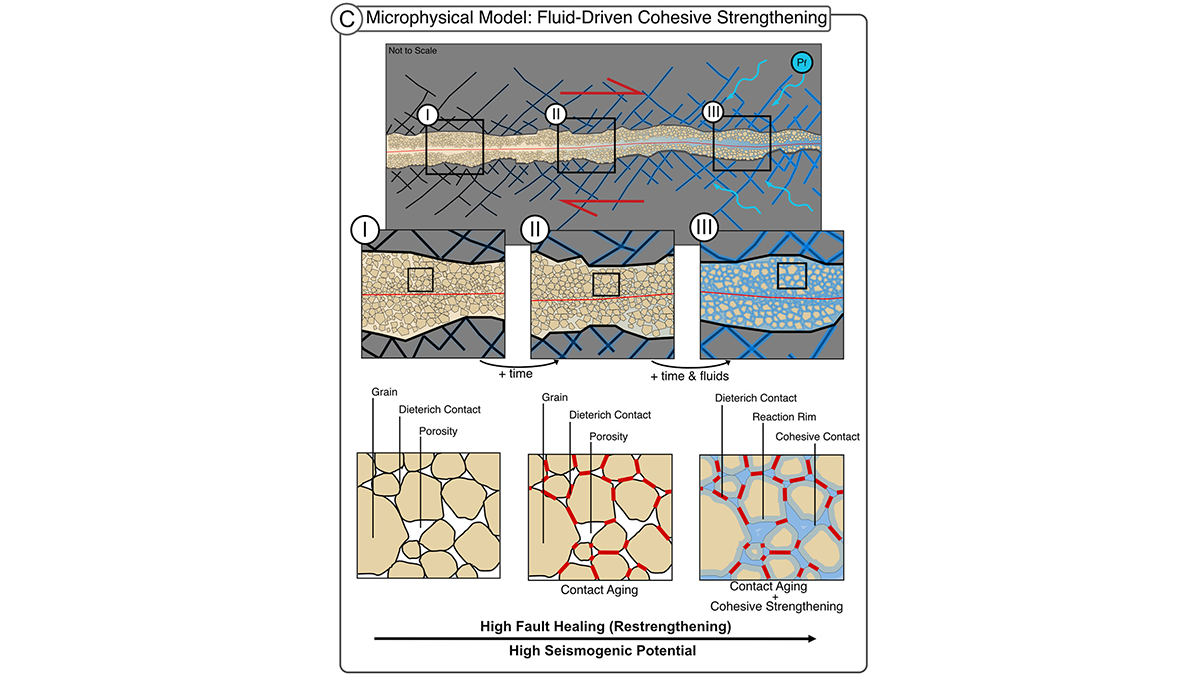
After an earthquake, the fault that ruptured locks up and rebuilds its strength in a process called fault healing. This restarts the slow buildup of elastic energy toward the next earthquake. Healing rebuilds strength through mechanical friction where grains touch and through chemical reactions such as mineral growth and cementation that bind grains into cohesive bonds. This chemical, cohesion-building side has been the hardest to reproduce in the laboratory, so how fast healing proceeds—and how its frictional and chemical parts combine—has remained poorly known.
Classic fault-strength laws such as the Coulomb criterion include cohesion but not healing, whereas the rate-and-state friction models used to predict how slip evolves capture the frictional part of healing while treating cohesion as negligible. Fluids also affect fault strength, reducing the stress that clamps a fault and weakening its resistance to sliding. Yet in fluid-rich settings—from injection wells to subduction zones—faults that fluids should have weakened into slow creep often rupture in earthquakes instead.
Affinito et al. [2026] address this paradox with controlled experiments on anhydrite, a calcium-sulfate mineral that reacts with water fast enough to study healing in hours rather than millennia, deformed under dry, water-saturated, and high fluid-pressure conditions. They show that water triggers a reaction—anhydrite turning into gypsum—that cements grains together, so wet faults heal much faster and build cohesion. Combining frictional and chemical healing into a single law, the authors add this growing cohesion to the standard criterion for fault stability, and find that it can drive seismic slip even on faults that friction laws expect to creep. Bridging rock physics and geochemistry, these results help explain seismicity in fluid-rich settings, though the model still needs testing against observations from natural faults and a description of how that cohesion is lost as a fault slips.
Citation: Affinito, R., Volpe, G., Calzolari, L., Mittal, T., Pozzi, G., & Marone, C. (2026). Fluid-driven cohesive strengthening: Critical role of reaction kinetics as the determinant for frictional stability. AGU Advances, 7, e2025AV001952. https://doi.org/10.1029/2025AV001952
—Marcos Moreno, Editor, AGU Advances