
Editors’ Highlights are summaries of recent papers by AGU’s journal editors.
Source: AGU Advances
Atmospheric rivers (ARs) are coherent current structures in the atmosphere that transport moisture and are important elements to deliver water through heavy precipitation events. They can also cause substantial hazards in many regions of the world. Due to their intrinsically long and narrow extent and high variability, it is challenging to observe and detect trends in AR activity and characteristics. Yet, this would be crucial for water resource planning and adaptation strategies.
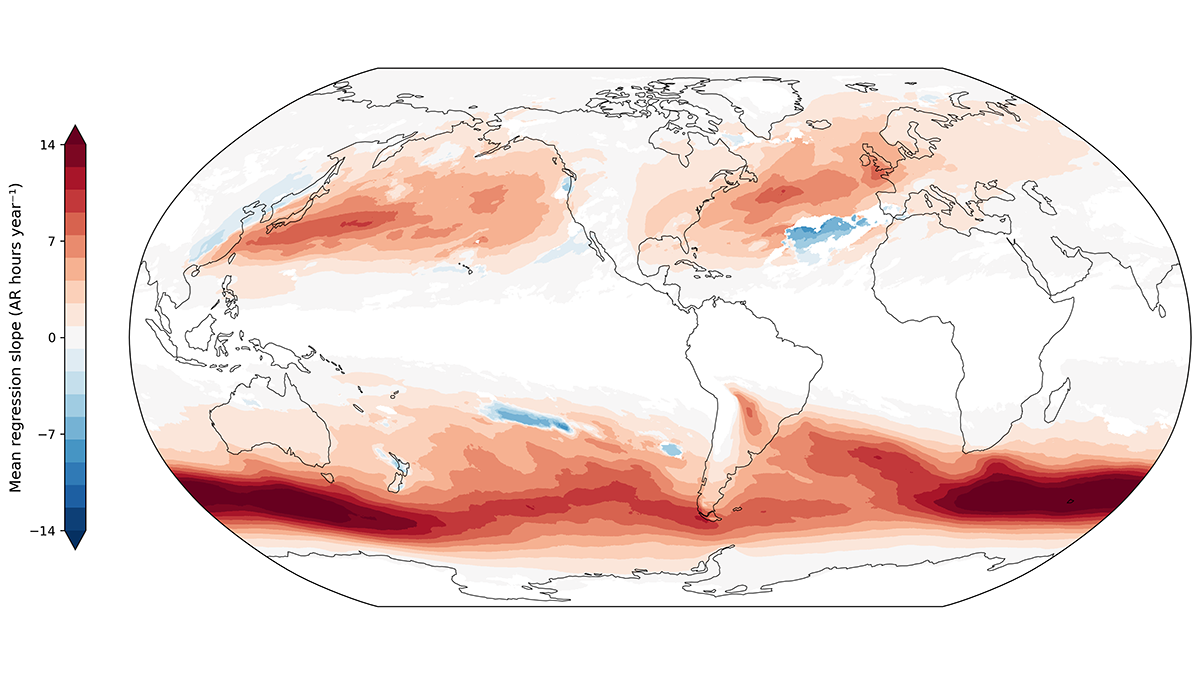
Based on hourly atmospheric reanalysis data and applying several identification tools, Scholz and Lora [2025] find that the frequency of ARs in mid-latitudes of both hemispheres has robustly increased since 1940. Particularly, in the Southern Hemisphere, over the eastern United States, the North Atlantic region and into western Europe (see Figure), with concurrent increases in precipitation and snowfall. Less obvious surface impacts of ARs are warm winters and extreme heat events.
The longer-term context for AR trends that is established by the authors helps climate model simulations to better assess this important feature of atmospheric circulations and eventually improve projections. These are crucial inputs for decision makers to make water management and hazard prevention fit for the future. However, for example, formal detection and attribution studies on ARs are still challenging due to the large uncertainties associated with this fine-scale feature of atmospheric circulation.
Citation: Scholz, S. R., & Lora, J. M. (2025). Widespread increase in atmospheric river frequency and impacts over the 20th century. AGU Advances, 6, e2025AV001888. https://doi.org/10.1029/2025AV001888
—Thomas Stocker, Editor, AGU Advances