
Editors’ Highlights are summaries of recent papers by AGU’s journal editors.
Source: Geophysical Research Letters
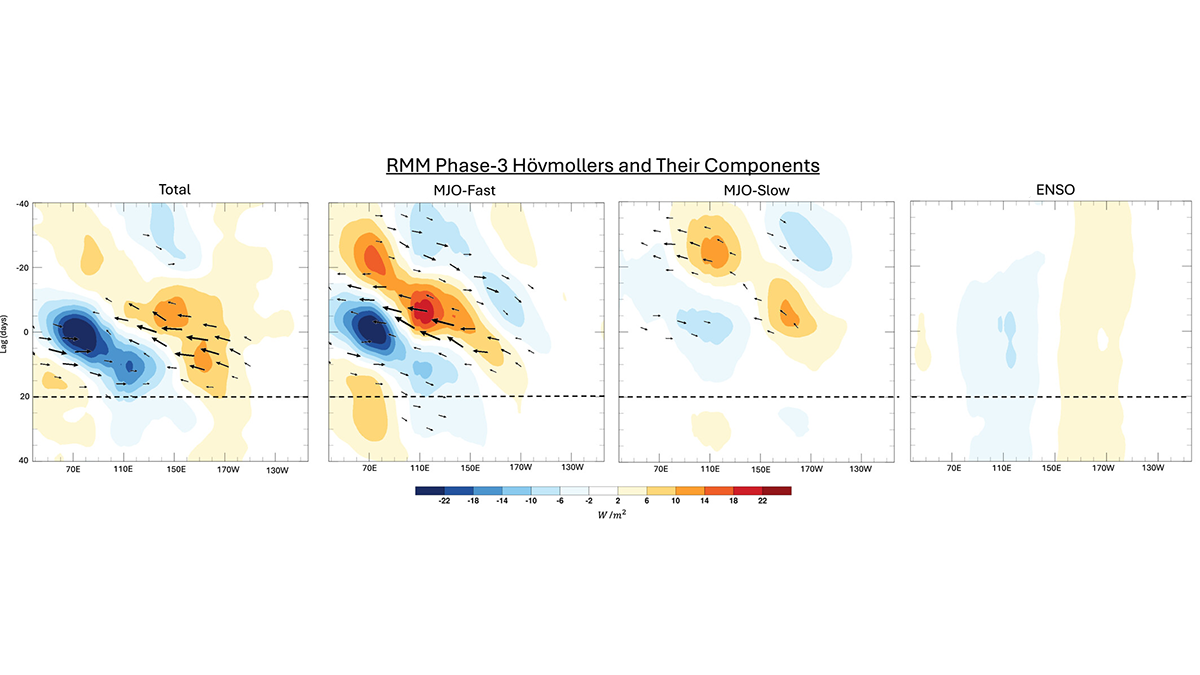
Subseasonal forecasts have skill due to the existence of the Madden-Julian Oscillation (MJO), which modulates convection in the tropics while moving eastward along the equator. In a new study, Marsico et al. [2026] use a data-driven model to identify two modes of the MJO — a fast-MJO mode, with a 45-day period, and a slow-MJO mode, with a 70-day period. These two modes interact constructively and destructively and when combined can reproduce the well-known characteristics of the MJO. The authors find that if these modes and their combination are identified in subseasonal forecasts, the skill of the MJO forecasts can be improved by approximately one week, which would significantly improve the forecast skill.
Citation: Marsico, D. H., Albers, J. R., Newman, M., Gehne, M., Dias, J., Kiladis, G. N., et al. (2026). Modal interference drives Madden-Julian Oscillation evolution and predictability. Geophysical Research Letters, 53, e2025GL118062. https://doi.org/10.1029/2025GL118062
—Suzana Camargo, Editor, Geophysical Research Letters