
Editors’ Highlights are summaries of recent papers by AGU’s journal editors.
Source: Water Resources Research
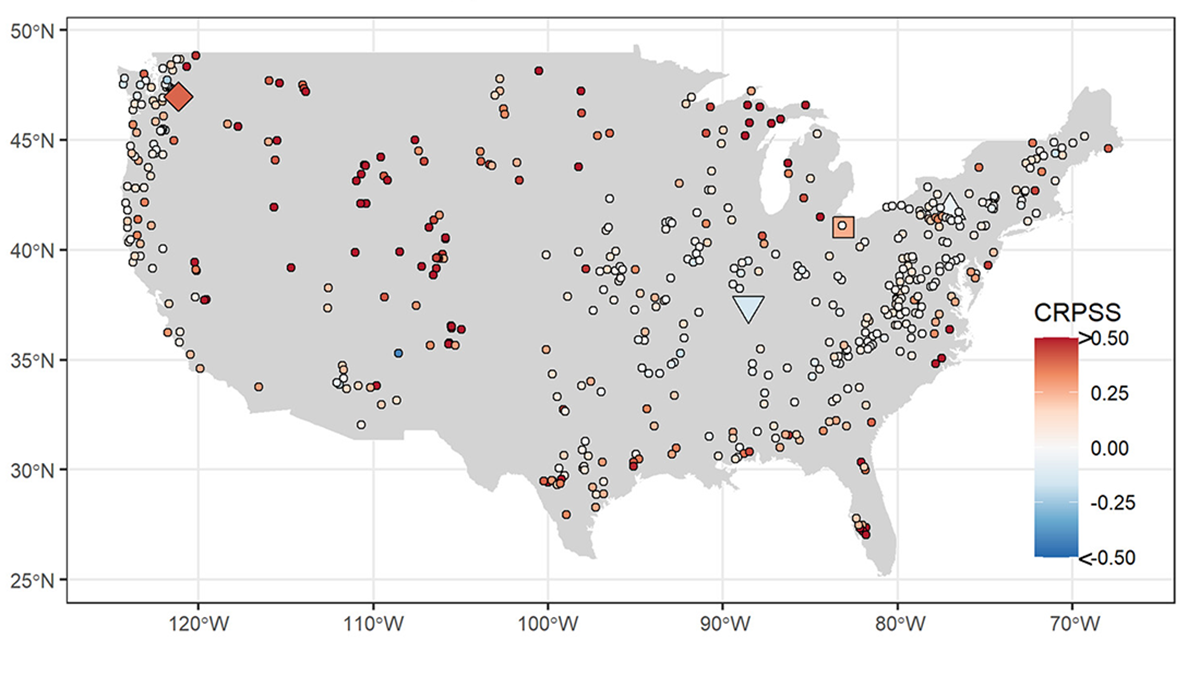
In the July 2026 issue of Water Resources Research, Yang et al. [2026] present an innovation in streamflow prediction utilizing an artificial intelligence (AI) technology that you probably already know from everyday smartphone applications. Imagine there is something in a photo that is bothering you. You use an eraser to remove it, and the background is filled automatically using a generative diffusion model. In this study, the diffusion model technology has been advanced and is used not only to predict streamflow, but also to temporally downscale and assimilate observations extremely efficiently. Benchmarking against other competitive methods on the Catchment Attributes and MEteorology for Large-sample Studies (CAMEL) data set shows improved performance with respect to the baseline and extremes. This study opens up many new avenues for addressing the major challenges in hydrology related to prediction under uncertainty, spatial and temporal downscaling, and merging models with observations.
Citation: Yang, W., Ji, H., Lonzarich, L., Song, Y., Pan, M., Lawson, K., & Shen, C. (2026). Diffusion-based probabilistic modeling for hourly streamflow prediction and assimilation. Water Resources Research, 62, e2025WR042720. https://doi.org/10.1029/2025WR042720
—Stefan Kollet, Editor, Water Resources Research