
Editors’ Highlights are summaries of recent papers by AGU’s journal editors.
Source: AGU Advances
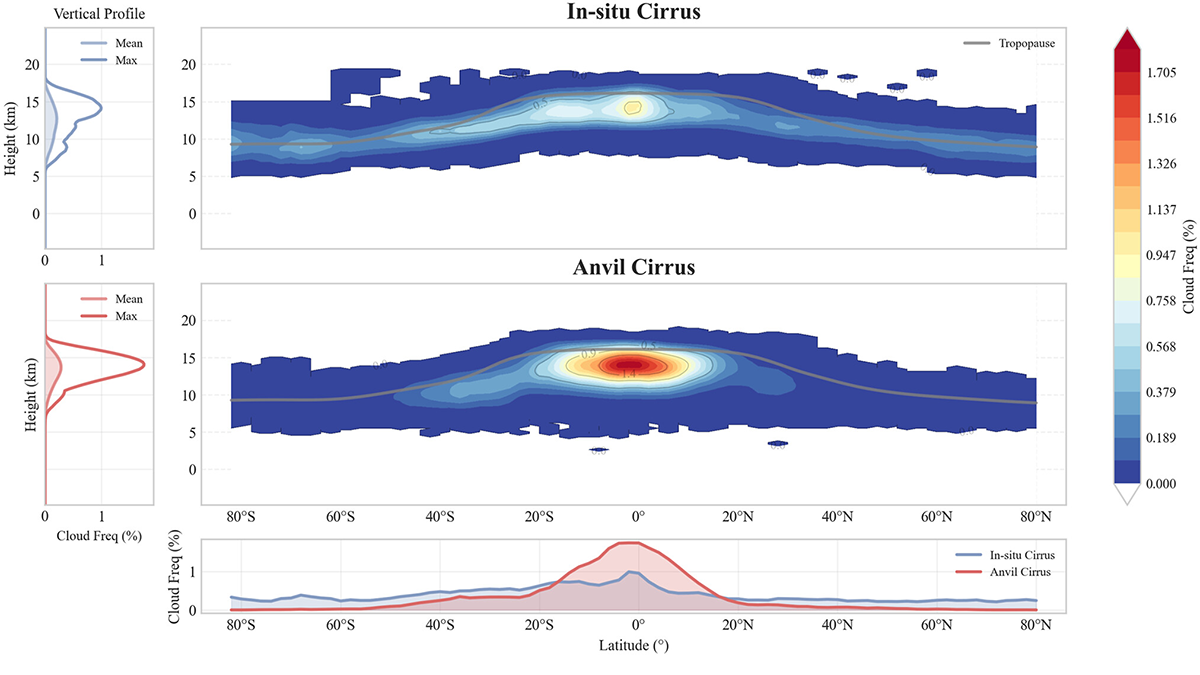
Cirrus clouds—the wispy, high-altitude ice clouds—are critical players in Earth’s climate. They form in two main ways: anvil cirrus spread out from large storm systems, while in-situ cirrus form on their own, high in the quiet atmosphere. Telling these two types apart on a global scale has been a long-standing challenge.
Using an innovative method that applies computer vision to satellite data, Mu et al. [2025] create the first global maps that cleanly separate these cloud types. The analysis reveals a surprising connection across the planet: powerful storm systems in one half of the world generate massive atmospheric waves that travel across the equator, significantly influencing the formation of in-situ cirrus in the opposite hemisphere.
This discovery highlights how interconnected our climate is and confirms that the two cirrus types are governed by different rules. Anvil cloud amount is driven by storm activity in its own hemisphere. In contrast, in-situ cloud formation, while dependent on local conditions, is also clearly controlled by major storms thousands of miles away. This newfound coupling is vital for climate models to accurately predict how shifting storm patterns under global warming will reshape our future climate.
Citation: Mu, Q., Ge, J., Huang, J., Hu, X., Peng, N., Li, Y., et al. (2025). A new classification of in situ and anvil cirrus clouds uncovers their properties and interhemispheric connections. AGU Advances, 6, e2025AV001919. https://doi.org/10.1029/2025AV001919
—Donald Wuebbles, Editor, AGU Advances