


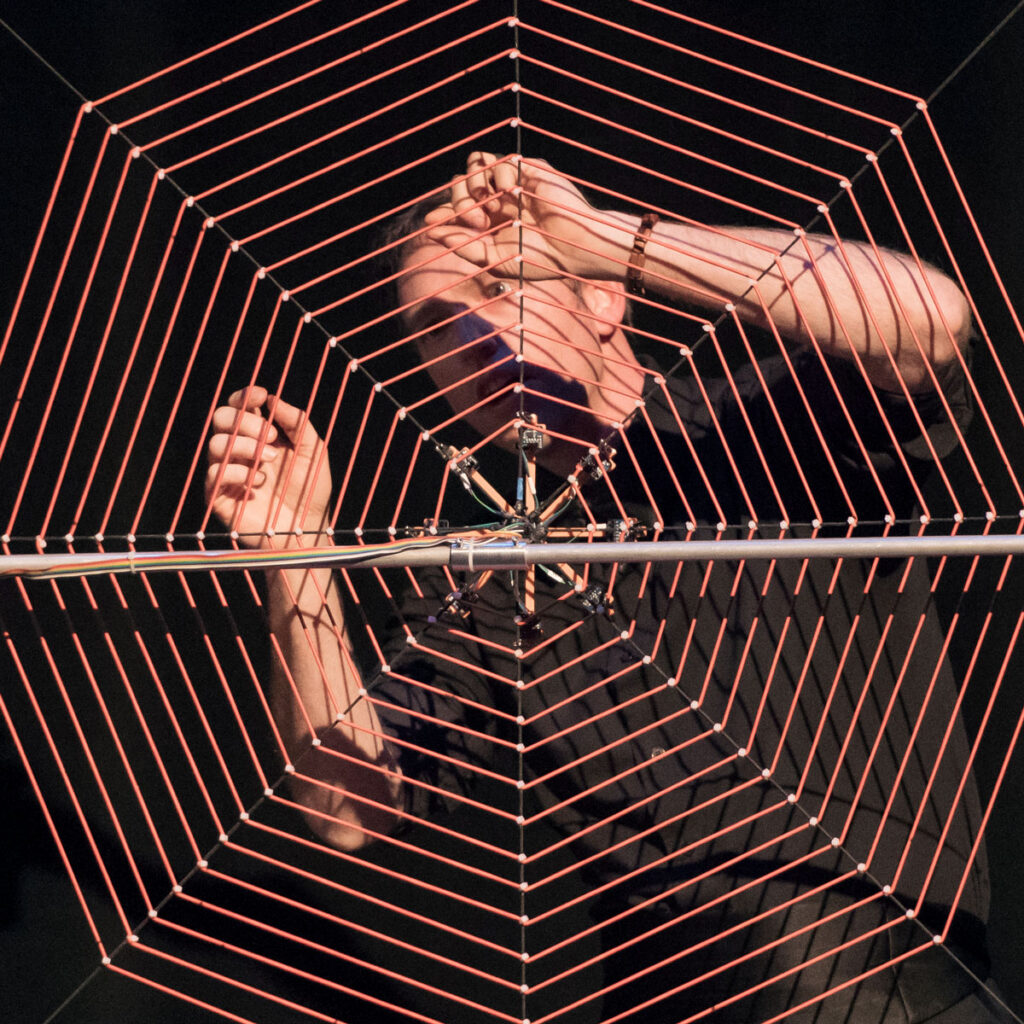
Just one musician has ever played a version of “The Itsy Bitsy Spider” on a larger-than-life spiderweb or covered Phil Collins’s “In the Air Tonight” on the Optron, an electric guitar–lightsaber mashup that visualizes music with multicolored lights.
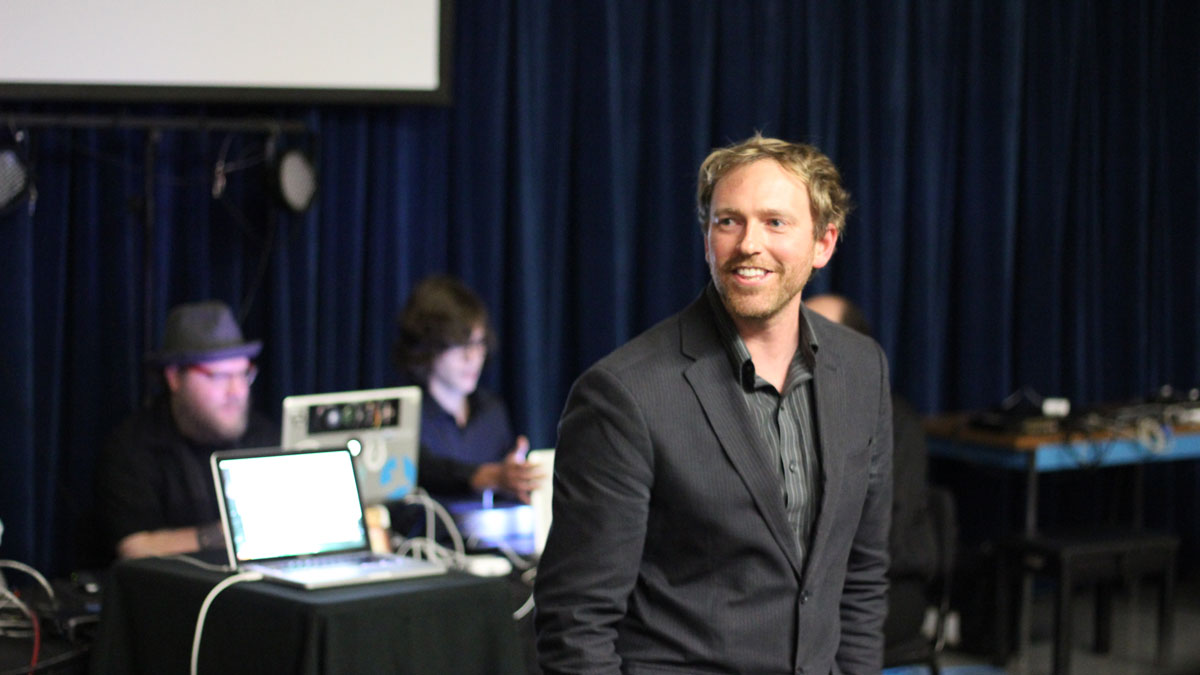
Chet Udell, a professor, musician, engineer, and designer at Oregon State University (OSU), is that musician. The Optron and SpiderHarp are just two of the inventive instruments—musical and otherwise—he’s created over his career.
When he’s not performing or designing new musical instruments, Udell creates instruments for scientists, too, including a vibrational camera trap that monitors agricultural pests and a dendrometer that measures tiny fluctuations in plant stems using magnets.
He’s passionate about creating new tools for hard-to-measure variables. As director of OSU’s OPEnS Lab, which stands for Openly Published Environmental Sensing Lab, Udell shares his knowledge to help undergraduates design, build, and deploy their own new environmental sensing technologies. At AGU meetings, Udell has convened MacGyver sessions to create spaces for scientists to experiment with their own designs.
“So many times, researchers are having to compromise their questions to fit within the constraints of instrumentation,” he said. “That’s the tail wagging the dog—wouldn’t it be great if it was the scientific questions that were driving innovation in instrumentation?”
At a young age, Udell developed a love for music, which kept him grounded during a tumultuous, difficult childhood. “Music was deeply personal, and a way to process reality,” he said. But he struggled in math and science classes.
What is one book, movie, or piece of media about your field that you would recommend to young scientists?
For opening up my ears, this book made a big impact on me in early grad school: R. Murray Schafer, The Soundscape: Our Sonic Environment and the Tuning of the World.
And this book helped me think more about myself and career situation as an organism-environment. There’s some great stuff in here about ecology (interconnectedness), play, and flexibility and adaptation. A great framework for considering any research subject, or yourself:
Gregory Bateson, Steps to an Ecology of Mind.
Music, though, turned him toward STEM (science, technology, engineering, and mathematics) topics: He attended Stetson University as an undergraduate on a trombone performance scholarship, where he was required to take a programming class tailored for musicians. Seeing that numbers and code on a screen could translate into “dope beats and really cool sounds,” Udell set out on a new path with a burgeoning interest in experimental music. He enrolled in math and physics classes to aid his understanding of music, instrument design, and engineering, eventually earning master’s and doctoral degrees from the University of Florida in music composition and electrical engineering.
“As long as I could tie it in with my passion for music and exploring sound,” he said, “then I did whatever it took to understand it.”
This August, Udell will finish a yearlong residency at the Hatfield Marine Science Center at Oregon State, where he’s created interactive audio installations for visitors to learn about the ocean and coasts. He’s appreciated the opportunity to learn about the ocean while developing creative projects. “There are so many different ways you can use sound to understand the oceans,” he said. “It’s really opened up my mind.”
Udell advises others who may not be able to clearly picture the direction of their career to follow their interests, “acknowledging that the currents of life are just going to take you to places you never expected to be.”
—Grace van Deelen (@gvd.bsky.social), Staff Writer
This profile is part of a special series in our August 2026 issue on science careers.