

In late April 2026, a weakened polar vortex drove the outbreak of a cold Arctic air mass that threatened European crops with frost just as the growing season was starting. Temperatures in some places dropped 10°C–15°C relative to the seasonal average, posing particular hazards for vineyards and orchards.
Severe cold air outbreaks (CAOs) like this aren’t uncommon: Another event, in February 2021, sent an Arctic blast that dropped temperatures precipitously through the central United States, causing prolonged, widespread, and costly power outages in Texas especially.
Outbreaks of cold, dry air from the Arctic, as well as influxes of warm and moist air masses to the region, influence and are being influenced by rapid changes occurring in the Arctic climate system.
Increasingly, outbreaks of cold, dry air from the Arctic, as well as influxes of warm and moist air masses to the region, influence and are being influenced by rapid changes occurring in the Arctic climate system, including enhanced warming and dramatic sea ice loss. These air mass transport events, which link the Arctic atmosphere with midlatitudes, are also often accompanied by extreme weather.
Air masses transform significantly as they travel over open ocean and sea ice. For example, their temperature and moisture contents, as well as cloud and precipitation patterns, evolve. These transforming characteristics determine both local and large-scale effects of weather events along the air mass transport paths. Seasonal variability, especially related to the influx of solar radiation (absent during polar night), can have dramatic influences on these air mass transformations. However, the processes driving these influences are not well understood.
Specifically, representations of the development of clouds and the atmospheric boundary layer (the layer closest to Earth’s surface) during air mass transport events to and from the Arctic, particularly during the polar night of winter, are a significant weakness of numerical weather and climate models.
Overcoming these deficiencies, which would help us understand and forecast the potential impacts of these events, can be achieved through coordinated observations intended to contrast seasonally varying influences. Such measurements are exceedingly rare, especially in winter, but forthcoming efforts can capitalize on newly developed techniques for observing air masses firsthand and for modeling their movement and transformation.
An Arctic-Midlatitude Link
The Arctic is a crucial regulator of the global climate system and is linked to processes that occur far beyond its boundaries. Atmospheric interactions between the Arctic and midlatitudes take place primarily through meridional (north to south or south to north) air mass transports, including CAOs and warm air intrusions (WAIs; Figure 1).
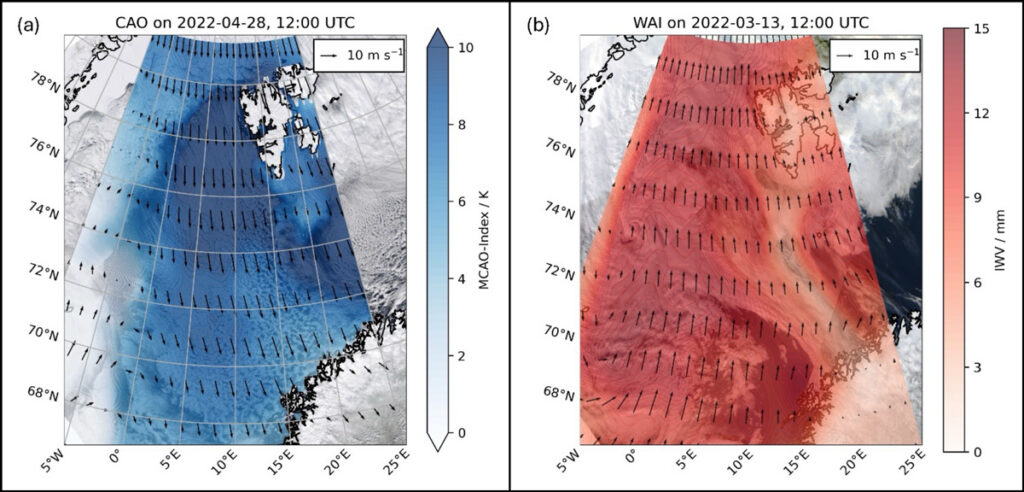
These dynamic exchanges influence near-surface air temperatures, sea ice extent and thickness, cloud formation, and the balance between incoming solar and outgoing terrestrial radiative energy. They also control the movement of energy (heat), moisture, and pollutants into and out of the Arctic, stimulating feedbacks that operate on local, regional, and global scales [Pithan et al., 2018]. For example, WAIs inject humidity (i.e., water vapor, a major greenhouse gas) into the Arctic, significantly increasing near-surface air temperatures, especially in winter. This humidity also promotes cloud development that further heats the Arctic surface and thus can limit sea ice growth.
Collectively, these exchanges and feedbacks determine how the Arctic shapes large-scale atmospheric circulation and weather patterns—both within and outside the Arctic—that often contribute to extreme, societally impactful events like severe winter storms, cold snaps, heat waves, and significant melting events [Zhang et al., 2025]. Given the wide-ranging implications of meridional air mass transports, observing, understanding, and modeling their fundamental drivers and behaviors, many of which vary seasonally and spatially, are essential steps for scientists.
Seasonal Contrasts Shape Dynamic Processes
The most striking seasonal difference in the Arctic arises from the extreme contrast between polar night and polar day.
The most striking seasonal difference in the Arctic arises from the extreme contrast between polar night and polar day that is driven by the profound effects of solar radiation “switching off and on.” This annual back-and-forth fundamentally alters the region’s radiative energy budget: During the polar night of winter, the surface predominantly loses energy, whereas in summer it gains energy. The radiative energy budget, in turn, modulates energy exchanges at the surface and the vertical distribution of heating and cooling throughout the atmosphere.
Radiative changes strongly influence the properties and structure of the atmospheric boundary layer through effects on vertical stratification and mixing processes. For instance, temperature inversions, which inhibit vertical mixing, tend to be stronger and more frequent in winter, whereas summer conditions can promote more vertical mixing. The radiative budget also affects turbulent and conductive heat fluxes at the surface, near-surface temperature variations, sea ice melting, and other surface processes and properties.
Seasonality affects north–south temperature gradients, further shaping atmospheric transport dynamics and influencing the frequency, properties, and intensity of key events like CAOs and WAIs. Cloud characteristics, including their coverage, thermodynamic phase (liquid versus ice), and precipitation type and frequency, also differ markedly between seasons. For example, the transition into the summer melt season supports a shift from mostly icy to more liquid-containing clouds [e.g., Lac et al., 2026], a change with significant influences on atmospheric boundary layer structure, radiative balance, and more.
Little is known about how seasonal variability affects air mass transformations.
Atmospheric composition also evolves over the year. Alongside variations in mixing and transport pathways, aerosol sources and properties shift because of changes in sunlight-driven photochemical activity, precipitation-driven removal of aerosol particles, surface conditions (e.g., melt pond formation), and biological production of particles and aerosol precursor gases [Schmale et al., 2021]. These aerosol transitions, in turn, affect cloud properties, precipitation efficiency, and possibly cloud lifetimes.
At the surface too, conditions are far from static. The frozen winter surface environment transitions into one with increasing meltwater, open ocean, and moisture availability, before eventually transitioning back after summer passes. These changes influence surface albedo, snow depth, surface roughness, and ice thickness, all of which modulate the exchange of heat, moisture, momentum, and matter between the atmosphere and surface.
Indeed, many drivers of, and constraints on, air mass transports vary seasonally. However, little is known about how seasonal variability affects air mass transformations, including rates of spatiotemporal changes in temperature and moisture that affect cloud formation and longevity, precipitation patterns, radiative properties, and surface interactions. In short, these transformation rates ultimately control the spatial extent of air masses and their impacts on people, yet they remain poorly understood.
Establishing Foundations for Accurate Models
The reliability and credibility of models for weather forecasting and for understanding long-term climate trends and feedbacks depend on strong foundations of observational ground truthing. These observations help models accurately represent fundamental physical processes such as Arctic amplification, meridional transport, and Arctic climate dynamics. However, building these foundations for the Arctic remains a major challenge.
A central issue is the particular scarcity of ground truth data collected over sea ice and during winter [Jung et al., 2016]. The lack of data makes it difficult to evaluate and improve models because key processes are insufficiently constrained.
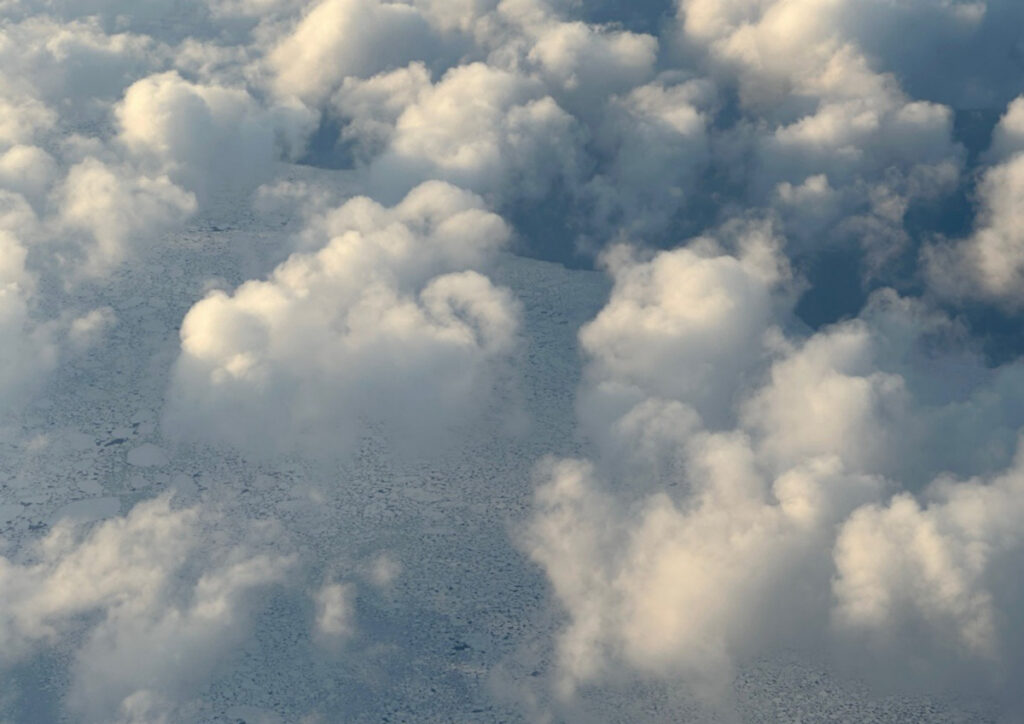
Characterizing the Arctic accurately across all seasons is essential because the effects of seasonal changes in the radiative energy budget extend beyond any single season. For example, although sea ice melting is limited during winter, the amount of ice growth during the dark season strongly influences how the ice evolves later in the year. The importance of interseasonal linkages like this one suggests that weaknesses in model representations of any single season can propagate through simulations over time, significantly affecting the longer-term trajectory of the Arctic that they portray.
With the limitations of available satellite data, in situ and remote sensing observations from ground-based and aerial platforms are indispensable.
Many current modeling tools, including global and regional climate models, reanalyses, and numerical weather prediction systems, exhibit substantial biases, particularly in representing clouds, humidity, and lower atmospheric structure. For example, models do not represent the height of the atmospheric boundary layer over sea ice well, and they often overemphasize cloud glaciation. These deficiencies are most pronounced in winter and in processes tied to net surface energy exchange, such as cloud phase partitioning, which are also among the processes least constrained by satellite observations.
With the limitations of available satellite data, in situ and remote sensing observations from ground-based and aerial platforms are indispensable. They provide high-resolution measurements that not only help calibrate and validate satellite data and support reanalyses but also enable a deeper understanding of the underlying mechanisms at work. Such observations are also crucial for improving model parameterizations and, ultimately, for building more reliable modeling tools.
Coordinated Campaigns Can Close Critical Gaps
Closing critical observational and modeling gaps and advancing predictive representations of Arctic weather and climate dynamics, including meridional air mass transport events, require coordinated research efforts. Field campaigns involving a variety of data-collecting platforms are needed to quantify seasonally and spatially varying processes and feed model development. Targeting the drastically underobserved winter season, for example, would help to isolate effects of solar radiation and other varying conditions.
Moreover, work is needed to implement and improve upon quasi-Lagrangian observational strategies [Wendisch et al., 2025]. These techniques focus on following a moving air mass and sampling it repeatedly as it travels and evolves, combining aircraft, ship-based, and ground-based measurements together with modeling to help constrain air mass transformation processes and rates [Karalis et al., 2025]. Initial quasi-Lagrangian aircraft-based measurements showed promise for estimating air mass temperature and moisture change rates, though they did not always agree well enough with model simulation results [Wendisch et al., 2025]. Further, cloud and precipitation change rates have not yet been derived from these observations.
A central objective of future campaigns should be directly observing and quantifying seasonal differences in the heating or cooling and the drying or moistening of air masses to guide model improvements. Upcoming initiatives offer valuable opportunities to expand the observational footprint and address this objective.
This fall, the Tara Polar station is scheduled to embark on an 18-month expedition—the first of 10 intended missions—to track atmospheric (and oceanic) conditions while drifting with Arctic sea ice. And in coming years, the Contrasting Polar Night & Day (CONIDA) airborne campaigns will follow CAOs and WAIs in the European Arctic, first during winter (CONIDA-Night, November–December 2028) and then during summer (CONIDA-Day, June–July 2029), to study transformations of clouds, precipitation, and radiative processes.
The multifaceted strategies of these efforts—more of which are needed—should provide the comprehensive, multiscale observational constraints we need to robustly characterize and model the processes governing and responding to Arctic seasonal variability, particularly meridional air mass transformations and their broader climate connections. These improvements will, in turn, allow us to sharpen forecasts of the effects of warm air arriving in the Arctic and of the cold air blasts that occasionally send midlatitude temperatures plummeting.
Acknowledgments
We thank Felix Pithan for his valuable discussion regarding this article and Marcus Klingebiel for providing Figure 1. This work was funded by Deutsche Forschungsgemeinschaft (DFG, German Research Foundation) project ID 268020496–TRR 172 and project ID 316646266 SPP 1294.
References
Hersbach, H., et al. (2020), The ERA5 global reanalysis, Q. J. R. Meteorol. Soc., 146, 1,999–2,049, https://doi.org/10.1002/qj.3803.
Jung, T., et al. (2016), Advancing polar prediction capabilities on daily to seasonal time scales, Bull. Am. Meteorol. Soc., 97(9), 1,631–1,647, https://doi.org/10.1175/BAMS-D-14-00246.1.
Karalis, M., et al. (2025), Lagrangian single-column modeling of Arctic air mass transformation during HALO–(AC)³, Atmos. Chem. Phys., 25, 13,177–13,198, https://doi.org/10.5194/acp-25-13177-2025.
Lac, J., et al. (2026), Understanding the spring cloud onset over the Arctic sea ice, Atmos. Chem. Phys., 26, 4,189–4,213, https://doi.org/10.5194/acp-26-4189-2026.
Pithan, F., et al. (2018), Role of air-mass transformations in exchange between the Arctic and mid-latitudes, Nat. Geosci., 11, 8050812, https://doi.org/10.1038/s41561-018-0234-1.
Schmale, J., P. Zieger, and A. M. L. Ekman (2021), Aerosols in current and future Arctic climate, Nat. Clim. Change, 11, 95–105, https://doi.org/10.1038/s41558-020-00969-5.
Wendisch, M., et al. (2025), Observed and modeled Arctic airmass transformations during warm air intrusions and cold air outbreaks, Atmos. Chem. Phys., 25, 15,047–15,076, https://doi.org/10.5194/acp-25-15047-2025.
Zhang, X., et al. (2025), Weather and climate extremes in a changing Arctic, Nat. Rev. Earth Environ., 6, 691–711, https://doi.org/10.1038/s43017-025-00724-4.
Author Information
Manfred Wendisch ([email protected]), Leipziger Institut für Meteorologie, Universität Leipzig, Germany; Matthew D. Shupe, Cooperative Institute for Research in Environmental Sciences and the National Snow and Ice Data Center, University of Colorado Boulder; also at Physical Sciences Laboratory, NOAA, Boulder, Colo.; Susanne Crewell, Institut für Geophysik und Meteorologie, Universität zu Köln, Cologne, Germany; Felix Ament, Meteorologie, Universität Hamburg, Germany; and Gunilla Svensson, Department of Meteorology and Bolin Centre for Climate Research, Stockholm University, Sweden