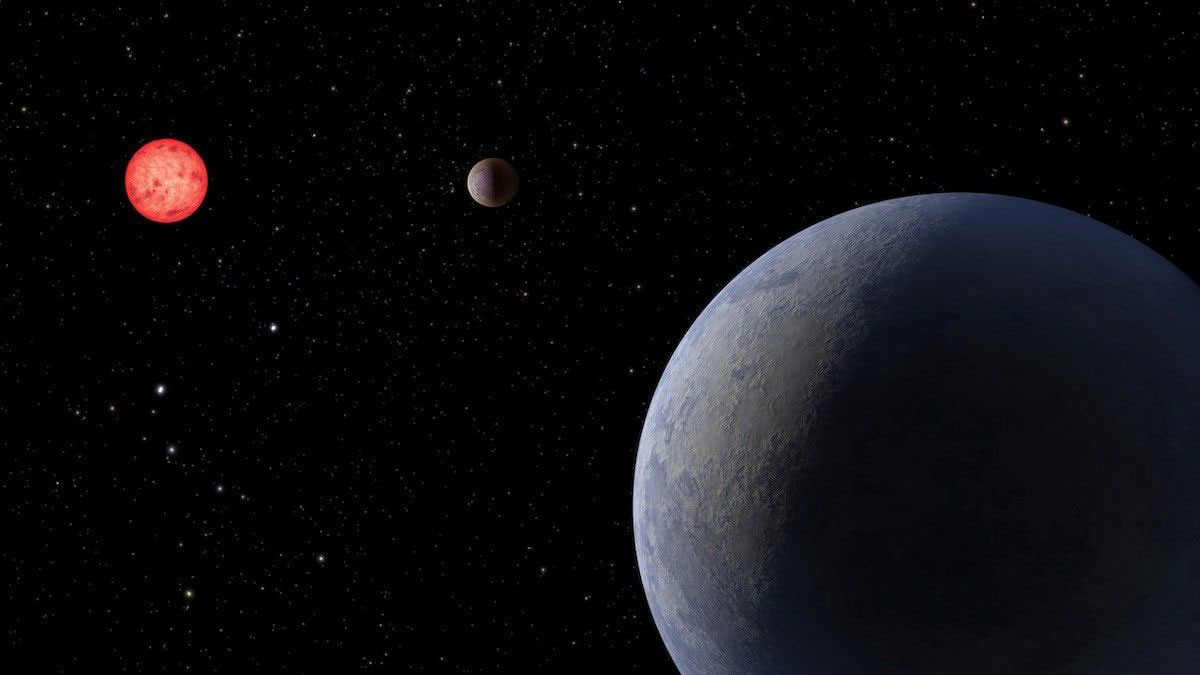
Source: AGU Advances
Deep inside super-Earths—rocky planets with a mass anywhere between 1 and 10 times that of Earth—high pressure can cause familiar minerals to take forms that are rarely seen on Earth. Understanding more about the temperature and pressure conditions under which these phases are reached could help researchers learn more about how planets evolve.
One such mineral is magnesium orthosilicate, or Mg2SiO4, one of the major building blocks of rocky planets. As pressure increases deep inside a planet, the atoms in this mineral rearrange into different crystal structures. One of these high-pressure forms is called the spinel phase, which is found in Earth’s mantle. At even higher pressures, this phase breaks down into two different minerals: bridgmanite, the most abundant mineral phase in Earth, and ferropericlase, a magnesium-rich oxide. However, under the far more extreme pressures expected inside massive rocky planets known as super-Earths, Mg2SiO4 becomes stable again in an entirely new crystal structure called post-post-spinel. Scientists predict that this ultrahigh-pressure phase of Mg2SiO4 is one of the dominant minerals in the deep mantles of super-Earths, making its melting behavior important for understanding how these planets form and evolve.
Re-creating the high temperatures and extraordinary pressures inside massive rocky planets is challenging in the lab, so Zheng et al. took a computational approach. The team used a technique called thermodynamic integration to study the melting curve of post-post-spinel Mg2SiO4 at up to 1,300 gigapascals of pressure.
They found that post-post-spinel Mg2SiO4 is an exceptionally refractory mineral, meaning it can withstand extremely high temperatures before melting. Depending on the pressure, it melts at between 9,780 K and 14,897 K, significantly hotter than temperatures at which related minerals melt, including bridgmanite and MgSiO3 postperovskite, the high-pressure form of bridgmanite stable near Earth’s core-mantle boundary. Even after moderate amounts of iron were added, something that likely happens to some degree in most exoplanets, the melting point for post-post-spinel Mg2SiO4 remained above the temperatures estimated for the deep mantles of most rocky planets, the authors say.
Their results indicate that many super-Earths likely have solid deep mantles, which has implications for convection deep inside rocky exoplanets, as well as for their magnetic fields, which are created by swirling molten metals in their interiors. (AGU Advances, https://doi.org/10.1029/2026AV002326, 2026)
—Nathaniel Scharping (@nathanielscharp), Science Writer