• About
  • Special Reports
  • Topics
    • Climate
    • Earth Science
    • Oceans
    • Space & Planets
    • Health & Ecosystems
    • Culture & Policy
    • Education & Careers
    • Opinions
  • Projects
    • Postcards From the Field
    • ENGAGE
    • Editors’ Highlights
    • Editors’ Vox
    • Eos en Español
    • Eos 简体中文版
    • Print Archive: 2015–2025
  • Policy Tracker
  • Blogs
    • Research & Developments
    • The Landslide Blog
  • Newsletter
  • Submit to Eos
  • AGU.org
  • Career Center
  • Join AGU
  • Give to AGU
  • About
  • Special Reports
  • Topics
    • Climate
    • Earth Science
    • Oceans
    • Space & Planets
    • Health & Ecosystems
    • Culture & Policy
    • Education & Careers
    • Opinions
  • Projects
    • Postcards From the Field
    • ENGAGE
    • Editors’ Highlights
    • Editors’ Vox
    • Eos en Español
    • Eos 简体中文版
    • Print Archive: 2015–2025
  • Policy Tracker
  • Blogs
    • Research & Developments
    • The Landslide Blog
  • Newsletter
  • Submit to Eos
Skip to content
  • AGU.org
  • Career Center
  • Join AGU
  • Give to AGU
Eos

Eos

Science News by AGU

Support Eos
Sign Up for Newsletter
  • About
  • Special Reports
  • Topics
    • Climate
    • Earth Science
    • Oceans
    • Space & Planets
    • Health & Ecosystems
    • Culture & Policy
    • Education & Careers
    • Opinions
  • Projects
    • Postcards From the Field
    • ENGAGE
    • Editors’ Highlights
    • Editors’ Vox
    • Eos en Español
    • Eos 简体中文版
    • Print Archive: 2015–2025
  • Policy Tracker
  • Blogs
    • Research & Developments
    • The Landslide Blog
  • Newsletter
  • Submit to Eos

Hazards & Disasters

Illustration of the AI algorithm estimating large earthquakes’ magnitudes on the basis of prompt elastogravity signals (PEGS) traveling at the speed of light, much faster than seismic (P and S) waves.
Posted inNews

Monitoring Earthquakes at the Speed of Light

by Mohammed El-Said 2 June 20222 June 2022

New research uses gravity and a machine learning model to instantaneously estimate the magnitude and location of large earthquakes.

Muon detectors in a tunnel under Tokyo Bay
Posted inNews

Muography Array Under Tokyo Bay Spots Meteotsunami Waves

Tim Hornyak, Science Writer by Tim Hornyak 20 May 20227 March 2023

A new study shows how muons can be used to study tide and wave phenomena, helping secure coastal communities.

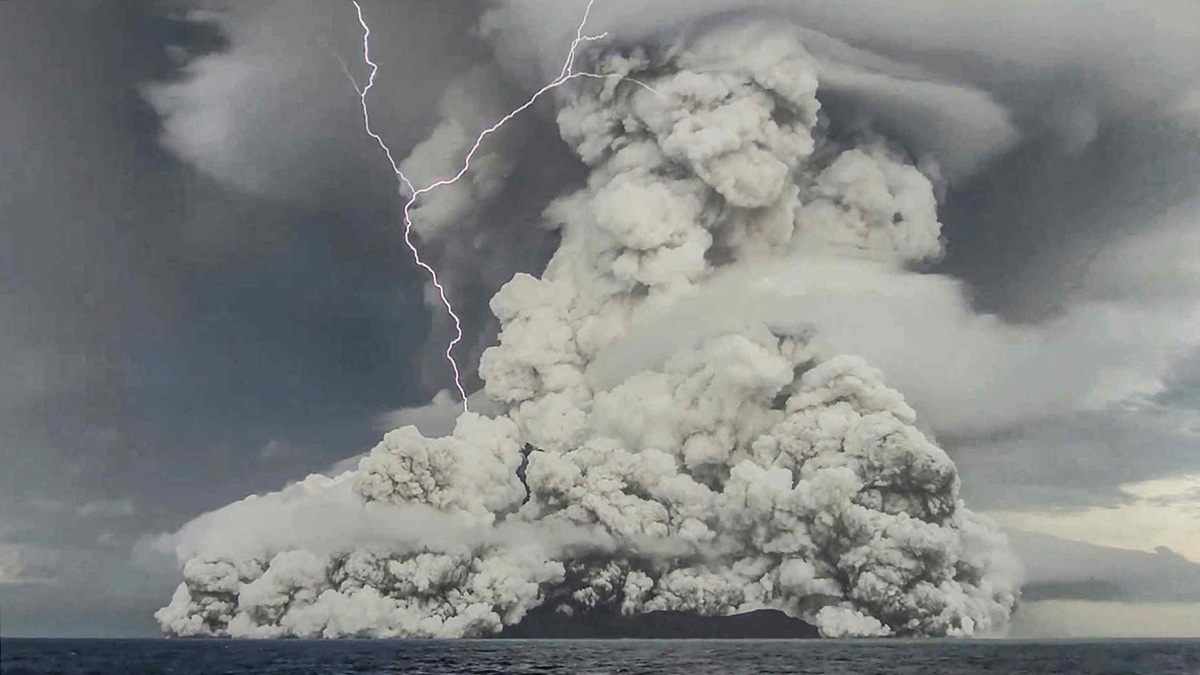
Red-filter image of the Hunga Tonga–Hunga Ha‘apai eruption on 15 January 2022
Posted inResearch Spotlights

Modeling Atmospheric Waves from Hunga Tonga–Hunga Ha‘apai

Aaron Sidder, freelance science writer by Aaron Sidder 12 May 202230 November 2022

A shallow-water oceanic model showed agreement with satellite observations of atmospheric waves produced by the eruption of the underwater volcano.

Photo of Hüfifirn, a medium-sized glacier in Central Switzerland.
Posted inEditors' Vox

Mountains Undergo Enhanced Impacts of Climate Change

by Nicholas Pepin, Carolina Adler, Sven Kotlarski and Elisa Palazzi 10 May 202210 November 2022

As climate change persists, amplified temperature increases in mountains and changes in precipitation will diminish snow and ice.

Gradual fault creep can be seen deforming the walls of this stadium at the University of California, Berkeley.
Posted inResearch Spotlights

Earthquake Modelers Unite to Compare and Improve Code

Sarah Stanley, Science Writer by Sarah Stanley 2 May 202224 June 2022

International community–driven efforts lend confidence to fault-slip simulations while highlighting key discrepancies.

Aerial view created of a forest with lidar—with trees artificially colored in many colors—as well as buildings and open spaces in part of Yosemite National Park
Posted inFeatures

A Lidar’s-Eye View of How Forests Are Faring

by Van R. Kane, Liz Van Wagtendonk and Andrew Brenner 29 April 202222 December 2022

Success in Yosemite is driving the wider use of lidar surveys to support forest health and wildfire resilience, study wildlife habitats, and monitor water resources.

Incendios arden sobre las montañas cerca del lago Elsinore, California, el 9 de agosto de 2018.
Posted inNews

Los incendios forestales empeorarán, advierte informe de la ONU

by Meghie Rodrigues 26 April 20227 September 2022

Desde el ecuador hasta el Ártico, es probable que aumenten los incendios forestales y que el cambio climático los empeore, según un nuevo informe de las Naciones Unidas. La acción todavía es posible, dicen los autores.

New Zealand’s Whakaari/White Island
Posted inFeatures

Studying Volcanoes through Myths, Legends, & Other Unconventional Data

by Nancy Averett 22 April 20221 June 2022

Studying historic eruptions through a storytelling lens often improves our understanding of and ability to prepare for such events.

An image of a partially submerged house, powerline pole, and foliage in a flooded neighborhood in Asunción, Paraguay
Posted inNews

More Frequent El Niño Events Predicted by 2040

Rachel Fritts, Science Writer by Rachel Fritts 20 April 20221 December 2022

Cutting-edge models predict that El Niño frequency will increase within 2 decades because of climate change, regardless of emissions mitigation efforts.

Una imagen del Frjiol (Cloud Gate) en el Parque Milenio en Chicago. Varias personas están en la imagen con atuendos veraniegos.
Posted inResearch Spotlights

Estimando la frecuencia e intensidad las olas de calor: Un caso de estudio en Chicago

by Saima May Sidik 20 April 202220 April 2022

Modelado numérico mostró los impactos extendidos de la ola de calor del 2012 en Chicago, clarificando los impactos de la ola de calor y la isla de calor urbana en la temperatura de la ciudad.

Posts pagination

Newer posts 1 … 62 63 64 65 66 … 178 Older posts
Over a dark blue-green square appear the words Special Report: The State of the Science 1 Year On.

Features from AGU Publications

Research Spotlights

As Wildfires Increase in the West, So Does Suppression Spending

10 June 202610 June 2026
Editors' Highlights

Multi-Scale Fault Roughness Encapsulated in a Friction Law

11 June 202611 June 2026
Editors' Vox

Small-Scale Indian Ocean Dynamics Underpin Marine Ecology and Climate

4 June 20263 June 2026
Eos logo at left; AGU logo at right

About Eos
ENGAGE
Awards
Contact

Advertise
Submit
Career Center
Sitemap

© 2026 American Geophysical Union. All rights reserved Powered by Newspack