• About
  • Sections
  • Topics
    • Climate
    • Earth Science
    • Oceans
    • Space & Planets
    • Health & Ecosystems
    • Culture & Policy
    • Education & Careers
    • Opinions
  • Projects
    • Postcards From the Field
    • ENGAGE
    • Editors’ Highlights
    • Editors’ Vox
    • Eos en Español
    • Eos 简体中文版
    • Print Archive: 2015–2025
  • Science Policy Tracker
  • Blogs
    • Research & Developments
    • The Landslide Blog
  • Newsletter
  • Submit to Eos
  • AGU.org
  • Career Center
  • Join AGU
  • Give to AGU
  • About
  • Sections
  • Topics
    • Climate
    • Earth Science
    • Oceans
    • Space & Planets
    • Health & Ecosystems
    • Culture & Policy
    • Education & Careers
    • Opinions
  • Projects
    • Postcards From the Field
    • ENGAGE
    • Editors’ Highlights
    • Editors’ Vox
    • Eos en Español
    • Eos 简体中文版
    • Print Archive: 2015–2025
  • Science Policy Tracker
  • Blogs
    • Research & Developments
    • The Landslide Blog
  • Newsletter
  • Submit to Eos
Skip to content
  • AGU.org
  • Career Center
  • Join AGU
  • Give to AGU
Eos

Eos

Science News by AGU

Support Eos
Sign Up for Newsletter
  • About
  • Sections
  • Topics
    • Climate
    • Earth Science
    • Oceans
    • Space & Planets
    • Health & Ecosystems
    • Culture & Policy
    • Education & Careers
    • Opinions
  • Projects
    • Postcards From the Field
    • ENGAGE
    • Editors’ Highlights
    • Editors’ Vox
    • Eos en Español
    • Eos 简体中文版
    • Print Archive: 2015–2025
  • Science Policy Tracker
  • Blogs
    • Research & Developments
    • The Landslide Blog
  • Newsletter
  • Submit to Eos

hydrothermal systems

Researchers look to hydrothermal vents for clues into the movement of Earth’s lower crust
Posted inResearch Spotlights

Is the Lower Crust Convecting Beneath Mid-Ocean Ridges?

by Terri Cook 2 October 201724 March 2023

The first attempt to couple models of hydrothermal circulation and magmatic convection along fast-spreading ridges may explain the spacing of hydrothermal vent fields along the East Pacific Rise.

Posted inResearch Spotlights

Detecting Gas Leaks with Autonomous Underwater Vehicles

by S. Witman 29 August 201728 February 2023

A Norwegian team develops an improved, cost-effective method to detect chemical discharges under the sea.
Plumes
Posted inNews

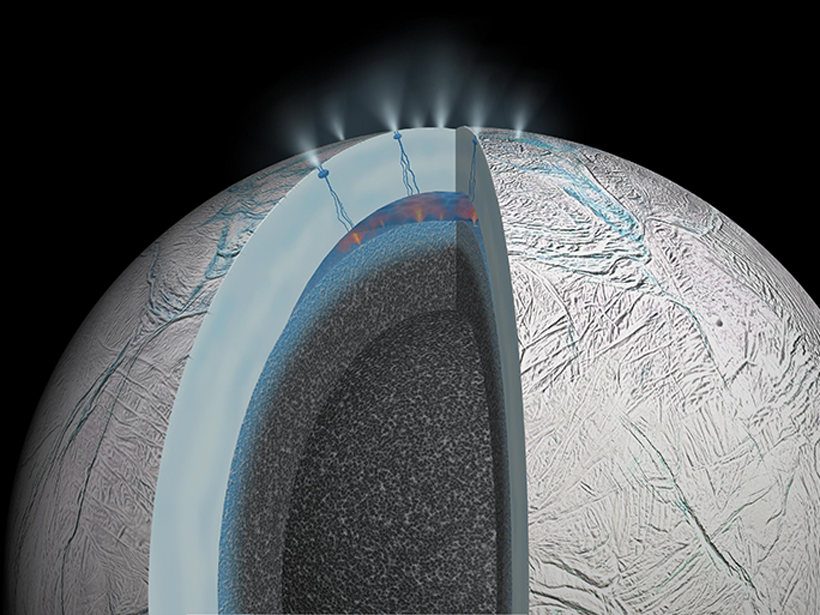
Hydrogen Molecules Hint at Habitability of Enceladus's Ocean

JoAnna Wendel, freelance science writer and illustrator by JoAnna Wendel 13 April 201711 January 2022

Scientists suggest that the hydrogen could be evidence of hydrothermal activity on the ocean floor of Saturn's sixth largest moon.

Cracking of a fluid barrier beneath Japan’s Mount Ontake may have caused the deadly eruption in 2014
Posted inResearch Spotlights

What Caused the Fatal 2014 Eruption of Japan's Mount Ontake?

by Terri Cook 17 March 20176 December 2021

Analysis of the change in the stratovolcano's tilt just prior to the explosion suggests that the cracking of a previously intact fluid barrier caused the country's deadliest eruption since 1926.

modeling-heat-source-hydrothermal-reservoir-long-valley-caldera
Posted inResearch Spotlights

Mapping Water and Heat Deep Under Long Valley Caldera

Leah Crane by L. Crane 29 September 201611 January 2022

Researchers use electrical resistivity to find the heat source and reservoir feeding Long Valley Caldera's labyrinthine hydrothermal system.

Sulfuric lake Kawah Ijen was used to study volcanic activity.
Posted inResearch Spotlights

A New Tool to Better Forecast Volcanic Unrest

Shannon Hall by S. Hall 8 July 20161 November 2022

In a retrospective study of volcanic unrest at Indonesia's Kawah Ijen, a new model was able to pick up on the rising probability of eruption 2 months before authorities were aware of the risk.

This relatively recent impact crater photographed last year spans a little more than a kilometer in the Sirenum Fossae region of Mars.
Posted inNews

Impacts Might Have Made Ancient Mars Briefly Hospitable to Life

Shannon Hall by S. Hall 28 April 201628 January 2022

A bombardment of the Red Planet 4 billion years ago could have created hot springs that allowed life to flourish.

Richard P. Von Herzen examining a gamma ray attenuation porosity evaluation machine aboard the drilling ship Glomar Challenger during Leg 3 of the Deep Sea Drilling Project in 1968.
Posted inNews

Richard P. Von Herzen (1930–2016)

by K. Becker and J. G. Sclater 27 April 20161 October 2021

Richard P. Von Herzen, a pioneer of marine heat flow studies who helped validate plate tectonics and discover oceanic hydrothermal vents, passed away on 28 January 2016. He was 85.

Posted inNews

Novel Vents Built from Talc Found Far from Mid-Ocean Rift

by S. Kelleher 5 January 20161 October 2021

Researchers discovered the first new variety of hydrothermal vents in a decade—a finding that may give clues to how oceanic crust cools.

Posted inScience Updates

Team Gets Firsthand Look at the New Holuhraun Eruption Site

by C. W. Hamilton 16 December 201510 October 2021

Iceland 2015: Field Workshop on Active Lava–Water Interactions; Holuhraun, Iceland, 20–28 August 2015

Posts pagination

Newer posts 1 … 5 6 7 8 Older posts
A view of a bridge, with the New Orleans skyline visible in the distance between the bridge and the water. A purple tint, a teal curved line representing a river, and the text “#AGU25 coverage from Eos” overlie the photo.

Features from AGU Publications

Research Spotlights

New River Chemistry Insights May Boost Coastal Ocean Modeling

9 January 20269 January 2026
Editors' Highlights

Central China Water Towers Provide Stable Water Resources Under Change

9 January 20269 January 2026
Editors' Vox

Hydrothermal Circulation and Its Impact on the Earth System

3 December 20253 December 2025
Eos logo at left; AGU logo at right

About Eos
ENGAGE
Awards
Contact

Advertise
Submit
Career Center
Sitemap

© 2026 American Geophysical Union. All rights reserved Powered by Newspack