

Researchers look at more than 3 decades of temperature trends in the deep ocean to understand the layers' energy budgets.
Oceans

Posted inScience Updates
Saving Our Marine Archives
A concerted effort has begun to gather and preserve archives of marine samples and descriptive data, giving scientists ready access to insights on ancient environments.
Posted inResearch Spotlights
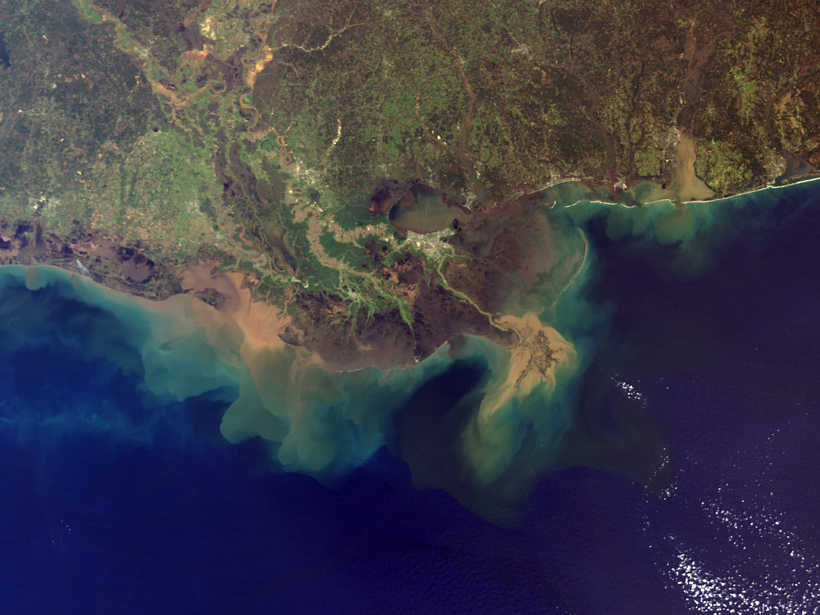
What Proportion of River Nutrients Reaches the Open Sea?

Results of the first geographically based estimates of river nutrient supply indicate that 75% of dissolved nitrogen and 80% of phosphorus reach the open ocean.

Posted inResearch Spotlights
Swirling Eddies in the Antarctic May Have Global Impacts

A new model examines how eddies in the Antarctic Circumpolar Current affect volume transport of the world's strongest current.

Posted inNews
Déjà Vu? Ocean Warmth Melted Ancient West Antarctic Ice Shelf

Clues in seafloor sediments reveal that relatively warm water beneath western Antarctic ice shelves, a major factor in today's massive ice sheet retreat, also fueled some past ice loss.

Posted inResearch Spotlights
Tiny Creatures Form Massive, Bright Ring Around Antarctica

Dense algae populations in the Great Calcite Belt could cause carbon dioxide release from the ocean into the atmosphere.
Posted inScience Updates
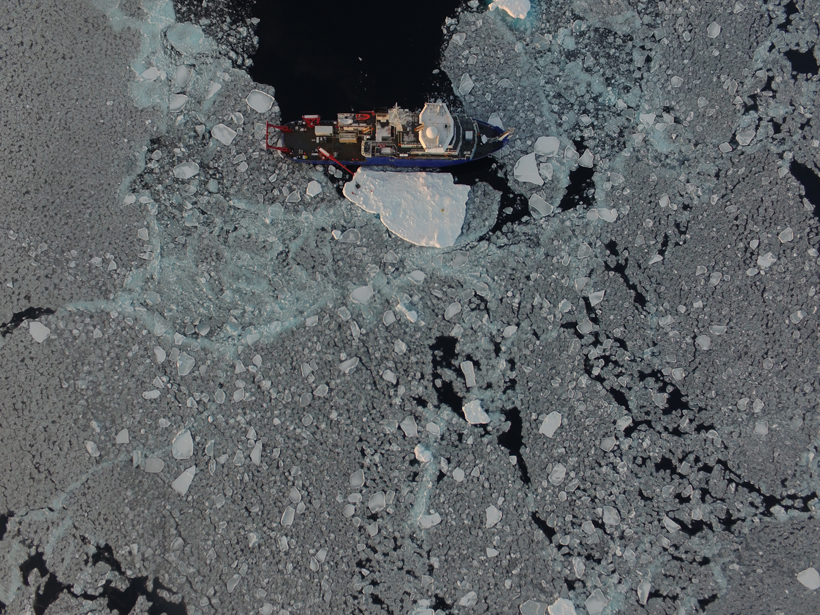
The Balance of Ice, Waves, and Winds in the Arctic Autumn
Although summer sea ice loss in the Arctic is well studied, less is known about how ice comes back in autumn. A new program is changing that.
Posted inAGU News
Heiko Pälike Receives 2016 Asahiko Taira International Scientific Ocean Drilling Research Prize
Heiko Pälike was awarded the 2016 Asahiko Taira International Scientific Ocean Drilling Research Prize at the American Geophysical Union (AGU) Fall Meeting Honors Ceremony, held on 14 December 2016 in San Francisco, Calif. The Taira Prize is a partnership between AGU and the Japan Geoscience Union (JpGU) and is made possible through a generous donation from the Integrated Ocean Drilling Program Management International (IODP-MI). The prize honors an individual for "outstanding transdisciplinary research accomplishment in ocean drilling."

Posted inResearch Spotlights
Wave Gliding in the Eye of the Storm

Scientists use a new remote-controlled robot to capture data from the middle of an open ocean typhoon.

Posted inResearch Spotlights
Notorious Ocean Current Is Far Stronger Than Previously Thought
The Antarctic Circumpolar Current is the only ocean current to circle the planet and the largest wind-driven current on Earth. It's also 30% more powerful than scientists realized.